

Should I increase weights at the gym? How often? And by how much?
- Written by Hunter Bennett, Lecturer in Exercise Science, University of South Australia
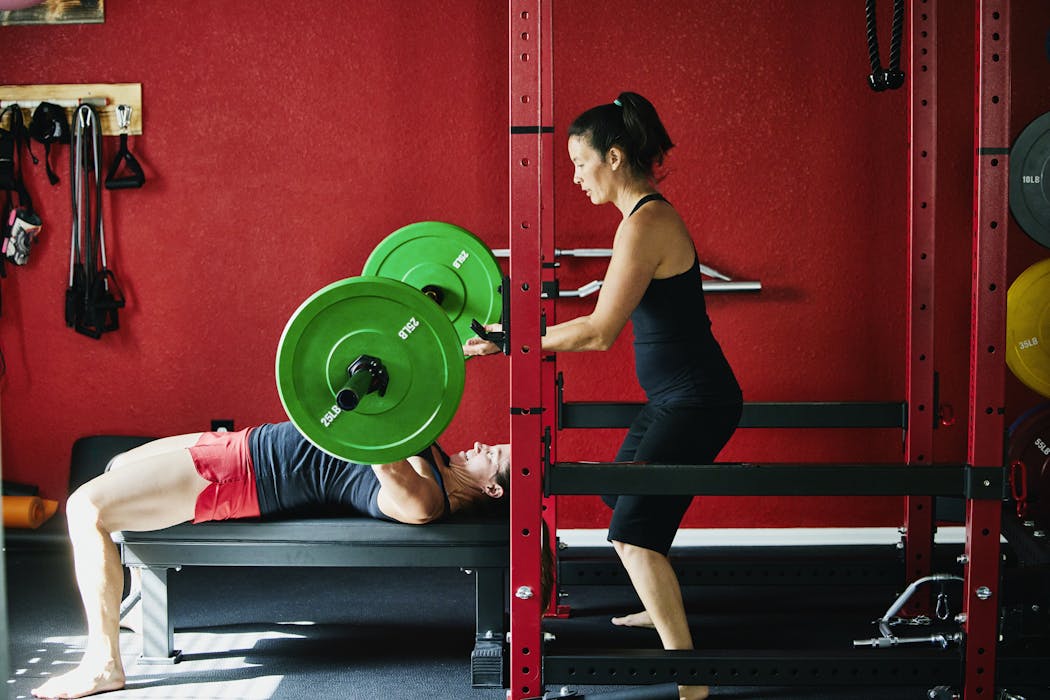
Many of us go to the gym to bulk up. But how does it actually work?
When you lift weights, it increases tension on the fibres in your muscles, and causes metabolic by-products (such as lactate and hydrogen) and inflammation to build up in the muscle tissue.
These signals tell your muscles to adapt and grow stronger.
But if your aim is to build muscle, lifting the same weight the same number of times every week won’t be enough; you need to continually increase the load or do more repetitions. This is known as “progressive overload”.
So, how do you know when to increase weight? And how much should you add? Let’s take a look.
Knowing how much you can increase
No matter how keen you are, the exact rate your muscles develop is mostly outside your control.
Your genetics likely play a role. Some people will simply adapt to lifting weights faster than others, meaning they can add weight more quickly.
However, lifestyle factors are also important.
Your body is more likely to be able to adapt when you get enough sleep, eat enough protein and keep life stress to a minimum. Otherwise, your progress is likely to be slower.
If you’re new to weight training, you will also likely improve faster than someone who has been training for years. This is sometimes known as “newbie gains” – especially noticeable in the first year of training.
But the more you train, the more your body adapts. Basically, the closer you are to your genetic “ceiling” – the natural limit to how much you can lift – the slower you will improve.
2 methods to increase weight
There are lots of ways you can increase weight in the gym. But we’ll focus on two good ones.
If you are a beginner, using the “linear progression” method is great. This means adding a small amount of weight (for example, 2.5kg) every week or two, while trying to keep your number of repetitions – or “reps” – the same.
For example, in week one, you might do five reps on the leg press at 50kg. Then in weeks two and three, you increase to five reps at 52.5kg, and by week four or five you’re doing five reps at 55 kg.
However, you’ll reach a point where you can’t just add the same amount of weight every couple of weeks. This is when you might try something like the “double progression” method.
Using this approach, you would pick a set and rep range, such as three sets of 8–12 reps. When you can finally do three sets of 12 reps, you increase the weight a little.
At the new higher weight, you might only be able to do eight reps in each set. So you work to slowly increase the number of reps, until you get back up to three sets of 12.
Then, repeat the process: add a little weight and start again at eight reps.
Read more: Your body can be a portable gym: how to ditch membership fees and expensive equipment
How can I tell I’m ready to lift more?
If the weights are feeling too light, or you can easily manage all your prescribed sets and reps, then it could be time to increase.
But you can add weight even when it’s still feeling challenging.
Research shows most people overestimate how hard they are working in the gym, and underestimate how much weight they can lift or how many reps they can do.
So keeping a logbook to track your progress is a good idea. This allows you to look back and try to beat what you did last week – by either going slightly heavier or adding another rep or two to your set.
You won’t beat your logbook every week. But if increasing weight is your aim, it can help keep you on track and know what to aim for so you keep getting stronger.
When should I ease off?
Two signs might suggest you need to back off a little.
First, if the way you do the repetition is changing drastically as you add more weight, this might suggest you are simply making the movement easier, rather than getting stronger.
For example, if you add weight to your squat but start squatting shallower, this probably isn’t actually increasing the load on your muscles.
Second, if you’re feeling unusually fatigued or like you’re getting weaker every week, you might need to take it easy for a week to recover. This can be a sign of overtraining, which commonly happens when people don’t allow adequate rest between sessions.
Can you increase weight too quickly?
Weight training is incredibly safe – especially compared to other sports.
But it can sometimes still be a good idea to take it slow, especially when you’re new to weight training. You’ll find you can increase strength very quickly. But this is also when you’re learning how to perform movements correctly, and your body is adapting to the new stress.
So keeping your weight increases small (for example, just 2.5kg every couple of weeks) will give you a chance to refine your technique and build tolerance gradually. This may also help protect against injuries.
Finally, don’t stress if you are unable to increase weight for a few weeks (or even months).
If the training still feels hard, you can be pretty confident that it is helping you build muscle and get stronger.
Authors: Hunter Bennett, Lecturer in Exercise Science, University of South Australia
Read more https://theconversation.com/should-i-increase-weights-at-the-gym-how-often-and-by-how-much-263048

















