

It’s been 50 years since the Balibo 5 were killed in Timor-Leste. No one’s been held accountable
- Written by Shannon Brincat, Senior Lecturer in Politics and International Relations, University of the Sunshine Coast
On October 16, 1975, five journalists were killed in the remote Timorese town of Balibo. To this day, no one has been charged with their deaths.
Known as the “Balibo Five”, the men were reporting on the covert Indonesian invasion of Timor-Leste. They were Greg Shackleton and Tony Stewart from Australia, Malcolm Rennie and Brian Peters from the United Kingdom, and Gary Cunningham from New Zealand.
Several months later, another Australian journalist, Roger East who went to investigate their disappearance, was executed. His body was never recovered.
Fifty years on, the case remains one of the most egregious examples of atrocities committed against war correspondents. It’s also a chilling case of a state failing to prosecute the murder of its own citizens.
The 1975 invasion
In 1975, Portugal abruptly decolonised Timor-Leste. The left-leaning FRETILIN party declared Timorese independence that November.
Indonesia, motivated by high estimates of oil and gas in the Timor Sea, launched a covert invasion under the pretext of anti-colonial stability.
Indonesian authorities felt they could operate with impunity because of the country’s strategic importance to the West’s fervent anti-communism agenda.
Indeed, it had done so in the previous decade, with mass killings of political dissidents in the 1960s.
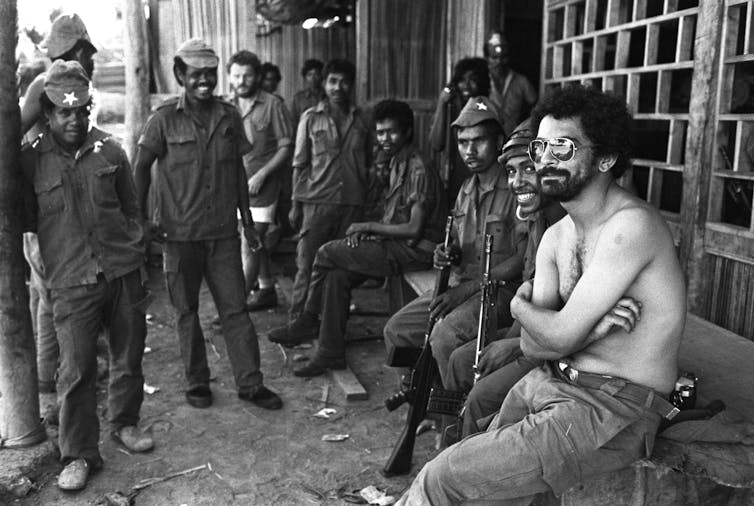
It’s against this backdrop that the journalists, or the “Mártires de Balibo” (the Martyrs of Balibo), as they’re called in Timor, arrived to report on the illegal incursion of Indonesian forces. They had been guided to the town by the current Timorese President Jose Ramos-Horta, then in his 20s.
They famously painted the Australian flag on a nearby building they took shelter in, hoping it would protect them from attack. This failed plea remains in Balibo today.

President Ramos-Horta has said in a statement the Balibo tragedy “remains a symbol of the sacrifice of journalists in conflict zones and the struggle for accountability and justice for war crimes”.
Honouring them as “national martyrs”, the President posthumously awarded the Collar of the Order of Timor-Leste – the nation’s highest honour – to Greg Shackleton (in 2014) and which will be declared to Cunningham, Stewart, Rennie, and Peters at a commemoration service at Balibo today – the Timorese national day for press freedom.
A ‘deliberate killing’
From the perspective of international law, the killings of the Balibo Five constitute a clear set of violations. Journalists are protected under the Geneva Conventions. They were unarmed and identifiable as foreign journalists.

An inquest by the New South Wales coroner in 2007 concluded the journalists had been “deliberately killed” by the Indonesian army to prevent them from reporting on the impending invasion.
This presaged the atrocities to come. While death tolls during Indonesia’s 24-year occupation of Timor-Leste are contested, we know hundreds of thousands of people died, many from forced starvation. Many scholars say Indonesia perpetrated a genocide.
Despite contradictory evidence, Indonesia maintains the five men were killed in crossfire.
Diplomacy over accountability
While the immediate facts of their execution by Indonesian Forces are now widely accepted by others and available in National Archives of Australia records, the subsequent legal and diplomatic story reveals a profound failure of international justice.
The pathway to justice for the Balibo Five has been systematically obstructed by the geopolitical calculus of Australia-Indonesia relations. For decades, the Australian government, regardless of political affiliation, prioritised maintaining a stable and cooperative relationship over pursuing legal accountability, including resisting calls for a full, transparent inquiry.
 Brian Peters was one of the Balibo Five.
Dean Lewins/AAP
Brian Peters was one of the Balibo Five.
Dean Lewins/AAP
At the time of the killings, the Australian government had a clear picture of Indonesian intentions and military movements. Yet, it chose not to intervene to protect the journalists and, in the aftermath, has actively downplayed evidence of Indonesian responsibility to preserve diplomatic relations.
Australia also had an economic incentive to work with Indonesia. The two countries signed the Timor Gap Treaty in 1989, allowing both to explore the area’s oil and gas reserves. It’s likely pursuing justice for the Balibo Five would have risked this economic benefit.
Decades of obstruction
Obstructions have been on both sides. In 2003, the United Nations-sponsored Serious Crimes Unit in Timor-Leste indicted former Indonesian officers for the Balibo killings.
But Indonesia refused to recognise the jurisdiction of the Timorese courts over its nationals.
The Rudd government promised a shift in Australia’s response, calling for a robust inquiry. It officially endorsed the findings of the New South Wales coroner in 2007 and opened an Australian Federal Police investigation.
 Memorial plaques were put up to commemorate the 40th anniversary of the Balibo Five’s deaths in 2015.
Roni Bintang/AAP
Memorial plaques were put up to commemorate the 40th anniversary of the Balibo Five’s deaths in 2015.
Roni Bintang/AAP
But without Indonesia’s cooperation, an Australian prosecution was impossible as the suspects in Indonesia could not be extradited. Rudd’s actions ultimately collided with the same geopolitical reality that had constrained all previous governments.
This decades-long impunity sends a dangerous message: powerful states can shield their military personnel from accountability for grave international crimes, provided they maintain sufficient strategic importance to their allies.
Australia continues to lag on press freedom, even threatening prosecution of reporters for investigating allegedly unlawful killings by Australian special forces in Afghanistan.
Protecting press freedom
Attacks against journalists globally are increasing at an alarming rate. Even as the Balibo case was re-opening in 2007, the comparison to the deaths of journalists in Palestine was already being made.
More than 210 journalists have since been killed in the recent Gaza crisis. At least 56 of them were intentionally targeted, according to Reporters Without Borders.
With this in mind, alongside the Balibo Five anniversary, there must be a renewed and unwavering commitment to protect journalists. They are the eyes and ears of the international community, especially in conflict zones. Their work is protected under international law, not as a privilege, but as a necessity.
Half a century on, the Balibo Five are remembered as martyrs for press freedom, yet justice remains elusive.
For the Timorese, the unresolved case symbolises the unfinished business of their struggle. It’s a painful reminder that while their nation is now free, the full truth and reconciliation with its past and powerful neighbours remain incomplete.
Authors: Shannon Brincat, Senior Lecturer in Politics and International Relations, University of the Sunshine Coast

















