

A tiny fossil suggests bowerbirds once lived in ancient New Zealand – new research
- Written by Elizabeth Steell, Research Fellow in Earth Sciences, University of Cambridge
Most of our knowledge of New Zealand’s prehistoric bird diversity comes from long-lost species with bones large enough to be studied by eye. But many bird bones are so tiny we can barely see their features without a microscope.
Some 14 to 19 million years ago, in the Miocene epoch, the remains of thousands of birds were preserved in and around the vast Lake Manuherikia, located in present-day Central Otago.
We know a lot about some of the lake’s larger birds such as ducks. But we have less information on smaller birds such as the highly diverse passerines, which include songbirds. Modern species in this group include the tūī and tauhou/silvereyes.
The minute bones of passerines are difficult to find in the field, and only come to light after many hours of painstaking sorting under a microscope. But technologies such as micro-CT scanning are now helping to reveal their secrets.
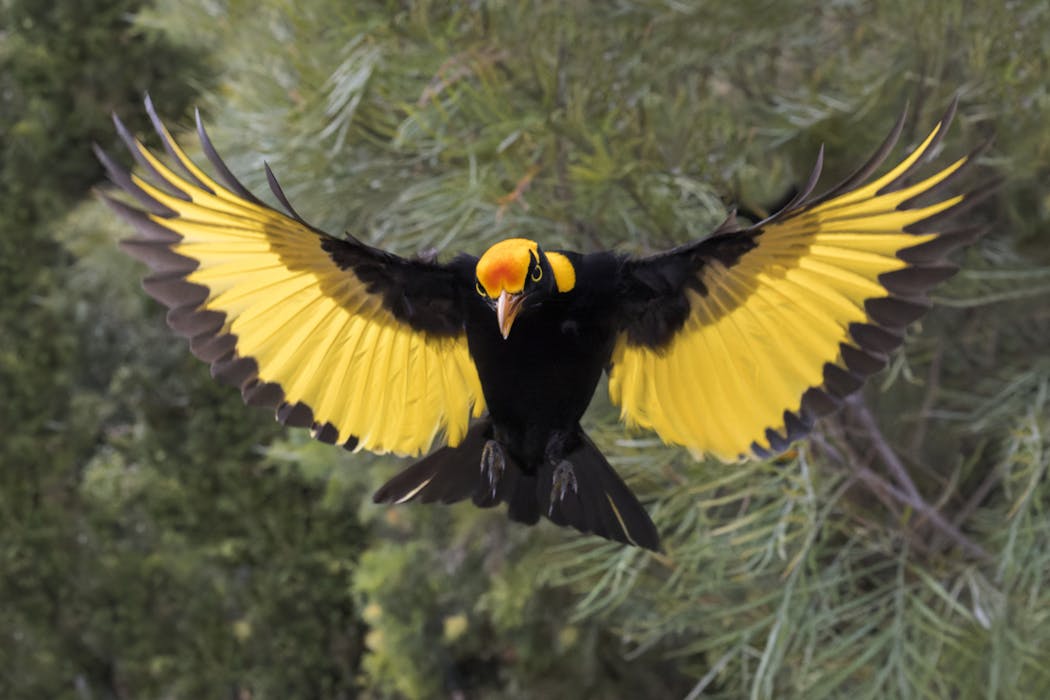
Our new research adds a quirky new passerine to the fossil record of Aotearoa and shows just how unique its ancient biodiversity was. The new species appears to be in the bowerbird family of songbirds, which are not native in New Zealand today.
Made famous by Sir David Attenborough’s nature documentaries, bowerbirds are best known for their elaborate courtship behaviour and the males’ efforts to decorate bowers with coloured fruit or leaves to attract a mate. These showy males are often brightly coloured, while females are more drab – and very choosy about their mates.
Courtship of the bowerbirds.Until now, bowerbirds and their fossil relatives have only been found in Australia and New Guinea.
The St Bathans bowerbird
Among all the tiny bones found in the St Bathans fossil site, a curious foot bone stood out. When we compared digital models of the fossil to a great number of other passerines, it bore all the hallmarks of a bowerbird; but this one was much smaller and more slender than living bowerbirds.
It’s name is Aevipertidus gracilis – the gracile one from a lost age.
The size of Aevipertidus gracilis would make it the smallest known bowerbird. Most living bowerbirds are chunky, weighing anywhere from 62 to 265 grams and spending time both on the ground and in the forest canopy.
New Zealand’s bowerbird weighed around 33 grams, similar to a korimako/bellbird but with longer feet.
Our analysis suggests the St Bathans bowerbird foot was most similar in shape to a group known to construct walk-through avenue bowers, such as the brightly coloured flame bowerbird.
We can only speculate about its plumage and behaviour, but Aevipertidus gracilis may also have performed elaborate displays to attract a mate.
The St Bathans bowerbird joins other New Zealand passerines with an ancient history – including huia, kōkako, piopio and mohua – whose ancestors flew across the ocean to Zealandia millions of years ago.
The St Bathans bowerbird lived far from its relatives in warm Australia and New Guinea. If it was a fruit eater, it may have been poorly equipped for temperatures that began dropping dramatically around 14 million years ago and caused a reduction in plant diversity. Ultimately, it may have become a victim of climate change.
Conservation palaeobiology
Fossils like the St Bathans bowerbird as well as genetic research are revealing New Zealand’s story of bird evolution, with extinctions and repeated colonisations across geological time.
For example, prehistoric shelducks colonised ancient Zealandia, only for them to go extinct. Around two million years ago, ancestors of the pūtangitangi/paradise shelduck recolonised New Zealand.
The same is true for the ancient passerine relatives of magpies, which went extinct after the Miocene. But unlike the native shelducks, modern makipai/Australian magpies were introduced by Europeans in the 1860s.
Some researchers suggest these long-extinct species muddy the concept of what is native or introduced in New Zealand, using magpies as an example.
Even though ancient magpie relatives once lived in Zealandia, it doesn’t mean their living cousins belong in the modern ecosystem. This thinking could undermine conservation management and lead to ecosystems being more degraded by invasive species.
The St Bathans wonderland existed in a Zealandia before the Southern Alps rose to create the South Island’s backbone. Lake Manuherikia was home to many plants and animals, including crocodilians and tortoises, making it very different from what is there today. It doesn’t make sense to consider these ancient animals as native in modern Aotearoa.
New discoveries like the St Bathans bowerbird provide wonderful insights into New Zealand’s biological heritage. Let’s celebrate these discoveries as clues to the past and not use them to undermine the ongoing fight to protect the country’s special living plants and animals.
We thank the coauthors on our paper, Daniel Field and Alex Brown, Sasha Votyakova for the artist’s reconstruction, the landowners at St Bathans for access to their land, Jean-Claude Stahl for preparation of the fossil photos, and numerous fieldworkers who helped with our excavations.
Authors: Elizabeth Steell, Research Fellow in Earth Sciences, University of Cambridge

















