how Indigenous songs recount deep histories of trade between Australia and Southeast Asia
- Written by: Aaron Corn, Professor of Music · Director, Centre for Aboriginal Studies in Music (CASM) · Director, National Centre for Aboriginal Language and Music Studies (NCALMS), University of Adelaide
In 1983, the prolific Yolŋu (Yolngu) educator and musician, Mandawuy Yunupiŋu, composed his first ever popular song, Djäpana: Sunset Dreaming. A decade later, this song would become an iconic Australian hit as Yunupiŋu’s band, Yothu Yindi, rose to stardom in the early 1990s.
At a time when other Yolŋu popular bands were emulating imported country and gospel styles, the composition of Djäpana: Sunset Dreaming changed music history. It drew on the Manikay tradition, the vast body of public ceremonial songs that were bestowed on Yolŋu clans of northeast Arnhem Land countless generations ago by the original ancestors who named, shaped and populated their homelands.
This revolutionary artistic act initiated an entirely new genre of popular music from Arnhem Land, with Yothu Yindi at its vanguard, which would build new bridges with audiences worldwide. Yet, unknown to most listeners is that this song echoes long histories of early engagements with Southeast Asian visitors that remain integral to Yolŋu ceremonial law to this day.
Music video for Djäpana: Sunset Dreaming (Radio Mix) performed by Yothu Yindi (1992)A song of homesickness
While other early hit songs by Yothu Yindi like Treaty and Mainstream inspire hope for a better future, the mood of Djäpana: Sunset Dreaming is sorrowful. It was composed when Yunupiŋu was working away from home as an Assistant Principal at Shepherdson College in Galiwin’ku on Elcho Island in Arnhem Land, while his wife and young children remained on the mainland some 150 kms to the east on the Gove Peninsula.
After work one evening, Yunupiŋu sat with his guitar and, in the fading light of the setting sun, channelled his homesickness into song. The lyrics that came to him reminded him of home: warwu (sorrow), djäpana (coral sunset), rräma rrämani (coral sunset clouds), dhurulaŋala galaŋgarri (fading coral sunset).
They affirmed Yunupiŋu’s own deep ancestry through the Gumatj Yolŋu clan and drew on a Gumatj Manikay series of distinct song subjects for the clan’s country of Bawaka on Port Bradshaw. The series remembers early Southeast Asian visitors. Specifically, the lyrics were drawn from a terminal song subject from this Manikay series, Djäpana (Coral Sunset).
A Gumatj clan Manikay item on subject on the Rräma (Coral Sunset Clouds) performed by Yothu Yindi in 1999.Before the first wave
The long histories of trade between commercial trepang (sea cucumber) harvesters from the port of Makassar in the pre-Indonesian Sultanate of Gowa on Sulawesi, and Indigenous Australian peoples of the Kimberley and Arnhem Land coastlines have been widely discussed by scholars since the release of Campbell Macknight’s seminal 1976 book, The Voyage to Marege’. Articles about this contact in magazines such as Walkabout appeared as early as 1934.
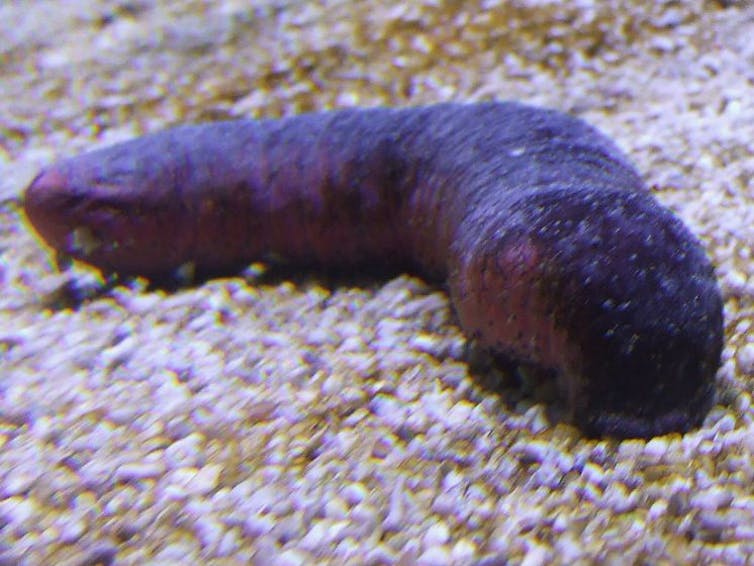 A trepang feeding on gravel in Sydney Aquarium.
Erin Silversmith
A trepang feeding on gravel in Sydney Aquarium.
Erin Silversmith
Based on Dutch colonial records from Jakarta dating from 1754, the Makassan trepang industry gained momentum in the 1750s. The trade with trepang harvesters predated British colonial contacts with most local Indigenous Australians by more than 50 years.
This is not a history of British exploration and conquest from the first wave of colonial expansion in Australia. Rather, it is one of lengthy exchanges with Southeast Asian neighbours in Australia’s north that predate the founding of New South Wales as a British Crown Colony in 1788. The exchanges left an enduring legacy that continues to influence language, culture and memory among Indigenous peoples of north Australia.
Trepang was a lucrative commodity, and is still sold at a premium throughout East and Southeast Asia. Used in Chinese cooking since the 17th century, it was coveted by Chinese buyers in Makassar both as a culinary delicacy and as a medicinal enhancer of male virility.
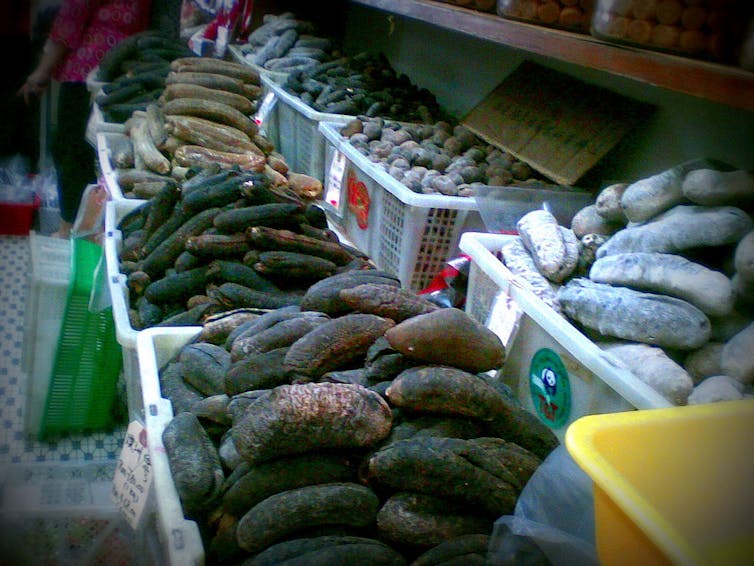 Dried trepang in an Asian market.
Bare Dreamer
Dried trepang in an Asian market.
Bare Dreamer
For at least 150 years, Makassan vessels known as perahu sailed to north Australia to harvest trepang from its warm coast waters. They arrived on the northwest monsoon each January, and returned home with hulls full of trepang, pearl shell, beeswax and ironwood around April.
The crews of these vessels were mostly speakers of the Makassan and Bugis languages, but also likely included people of Sama (Bajau), Butonese and other ethnicities. They knew the Kimberley by the name of Kayu Jawa and Arnhem Land as Marege’.
Macknight estimated that at the height of this trade, some 30–60 Makassan vessels carried at least 1,000 sailors from Sulawesi to Arnhem Land each year. In 1803, during their voyage on the HMS Investigator, Matthew Flinders and Robert Brown met a fleet of 60 Makassan vessels off Arnhem Land’s coast and spoke at length with one of their captains, Pobassoo.
Harvesting trepang in Arnhem Land for Asian markets began to ebb in 1884 following the 1883 eruption of Krakatoa and the imposition of new taxes upon Makassan vessels landing in the Northern Territory. One final Makassan perahu captained by Otching Daeng Rangka, the Bunga Ejaya, sailed to Arnhem Land in 1906 and its departure in 1907 brought the exchanges to an end.
Trade and autonomy
Long before the first Methodist missionaries arrived in northeast Arnhem Land at Milingimbi in 1923, the Yolŋu held extensive knowledge of their Southeast Asian neighbours. Some Yolŋu people even travelled to Makassar and made families with shared Makassan ancestry.
Read more: Long before Europeans, traders came here from the north and art tells the story
Makassan religion, culture, goods and seacraft are recorded in many Yolŋu ceremonies still practised today. In return for rights to harvest their resources, the Yolŋu received goods imported by the Makassans including rice, tamarind, tobacco, alcohol, cloth, axes and knives.
Consequently, Yolŋu languages still retain hundreds of Makassar and Bugis words including rrupiya (money), bandirra (flag), buthulu (bottle), lipalipa (canoe), and baŋ’kulu (axe). Many Yolŋu Manikay series also refer to these historical visitations extensively.
Accordingly, most Manikay series for the Dhalwaŋu clan homeland of Gurrumuru sing of Makassan exchanges through song subjects including yiki’ (knife), ŋarali’ (tobacco), manydjarrka (cloth), dhamburru (drum), djuliŋ (flute), dopulu (playing cards), ŋänitji (alcohol), barrundhu (drunken fighting), parrurru (flag), berratha (rice) and watjpalŋa (rooster). Other subjects sung by the Warramiri and Gumatj clans include wurramu (a ghost Makassan captain), djakura ga lanytja (kickboxing), waraliny (pipe smoking), wayathul’ (scrub fowl), Luŋgurrma (northerly trade wind) and djäpana (coral sunset).
Imams accompanied Makassan fleets to Australia and observations of Islamic practices were recorded in Yolŋu ceremonial law. The Wurramu mortuary ceremony, for instance, sings of offerings of thanks to Allah.
The Yolŋu elder, David Burrumarra MBE, explained that the Makassans’ god was absorbed into Yolŋu ceremonial law as a kind of ancestral mokuy (ghost) called Walitha’walitha after the devotional Islamic recitation, Lā ʾilāha ʾillā llāh (There is no god but God). The purpose of Walitha’walitha in Yolŋu law is to provide an ancestral basis for the existence of foreign peoples beyond Australia’s shores.
Makassan captains were also immortalised in Yolŋu law as ancestral ghosts with the potential for malevolence. This reflected the reality that, while Makassan seafarers imported goods that were useful and desirable to the Yolŋu, their presence could also bring conflict.
The Yolŋu developed an elaborate system of colour-coded flags made from imported cloth that marked beaches owned by different clans where Makassan visitors could land. Used prominently in public ceremonies, these flags remain strongly linked to Yolŋu clan identities to this day.
Yet, Yolŋu ceremonies also record that, whenever Makassan visitors failed to observe Yolŋu law, the country itself would expel them. Many are remembered for meeting unfortunate ends including being chased by swarming bees into a boiling cauldron for cooking trepang, and having their vessels capsized amid torrents of seawater and entrails projected by the trepang themselves.
Read more: Friday essay: Dr Joe Gumbula, the ancestral chorus, and how we value Indigenous knowledges
Music video for Djiliwirri by Joe Gumbula and Fred Dhamarrandji performed by Soft Sands (1997).In the Daygurrgurr Gupapuyŋu clan homeland of Djiliwirri, the trespassing Makassan captain, Nuwa, was repelled with such great force that sparks flew down the escarpment creating fires and termite mounds at the wellspring, Buŋu. Gupapuyŋu ceremonies also recount how the ancestor, Djunranydjura (Dingo), refused Makassan offers of trade to remain free from foreign influence.
Women who travelled with foreign crews were also observed. For instance, in the Birrkili Gupapuyŋu clan homeland of Luŋgutja, a trespassing vessel captained by Bäpa-djambaŋ was unable to weigh anchor and devoured whole by the ancestor, Mundukul (Water Python), in the form of a thunder storm.
Its wreckage is now a coral reef. A young girl who was kept chained in its hold, Wurrathithi, also remains there as an ancestral ghost, watching over Luŋgutja’s waters as she tends to the Gupapuyŋu clan’s recently deceased.
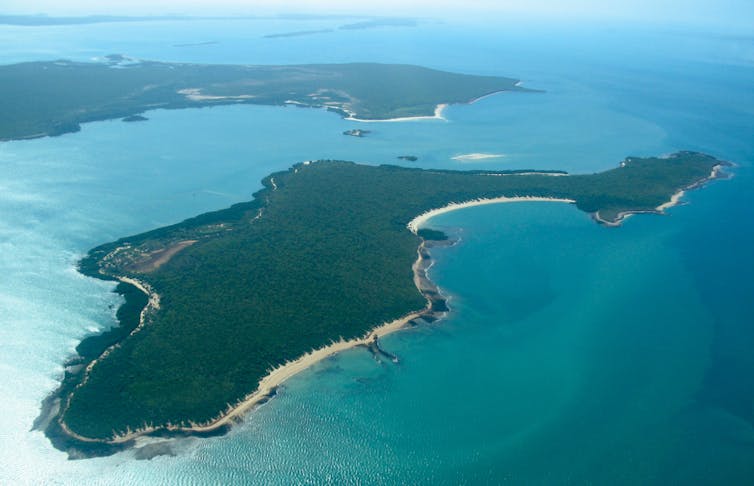 The Birrkili Gupapuyŋu clan homeland of L̲uŋgutja.
Aaron Corn
The Birrkili Gupapuyŋu clan homeland of L̲uŋgutja.
Aaron Corn
Reenactment and revival
In 1986, 10 Aboriginal students from Batchelor Institute accompanied the historian Peter Spillet to Makassar. They were amazed to find many words and images that their own languages and traditional designs had absorbed. Since then, several initiatives have commemorated the long history of Makassan exchanges with Yolŋu communities.
For the Australian Bicentenary of 1988, Spillet commissioned a replica perahu called the Hati Marege’ (Heart of Arnhem Land) to reenact the old sea voyage from Makassar to Galiwin’ku. Its captain was Mansjur Muhayang, whose late father had been the last surviving crewman to have sailed to Arnhem Land on the Bunga Ejaya in 1906.
In Sydney, the Bicentenary’s reenactment of the 1788 landing of the British First Fleet was met by more than 40,000 protesters for Indigenous rights. Yet, the landing of the Hati Marege’ in Galiwin’ku returned Makassan mariners to Arnhem Land for the first time in 82 years.
The Hati Marege’s crew were greeted by their Yolŋu hosts as family through ceremony. Witnessing their moving arrival even inspired the prolific local band, Soft Sands, to compose a new rock ballad, Land, Our Mother, which captured the warmth of the Hati Marege’s welcome to Galiwin’ku, while simultaneously asserting the enduring rights of the Yolŋu in their ancestral homelands.
Land, Our Mother by Joe Gumbula and Frank Garawirrtja (1988) performed by Soft Sands (2006).In 1993, the celebrated Yolŋu artist, John Bulunbulun, led an ensuing visit from Maningrida to Makassar, where he directed a three-night Marayarr Murrukundja diplomacy ceremony. It involved the creation of an elaborate ceremonial pole that represents the mast and rigging of a Makassan perahu.
Two subsequent initiatives were championed by the noted Indigenous anthropologist, Marcia Langton. The first, Trepang: An Indigenous Opera, premiered in Makassar in 1997, and reunited an intermarried Yolŋu–Makassan family who had been separated since the Bunga Ejaya’s departure from Arnhem Land in 1907.
The second, the Trepang exhibition, opened at the Capital Museum in Beijing in 2011 and explored the historical sale of Australian trepang into China. I was honoured to play yidaki (didjeridu) for Bulunbulun’s stepson, Paul Pascoe, as he sang Manikay to launch this exhibition.
Ochre and Ink (2011) documents the Trepang exhibition.Such initiatives continue to widen public awareness of the most recent wave of Makassan trade in Arnhem Land (1750–1907). However, the prominence of Southeast Asian contact histories in Yolŋu ceremonies still practised today has never waned, and retains intriguing allusions to even earlier waves of international exchange.
How far back?
While we know Southeast Asian trade in northeast Arnhem Land ended in 1907, we do not know when it began or how many different foreign peoples sailed to Australia before 1750. Recent radiocarbon dating in Arnhem Land tells us that a Southeast Asian pottery shard from Groote Eylandt was made as early as 1107, that rock art depicting a perahu in Wellington Range was painted before 1664, and that a person of Southeast Asian origin perished at Anuru Bay before 1730.
Read more: Archaeology is unravelling new stories about Indigenous seagoing trade on Australia's doorstep
It is difficult to know who these early Southeast Asian visitors might have been or why they visited Arnhem Land. Yolŋu ceremonial law is a heterogeneous system incorporating dozens of different clans across northeast Arnhem Land, who maintain their own unique ancestral traditions of ceremonial names, songs, dances and designs.
These traditions encode knowledge in ways that necessitate interpretation by ceremonial leaders and through firsthand experience of specific sacred sites on country. Consequentially, Yolŋu Manikay series that address contact histories typically reference earlier waves of seafaring visitors in cryptic and multilayered ways.
Burrumarra recalled that the first wave of foreign visitors were whale, dugong and turtle hunters, who the Yolŋu saw as equals. Unlike the commercially motivated Makassans who arrived much later, they shared the Yolŋu’s dark skin, and came from north(east) of Arnhem Land in dugout sailing canoes.
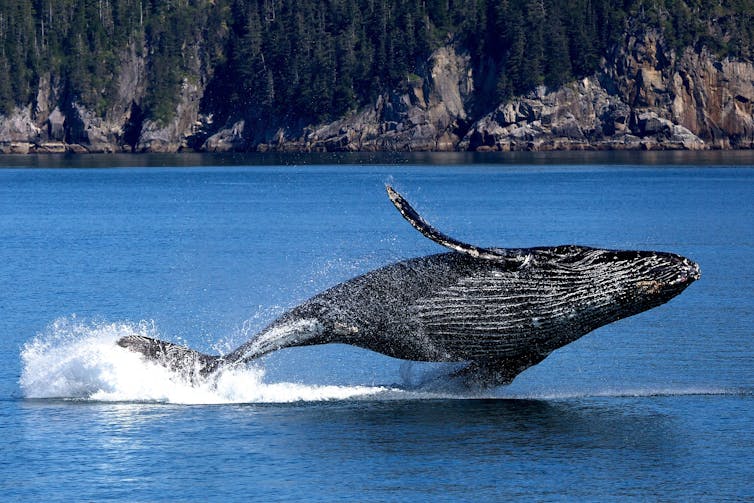 A humpback whale in Australian waters.
Skeeze
A humpback whale in Australian waters.
Skeeze
These hunters were followers of Allah. But, like the Yolŋu, they also held ceremonial law for Whale and Octopus, and possessed a colour-coded flag of their own with two horizontal bands of black over white representing their camp at Motatj in the Wessel Islands.
They remain known to the Yolŋu by various names including the Bäpayili, Wurramala, Gelurru and Dhurrutjini. This latter name suggests a Sama origin, as Turijene is a Makassan moniker for the Sama clans who settled in Sulawesi and Kalimantan in the 16th century, and later spread to nearby islands including Lesser Sunda, Maluku and Raja Ampat.
Coral Sunset
Burrumarra also mentioned an ensuing wave of visitors with distinctive golden skin, who did not harvest trepang, and instead built boats, made pottery, grew rice, dug wells and loomed cloth. They mostly respected the Yolŋu and participated in their ceremonies, yet kept their technological secrets to themselves, which led to conflict and their eventual departure.
The Yolŋu associate this intermediate wave of seafarers with a class of women ancestors known as the Bayini. The Bayini presence at Bawaka informs the sorrowful mood of Gumatj clan Manikay for Djäpana (Coral Sunset), which later imbued Yunupiŋu’s composition of Djäpana: Sunset Dreaming and sparked the creative impetus towards his band, Yothu Yindi.
Read more: My favourite album: Yothu Yindi's Tribal Voice
At Bawaka, there was a beautiful Bayini woman named Djotarra, who was enslaved by a foreign captain, Gurrumulŋa, in his vessel, the Mätjala. In a recurring theme found in various Yolŋu Manikay series, Djotarra was chained in the Mätjala’s hold and, as it set sail from Bawaka into the djäpana sunset, it stuck a submerged rock in the shallows drowning all aboard.
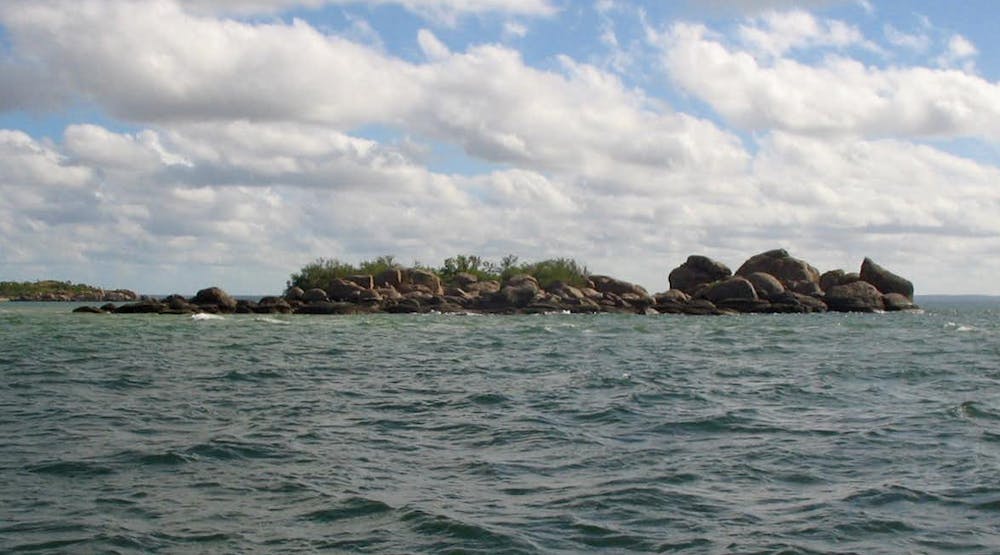 The island of Binanhaŋay in the waters of Bawaka.
Photo: Aaron Corn, Author provided
The island of Binanhaŋay in the waters of Bawaka.
Photo: Aaron Corn, Author provided
The Mätjala’s wreckage remains in Port Bradshaw’s waters as the island of Binanhaŋay, while the tragedy of Djotarra serves as another Yolŋu exemplar for exercising caution in dealings with foreigners. This wariness of foreign motivations would also imbue Yunupiŋu’s composition of Djäpana: Sunset Dreaming, which warns, “Don’t be fooled by the Balanda [European] ways”.
Such assertions remain an intrinsic trait of how the Yolŋu understand and negotiate the otherness of foreigners in the contemporary world. They stem from an enduring legacy of extensive engagements with Southeast Asia that long predate the 1788 landing of the British First Fleet in Sydney and continue to affirm the ancestral rights of Indigenous peoples in Australia.
This essay draws on Aaron Corn’s essay with Brian Djangirrawuy Garawirrtja in The First Wave: Exploring Early Coastal Contact History in Australia edited by Gillian Dooley and Danielle Clode.
The Gupapuyŋu App is a free download from Charles Darwin University that provides a Yolŋu language pronunciation guide.
Authors: Aaron Corn, Professor of Music · Director, Centre for Aboriginal Studies in Music (CASM) · Director, National Centre for Aboriginal Language and Music Studies (NCALMS), University of Adelaide