

Neaera, the Athenian child slave raised to be a courtesan
- Written by: Marguerite Johnson, Professor of Classics, University of Newcastle
In this series, we look at under-acknowledged women through the ages.
The ancient worlds of Greece and Rome have perhaps never been as popular as they presently are. There are numerous television series and one-off documentaries covering both “big picture” perspectives and stories of ordinary people.
Neaera was a woman from fourth century BCE Athens whose life is significant and sorrowful – worthy to be remembered – but may never feature in a glossy biopic.
Possibly born in Corinth, a place where she lived from at least a young age, Neaera was raised by a brothel-keeper by the name of Nicarete.
Her predicament was the result of her being enslaved to Nicarete. While we don’t know the reason for this, we do know that foundlings were common in antiquity. The parents of baby Neaera, for whatever reason, left her to fate – to die by exposure or be collected by a stranger.
From a young age, Neaera was trained by Nicarete for the life of a hetaira (a Classical Greek term for “courtesan”). It was Nicarete who also named her, giving her a typical courtesan title: “Neaera” meaning “Fresh One”.
Ancient sources reveal Naeara’s life in the brothel. In a legal speech by the Athenian politician and forensic orator, Apollodorus, the following description is provided:
There were seven young girls who were purchased when they were small children by Nicarete … She had the talent to recognise the potential beauty of little girls and knew how to raise them and educate them with expertise – for it was from this that she had made a profession and from this came her livelihood.
She called them ‘daughters’ so that, by displaying them as freeborn, she could obtain the highest prices from the men wishing to have intercourse with them. After that, when she had enjoyed the profit from their youth, she sold every single one of them …
The occasion for the passage from Apollodorus is a court case that was brought against Neaera in approximately 343 BCE. Neaera was around 50-years-old by the time of her prosecution, which took place in Athens.
Read more: The grim reality of the brothels of Pompeii
Trafficking and abuse
The circumstances of her trial are complicated, involving the buying, selling, trafficking and abuse of Neaera from a very young age.
Piecing together the evidence from Apollodorus’ prosecution speech, which has come down to us with the title, “Against Neaera”, it transpires that two of her clients, who shared joint ownership of her, allowed her to buy her freedom around 376 BCE.
Afterwards, she moved to Athens with one Phrynion, but his brutal treatment of her saw Neaera leave for Megara, where circumstances caused her to return to sex work.
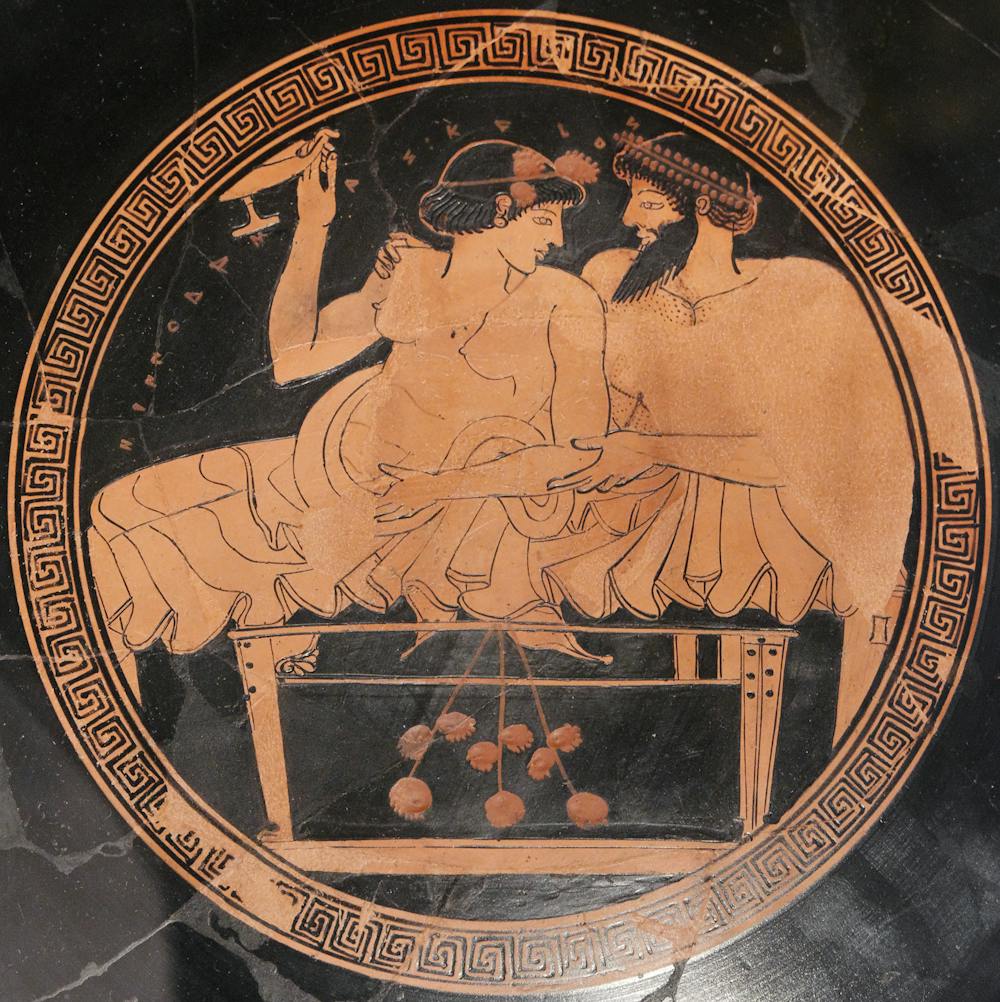 A man and a prostitute reclining on a bench during a banquet; Tondo from an Attic red-figure kylix, circa 490 BC.
Wikimedia Commons
A man and a prostitute reclining on a bench during a banquet; Tondo from an Attic red-figure kylix, circa 490 BC.
Wikimedia Commons
Further intrigues involving men and sex work saw Neaera eventually face trial on the charge of falsely representing herself as a free Athenian woman by pretending to be married to a citizen.
The charge of fraud was based on the law that a foreigner could not live as a common law “spouse” to a freeborn Athenian. The fact that Neaera also had three children, a daughter by the name of Phano, and two sons, further complicated the trial and its range of legal entanglements.
While we never discover the outcome of the trial, nor what happened to Neaera, the speech of the prosecutor remains, and reveals much about her life. Unfortunately, the speech of the defence is lost.
We do know, however, that the man with whom Neaera cohabitated, Stephanus, delivered the defence. Of course, he was not only defending Neaera – he was defending himself! Should Neaera have been found guilty, Stephanus would have forfeited his citizenship and the rights that attended it.
Stephanus had a history of legal disputes with the prosecutor, Apollodorus. He also had a history of being in trouble with the law. For example, he had illegally married off Phano – not once, but twice – to Athenian citizens. Shady “get rich quick” schemes motivated such activities, and it seems that Stephanus was adept at using both his “wife” and his “daughter’ for bartering and personal profit.
Another accusation revealed during the trial alleged that Stephanus arranged for Neaera to lure men to his house, engage them in sex, and then bribe them. And while Apollodorus provides no evidence for such a scam ever having taken place, judging by Stephanus’ track-record, it does not seem implausible.
Read more: Friday essay: the myth of the ancient Greek 'gay utopia'
Remembering Neaera
Reading through the long, complex and damnatory speech of Apollodorus, we risk of losing sight of the woman at the centre of it. Caught amid petty politics, sex scandals, and personal vendettas is a woman who becomes peripheral to the machismo being played out in court.
Yet, somewhat ironically, this is the only ancient source we have that records not only Neaera and the life she was forced to lead – but the life of a hetaira from infancy, girlhood, middle-age and, ultimately, past her "use by” date.
Had she not been taken to court as part of the factional fighting of ancient Athens, had she not had her reputation annihilated so publicly, we would have never known about Neaera.
Were it not for Apollodorus and his ancient version of “slut-shaming”, Neaera’s story would have been lost.
But it hasn’t been lost. Somewhere, amid the male rhetoric, her story endures. Unfortunately, her voice is not preserved. All we can read in the speech, “Against Neaera” are the voices of men; her prosecutor and the witnesses he calls to the stand.
Ironically, these testimonies and accusations - so casually introduced in ancient Athens, but received so differently today - emphasise the inhumanity of the sex trade in an antiquity too often and too unthinkingly valorised.
The document known as “Against Neaera” is the only record we have of this (almost) hidden woman. It prompts us to remember. And it’s important to remember Neaera.
Authors: Marguerite Johnson, Professor of Classics, University of Newcastle


















