

Ancient Greeks and Romans knew harming the environment could change the climate
- Written by Konstantine Panegyres, Lecturer in Classics and Ancient History, The University of Western Australia
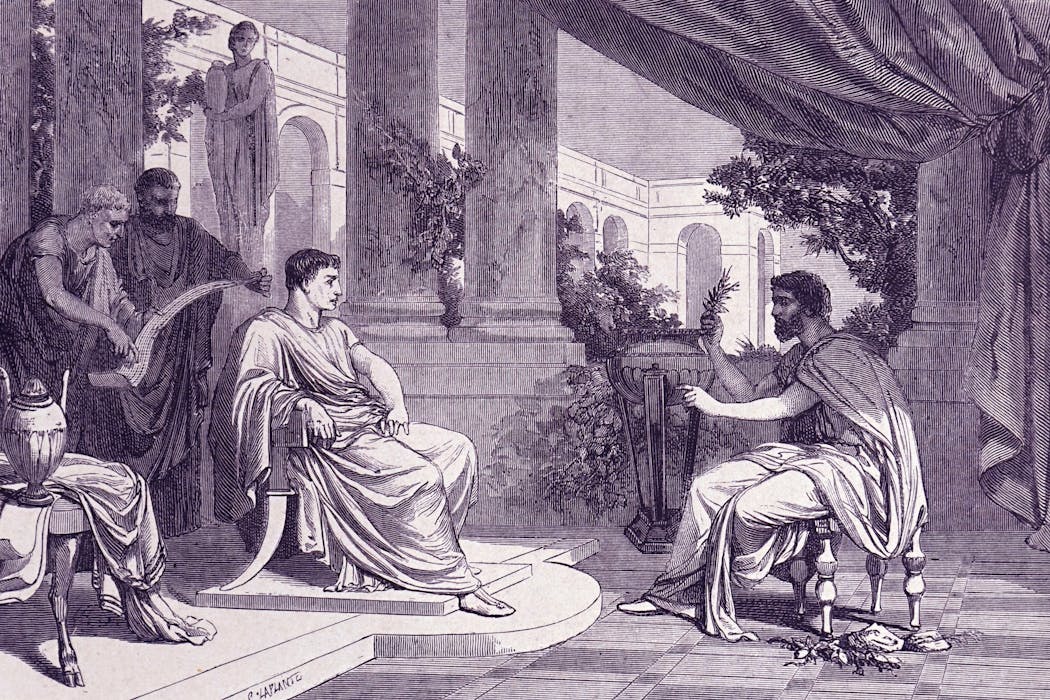
Humans have known about, thought about and worried about climate change for millennia.
Since at least the fourth century BC, the ancient Greeks and Romans recognised that the climate changes over time and that human activity can cause it.
They worried deeply about the impact it would have on us as individuals, and on broader society.
The earliest mention of climate change?
Greek writer Theophrastus of Eresus (who lived roughly from 372 BCE to 282 BCE) was a student of Aristotle. He is sometimes credited with the earliest reference to climate change.
In his treatise On Winds, Theophrastus notes people in Crete recognised their climate had changed over the centuries:
[they say] that now the winters are longer and more snow falls, presenting as proof the fact that the mountains once had been inhabited and bore crops, both grain and fruit-tree, the land having been planted and cultivated.
For there are vast plains among the Idaean mountains and among others, none of which are farmed now because they do not bear (crops).
But once, as was said, they were in fact settled, for which reason indeed the island was full of people, as heavy rains occurred at that time, whereas much snow and wintery weather did not occur.
It’s unclear how accurate Theophrastus’ account of Crete’s climate might be or what time period is meant by the word “once”.
Modern scientific studies suggest that from 8000 BCE to 600 BCE Crete experienced various alternations of climate, for example from humid and warm to dry and warm to cold and humid, while in the time when Theophrastus was writing the climate is meant to have been relatively warm and dry.
Theophrastus’ observation shows people handed down information about climate change from generation to generation.
Ancient awareness of the role of humans in climate change
In ancient Greek and Roman times, some were even aware that human actions could contribute to changes in climate.
The Roman aristocrat Pliny the Elder (23/24-79 CE) wrote a work titled Natural History, in which he gave examples of human induced climate change.
In one passage, Pliny noted that
in the district of Larisa in Thessaly the emptying of a lake has lowered the temperature of the district.
According to Pliny, because of this change of climate:
olives which used to grow there before have disappeared, also the vines have begun to be nipped (by frost), which did not occur before.
Pliny noted this kind of change caused by human activity had happened elsewhere in Greece:
The city of Aenos, since the river Maritza was brought near to it, has experienced an increase of warmth and the district round Philippi altered its climate when its land under cultivation was drained.
Ancient awareness of long-term climate changes
Ancient Greeks and Romans understood the climate is not static over time.
The Roman writer Columella (active around 50 CE) noted in his work On Agriculture that climate change had been mentioned by earlier writers:
For I have found that many authorities […] were convinced that with the long passing of the ages, weather and climate undergo a change.
Columella refers to the Roman writer Saserna (who was active in the early first century BCE). Saserna had observed how:
Regions which formerly, because of the unremitting severity of winter, could not safeguard any shoot of the vine or the olive planted in them, now that the earlier coldness has abated and the weather is becoming more clement, produce olive harvests and the vintages of Bacchus (wine) in the greatest abundance.
Saserna did not, however, attribute these long-term climactic changes to human activity. He suggested they were caused by the position of the Earth in relation to the Sun and the other planets, writing that:
The position of the heavens has changed.
Ancient responses to climate change
Greek and Roman writers sometimes complained about the destruction being done to the environment.
Roman writer Pliny the Elder said that:
We taint the rivers and the elements of nature, and the air itself, which is the main support of life, we turn into a medium for the destruction of life.
However, most ancient authors tended not to link environmental damage or pollution with climate change as much as we do today. The exception is when they talk about the draining of lakes or diversions of rivers, which worried many.

Ancient authors did, however, see protection of the environment as a serious concern. Their view was making the environment unhealthy would make people unhealthy, too.
For example, the physician Galen (129-216 CE) said that in his time the Tiber River in Rome was so polluted that it was not safe to eat fish caught there. Nonetheless, many people ate the fish, got sick, and died. The main pollution sources were sewage and rubbish.
Some ancient leaders took action to clean up the environment.
For instance, the Roman emperor Nerva (who ruled 96-98 CE) undertook construction works that caused the appearance of the city to be “clean and altered” and made the air “purer”, according to the Roman writer Frontinus.
What the modern world can learn
Ancient Greek and Roman writings reveal ancient concerns about our negative impact on the environment.
They show that places once rich and fertile later became desolate and barren.
Although the Greeks and Romans linked environmental harm with climate change to a more limited extent than we do today, they nevertheless knew harming the environment could change the climate.
This, they understood, can ultimately bring harm to ourselves personally and to our societies as a whole.
Authors: Konstantine Panegyres, Lecturer in Classics and Ancient History, The University of Western Australia

















