

Even in a simple game, our brains keep score – and those scores shape every choice we make
- Written by Denise Moerel, Research Fellow in Cognitive Neuroscience, Western Sydney University
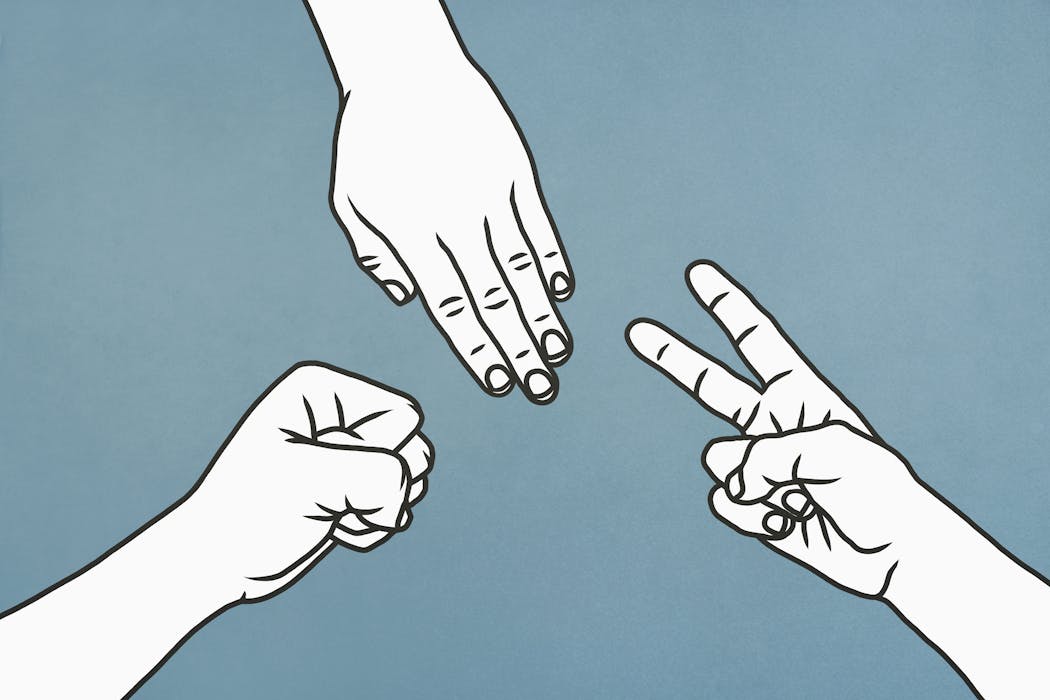
There’s an optimal strategy for winning multiple rounds of rock, paper, scissors: be as random and unpredictable as possible. Don’t pay attention to what happened in the last round.
However, that’s easier said than done.
To find out how brains make decisions in a competitive setting, we asked people to play 15,000 games of rock, paper, scissors while recording their brain activity.
Our results, now published in Social Cognitive and Affective Neuroscience, found that those who were influenced by previous rounds really did tend to lose more often.
We also showed that people struggle to be truly random, and we can discern various biases and behaviours from their brain activity when they make decisions during a competition.
What we can learn from a simple game
The field of social neuroscience has mostly focused on studying the brains of individual people. However, to gain insight into how our brains make decisions when we interact with each other, we need to use a method called hyperscanning.
With this method, researchers can record the brain activity from two or more people while they are interacting with each other, providing a more real-world measure of social behaviour.
So far, most research has used this method to investigate cooperation. When cooperating with someone else, it’s useful to act as predictably as possible to make it easier to anticipate each other’s actions and intentions.
However, we were interested in decision-making during competition where unpredictability can give you a competitive advantage – such as when playing rock, paper, scissors.
How do our brains make decisions, and do they keep track of the previous actions of both ourselves and the other person?
To investigate this, we simultaneously recorded the brain activity from pairs of players as they played 480 rounds of rock, paper, scissors with each other on a computer. From the resulting 15,000 total rounds across all participating pairs, we discovered that players were not good at being unpredictable when deciding which option to play next.
Even though the best strategy is randomness, most people had a clear bias where they overplayed one of the options. More than half of the players favoured “rock”, followed by “paper”, and “scissors” was favoured least.
In addition, people tended to avoid repeating choices – they went for a different option on their next round more often than would be expected by chance.
Real-time decisions
We could predict a player’s decision about whether to choose “rock”, “paper”, or “scissors” from their brain data even before they had made their response. This means we could track decision-making in the brain, as it unfolds in real time.
Not only did we find information in the brain about the upcoming decision, but also about what happened in the previous game. The brain had information about both the previous response of the player and their opponent during this decision-making phase.
This shows that when we make decisions, we use information about what happened before to inform what to do next: “they played rock last time, so what’s my move?”
We can’t help but try to predict what’ll happen next by looking back.
Importantly, when trying to be unpredictable, it’s not helpful to rely on past outcomes. Only the brains of those who lost the game had information about the previous game – the brains of the winners did not. This means overreliance on past outcomes really does hinder one’s strategy.
Why does this matter?
Who hasn’t wished they knew what their opponent would play next? From simple games to global politics, a good strategy can lead to a decisive advantage. Our research highlights our brains aren’t computers: we can’t help but try to predict what’ll happen next, and we rely on past outcomes to influence our future decisions, even when that might be counterproductive.
Of course, rock, paper, scissors is one of the simplest games we could use – it made for a good starting point for this research. The next steps would be to move our work into competitive settings where it’s more strategic to keep track of past decisions.
Our brains are bad at being unpredictable. This is a good thing in most social contexts and could help us during cooperation. However, during competition, this can hinder us.
A good takeaway here is that people who stop overanalysing the past may have a better chance at winning in the future.
Authors: Denise Moerel, Research Fellow in Cognitive Neuroscience, Western Sydney University

















