

climate law changes mean NZ could retreat from its international obligations
- Written by Cathrine Dyer, Lecturer in Climate Change, Te Herenga Waka — Victoria University of Wellington
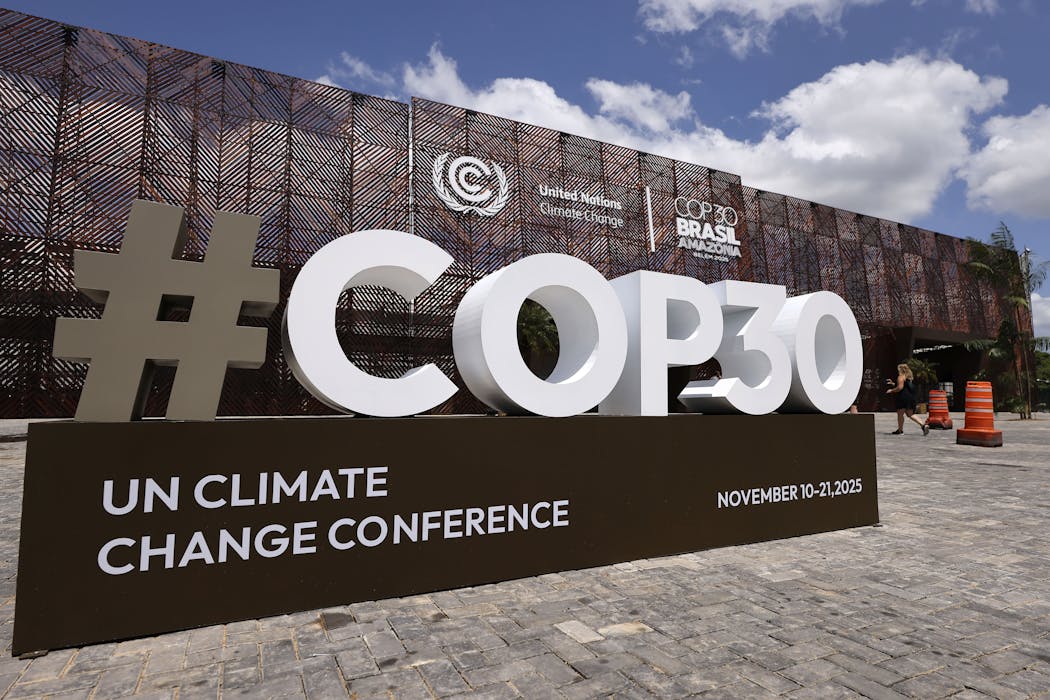
As this year’s UN climate summit (COP30) gets underway in Belém, Brazil, the New Zealand delegation will be attending beneath a cloud of scepticism about the government’s seriousness in addressing carbon emissions.
In a late-night announcement last week, the government proposed changes to New Zealand’s landmark climate law, including a decoupling of domestic efforts to cut emissions from New Zealand’s pledge under the Paris Agreement.
Delinking the Emissions Trading Scheme – one of the few remaining policy tools for cutting domestic emissions – from the country’s Paris Agreement pledge constructs a pathway for the government to abandon its international obligations, while remaining compliant with domestic law.
The retort from the market was immediate. The price of New Zealand carbon units plummeted 10% once trading resumed on the morning after the announcement, and crashed 18% by the end of the day.
Having earlier promised to “let the market do its work”, the government’s move was described by Carbon News as “a brutal blow to confidence in an already moribund market”.
New Zealand’s current promise to the world
New Zealand’s 2030 pledge under the Paris Agreement (known as a Nationally Determined Contribution, or NDC) is to cut greenhouse gas emissions by 50% compared to 2005 levels.
According to the latest figures from the Climate Change Commission, roughly half of this target would have to be met through investing in emissions-cutting projects in other countries or by purchasing offsets on the international carbon market.
New Zealand’s high reliance on international offsets makes it more exposed to global carbon pricing than any other OECD country. Despite acknowledging the potentially significant cost involved, Treasury has never accounted for offshore mitigation in its financial statements, arguing the government might change its policy settings.
Ministers have previously expressed the Government’s unwillingness to purchase international offsets, claiming the idea was “not palatable” without providing any clear alternatives.
Attempting to avoid further reliance on international offsets, the government made the smallest possible progression on the 2030 target in its proposal for New Zealand’s 2035 target, promising to cut net emissions by 51-55%, on 2005 levels.
Even on the basis of domestic emissions reductions alone, the target has been widely criticised as unambitious.
Discussions at COP30 are expected to advance implementation of international carbon markets, providing the policy tools required for New Zealand to meet its 2030 Paris Agreement target. In this latest move, the government appears to be trying to shut the door on it.
In his policy advice to Cabinet ahead of the recent announcement, Climate Change Minister Simon Watts claimed New Zealand’s Emissions Trading Scheme is a domestic policy instrument that should be made to align solely with domestic targets – despite originally being designed explicitly to link with international markets.
Included in the announcement was a plan to weaken New Zealand’s target for methane emissions from livestock. This goes against the Climate Change Commission’s advice, which proposed stronger cuts. Instead, the government presented calculations from a separate expert panel it appointed with narrow terms of reference (including a pre-determined target formula).
This means that unless other sectors step up, New Zealand will struggle to meet domestic targets and the gap with the Paris Agreement target will widen.
The removal of the means to achieving climate goals amounts to a “soft renege” on the Paris Agreement that has potentially significant consequences.
Consequences of retreat
The government’s latest proposed changes to climate law dismantle much of New Zealand’s remaining climate policy architecture, which had been painstakingly enacted with bi-partisan support to ensure stability around crucial long-term goals.
The Climate Change Response (Zero Carbon) Amendment Act 2019 enshrined long-term targets and established the Climate Change Commission.
To secure bipartisan support for the act, implementation of the commission’s advice was made optional. The compromise imposed a requirement for governments to at least seek the commission’s advice when setting targets and to provide the public with an explanation if it chose to depart from that advice.
This created transparency about the government’s actions and encouraged accountability to the public.
Eliminating some of the commission’s advice has one guaranteed outcome. The public will be less informed on the robustness of the government’s mitigation plans or its progress toward meeting the country’s international obligations.
Failure to meet those obligations could do immeasurable harm to New Zealand’s international reputation, while undermining free trade agreements that include clauses requiring those targets be met.
Even if the coalition is no longer in government in 2030, getting the country back on track to meeting its Paris Agreement obligations will be difficult.
The loss of bipartisan agreement on climate policy will increase instability well into the future as governments take turns to flip flop on the settings.
That could prove costly in the long run. A recent joint report issued by the World Economic Forum and Boston Consulting Group highlights the costs of climate inaction.
It calculates the financial penalties of a late, chaotic transition to a zero-emissions world, estimating that investment today in climate adaptation and mitigation will be repaid five to six times over in avoided loss and damage in the future.
This is completely at odds with the government’s stated concerns about the transition costs for itself and businesses, and even more at odds with public wellbeing in the face of rapidly worsening risks from climate change.
Authors: Cathrine Dyer, Lecturer in Climate Change, Te Herenga Waka — Victoria University of Wellington

















