

how ancient Greeks, Romans and early Christians used olive oil
- Written by: Tamara Lewit, Honorary Fellow, School of Historical and Philosophical Studies, The University of Melbourne
Today, olive oil is often hailed as helping to protect against disease, but beliefs in its medicinal or even sacred properties date back millennia.
Olive oil was used for healing and purification and associated with important rituals from at least the second millennium BCE, in ways which still influence practices today.
A holy liquid
Mid 2nd millennium BCE texts from the capital of the Hittite empire (in what is now Turkey) describe the anointing of a newborn child and the mother to ward off the dangers of birth.
In ancient Syria the high priestess of the god Baal was initiated with an anointing of “fine oil of the temple”.
Mycenaean Bronze Age tablets from the palace of Pylos in what is now Greece record the making of special scented oil to be offered to the gods.
In the Hebrew scriptures, oil is used to to initiate priests and kings such as David and Solomon, and to sanctify ritual objects.
A preserver of health
Olive oil was used by Greeks and Romans for cleansing and healing.
Oiling while bathing was a vital part of health regimes. No visit to the baths was complete without rubbing your body with oil (in place of soap) and scraping it off with a metal tool called a strigil.
Roman author Pliny the Elder wrote:
There are two liquids that are especially agreeable to the human body: wine inside and oil outside […] but oil is an absolute necessity.
He recommended olive oil as a cure for nettle stings and a base for many medicinal herbs.
Celsus, a Greek medical writer of the second century CE Roman Empire, advised:
If an exhausted person is bordering on a fever, they should immerse themselves […] in warm water to which a little oil has been added and then gently rub the whole body […] with oil.
Another medical writer Soranus says to anoint a newborn with olive oil, as had the Hittites 1,500 years earlier.
A recent study has shown that perfumed oil was used in Greco-Roman offerings to deities, and for the ritual anointing of statues.
Olive oil and Christianity
When Christianity developed in the later Roman Empire, the Greek term Christos was used as a translation of the Hebrew word messiah, meaning “one anointed with sacred oil”. This was the origin of the words Christian and Christ.
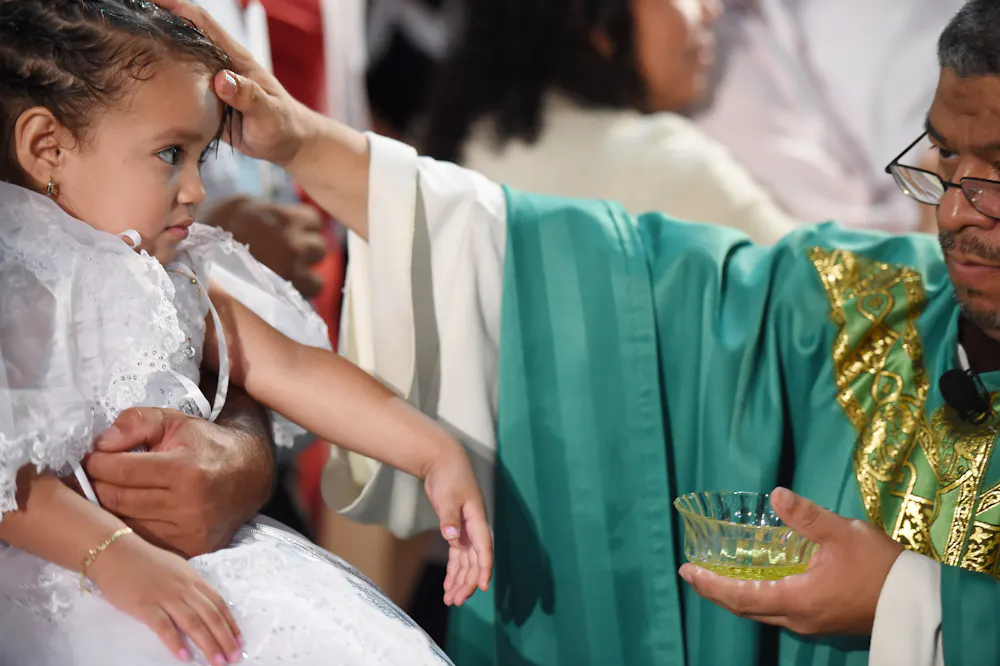
Scented and blessed olive oil called a chrism was used for sanctification and purification.
A church council of 381 CE records that:
Those who […] are being saved from the heretics […] are first anointed with holy chrism on the forehead, eyes, nostrils, mouth and ears […] and then we baptise them.
Such perfumed olive oil was (and indeed still is) used to sanctify liturgical objects such as chalices, in rituals such as the ordination of priests, before baptism, and to anoint the sick.
Churches were lit by a new type of lamp called a polycandelon, which had multiple glass bowls filled with scented olive oil, as well as lamps made in symbolic shapes such as a dove, crown or boat. These symbolised the light of God and contributed a heavenly fragrance.
The oil from saints’ tombs and sacred places was reputed to bring about healing miracles. Reliquaries containing the remains of saints had special holes for oil to be poured in and then dispensed.
This and the scented oil from lamps at martyrs’ shrines was used to anoint the sick.
A ninth century text describes how at Saint Menas’ tomb in Egypt:
a lamp before the grave […] burned day and night and was filled with fragrant oil. And when anyone took of this lamp oil […] and rubbed a sick person with it the sick person was healed.
Pilgrims who visited holy sites collected such oil in flasks, hoping to take home its healing power.

The early Church not only used olive oil, but also produced it.
Sixth century and later monastic and church archives record gifts of olive groves and enslaved workers to ecclesiastical and monastic estates.
This is confirmed by my own recent research into archaeological finds of oil production remains in episcopal complexes, annexes attached to churches, and in monasteries.
Christian symbols appear on the seals of oil transport containers from a fourth century CE shipwreck recently found off the coast of Mallorca.
Their painted inscriptions identify the contents as a special “sweet oil”, perhaps produced at monasteries in southern Spain and marketed for ritual and healing use.
Olive oil today
Ancient uses of olive oil for rituals of initiation, sanctification and healing have a modern legacy.
In 2023, oil for the coronation of Charles III was harvested from groves on the Mount of Olives, processed at local monasteries and blessed by archbishops in Jerusalem.
The anointing ritual continued a tradition derived from early medieval coronations of the first English kings, in turn modelled on that of the ancient King Solomon.
Olive oil is still used in Christian sacraments, the consecration of churches, and anointing of the sick.
Beautiful to taste, touch, see and smell, olive oil has had a special significance in human history. Its uses today have grown from the roots of a long tradition.
Authors: Tamara Lewit, Honorary Fellow, School of Historical and Philosophical Studies, The University of Melbourne


















