

Amelia Earhart disappeared almost 90 years ago. Why are so many people still looking for her?
- Written by Natasha Heap, Program Director for the Bachelor of Aviation, University of Southern Queensland
It has been more than 88 years since the world’s most famous female aviator, Amelia Earhart, and her navigator Fred Noonan, disappeared on the second-last leg of their around-the-world flight odyssey.
According to the United States government’s official report of the 16-day search, Earhart and Noonan ran out of fuel and crashed into the Pacific Ocean, short of their objective of Howland Island, on July 2 1937.
The disappearance, which is often labelled as “mysterious”, continues to captivate the world. With no confirmed wreckage found, millions of dollars have been spent on repeated, fruitless searches. And sensational claims of a possible discovery make splashy headlines with alarming regularity.
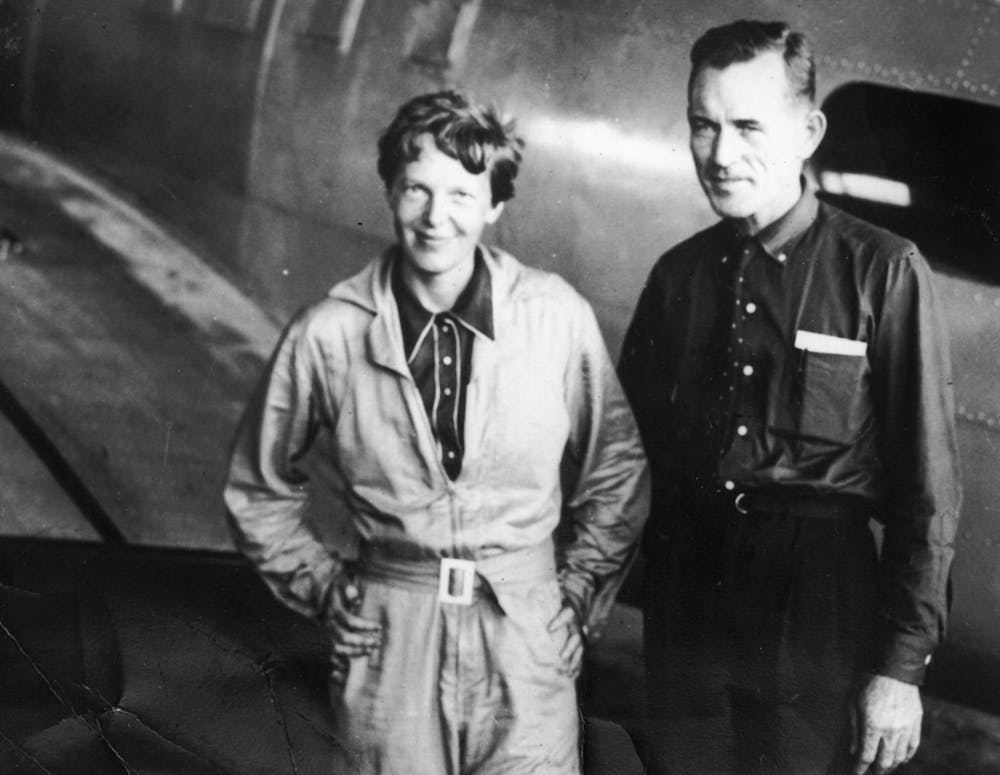
Interest in Earhart’s case has also been bolstered by United States President Donald Trump who, in September, said he would order his administration to declassify secret government records related to the disappearance.
A cycle of discovery and disappointment
Many expeditions for Earhart have followed a predictable four-step pattern: a dramatic announcement of a new, startling find; “we found Amelia” stories in the press; the evidence is quietly debunked, or the expedition is postponed; the coverage fades from the media cycle until the next “startling find”. And repeat.
In recent months, we have seen extensive media coverage of yet another such planned expedition. The destination is the so-called “Taraia object”, photographed off Nikumaroro Island, Kiribati – some 644km south-west of Earhart’s destination of Howland Island.
The expedition team includes experts from Purdue University, and the Archaeological Legacy Institute (ALI), headed by ALI’s Executive Director Richard Pettigrew.
It is based on a hypothesis by The International Group for Historic Aircraft Recovery (TIGHAR) that Nikumaroro Island was the final destination of Earhart and Noonan. However, the US government’s initial search (which included Nikumaroro) turned up no evidence of Earhart, Noonan or the aircraft.
Still, the joint ALI and Purdue team seem hopeful. As Pettigrew told Newsweek:
Everything that we see indicates it’s very possible, perhaps even likely, that this is what remains of Amelia Earhart’s aircraft.
The Conversation reached out to TIGHAR founder Ric Gillespie, who said he does not think the Taraia object is the wreck of Earhart’s Lockheed Model 10E Electra aircraft.
Originally scheduled to launch on November 4, the joint ALI and Purdue expedition was postponed last month due to issues with getting permits from the Kiribati government.
ALI continues to publicly fundraise for it, hoping to reach a target of US$900,000 for “Phase 1” (a site visit). Estimated costs for the proposed Phase 2 (the archaeological excavation) and Phase 3 (the “recovery of the aircraft remains”) are yet to be released.
Before ALI, there was TIGHAR
TIGHAR was founded by as a private non-profit in 1985 by Ric Gillespie, and has been searching for aircraft wrecks, including Earhart’s, since 1989. It has mounted at least five expeditions to Nikumaroro since 2010.
Last year, Gillespie said he was “absolutely certain” Earhart crash-landed and lived as a castaway on Nikumaroro Island. But no definitive evidence has been presented.
The organisation has never recovered a complete aircraft of any type, nor a single verified piece of an historic aircraft. For each search project, it raises funds from members, the public, and other interested parties.
Although Gillespie told The Conversation TIGHAR is currently “not fundraising for Earhart research or expeditions”, the organisation’s website contradicts this.
Dorothy Cochrane, a now-retired curator of the Smithsonian National Air and Space Museum, and a long time sceptic of TIGHAR’s work, said in 2016:
He’s (Ric Gillespie) used the same quote unquote evidence over and over again. […] He does this on a routine basis whenever he wants to mount another expedition … It’s his business. It’s his livelihood.
TIGHAR generates income through multiple channels, including various tiers of membership fees, the sale of publications, and general donations. But its website provides little information regarding how funds are allocated to or used within projects.
In response to questions about transparency around how donations are used, Gillespie told The Conversation:
TIGHAR is a recognised educational non-profit foundation. Like any non-profit organisation, we raise money to cover the cost doing our work. All US non-profits are prohibited from “making” money. All money raised is put into the organisation.
Professional heritage and preservation organisations have also raised concerns regarding private bodies searching for, and salvaging, historic wrecks – especially when such organisations only speak of finding and recovery, and not of subsequent preservation or research.
The competing hypotheses
There are several competing views on what happened to Earhart. Some searchers follow the official report’s finding that she crashed and sank close to Howland Island.
In January 2024, much media hype was generated by a sonar image – taken by exploration company Deep Sea Vision – of what some claimed was Earhart’s aircraft. But in November, it was revealed to be a natural rock formation, with far less publicity. Many people will have seen the “discovery”, but not the correction.
The Nauticos Corporation has also been searching for Amelia since 2001, mounting searches in 2002, 2006 and 2017. Each one has come back empty-handed.
Some searchers have also put forward outlandish theories that have all been debunked. These include the claims that Earhart was a spy for then US president Franklin D. Roosevelt, that she crashed in Papua New Guinea, that she was taken prisoner by the Japanese, and that she survived the flight and returned to live anonymously in the US.
Cultural fascination and media myth-making
The global media loves a sensational story: if it bleeds, it leads. But while there’s no fresh blood in the Earhart story, the legacy and modern media have contributed to the proliferation of reports from dubious organisations.
This kind of sensationalism can overshadow critical inquiry, and lead to unsupported claims being remembered long after quiet retractions and scientific rebuttals are published.
At the time of her death, Earhart was among the most famous women in the world. She was a record-breaking pilot, best-selling author, feminist hero and friend of the first lady Eleanor Roosevelt. She disappeared at the peak of her career, and towards the end of the golden age of aerial exploration.
Even people with no interest in historical aviation or aviation archaeology have heard of her, and want to read about the next expedition to find her. But at what cost?
Each high-tech expedition costs millions of dollars. As yet, not one has produced irrefutable evidence of the wreckage. As searches continue, we must ensure they are supported by ethical funding and evidenced-based reporting.
The story of Earhart’s disappearance persists not just because of what we don’t know, but because of how we choose to keep the myth alive. Perhaps one day we can let her rest in peace.
Authors: Natasha Heap, Program Director for the Bachelor of Aviation, University of Southern Queensland

















