

Google AI


Modern Australian

We planted two woody meadows a decade ago to see what would thrive. Now the concept is popular across Australia.

  • Written by: Claire Farrell, Associate Professor (Green Infrastructure) School of Agriculture, Food and Ecosystem Sciences, The University of Melbourne

It sounds like a gardener’s holy grail: beautiful and practical plantings that can turn cities into green spaces with benefits for people and biodiversity.

Our Australia-first collaborative research has made this dream a reality. Woody meadows have transformed urban spaces in Australian cities by adding green beauty and colour in public spaces at a much lower cost than other approaches.

Ours is a collaborative research project that engages with urban land managers, designers and horticultural crews to research and trial woody meadows under real-world conditions. Their popularity reflects the huge demand to green our urban places in a cost-effective way.

After ten years of success, failure and constant experimentation, we can now share our insights into how woody meadows can be both beautiful and hardy.

A range of different Australian native plants
Woody Meadows (left) are designed to replace low quality landscapes (right) while still being low maintenance. University of Melbourne, Author provided (no reuse)

What is a woody meadow?

A uniquely Australian concept, woody meadows are diverse, naturalistic plantings of native groundcover, shrubs and small trees. They are designed for maximum visual and ecological function, and are robust to heat and drought. A beautiful corridor for nature, they can cool cities and reduce stormwater runoff into waterways. They differ from naturalistic meadow-like plantings popular in Europe and America, which only contain flowering herbs and grasses.

Woody meadows mimic the structure of natural shrubland communities and include wattles, grevilleas, melaleucas, goodenias and correas for year-round flowering. They are planted densely into low-nutrient materials such as crushed scoria or sandstone (which exotic species don’t like). This promotes rapid canopy coverage and requires less weeding, fewer chemicals and lower maintenance costs.

Woody meadow plants are managed by coppicing – hard pruning to around 15 centimetres every two to four years. This maintains diversity and ensures dominant plant species don’t take over. It also mimics disturbances such as fire and storm damage and stimulates dense new growth and lots of flowers.

We have tested more than 300 Australian plant species and shown most species can resprout after coppicing. This means that plants can be tailored for different climates and site conditions without high risk of failure.
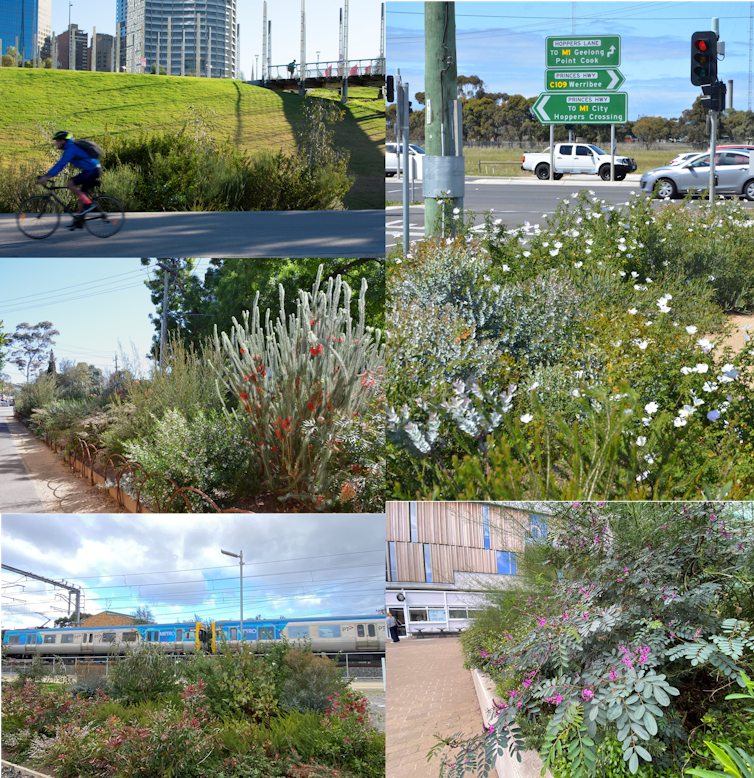
We planted two woody meadows a decade ago to see what would thrive. Now the concept is popular across Australia.
Woody Meadows are a flexible design approach that can be adapted to a range of challenging urban sites. University of Melbourne, Author provided (no reuse)

From little things…

Ten years ago, we planted two small plots of native plants in inner Melbourne. We wanted to find a novel and low-cost approach to urban greening.

From this single pilot project, the concept of woody meadows has grown exponentially. Our partners include transport agencies, water authorities, cemeteries, government agencies and councils. They have shared their successes and failures through a growing national Woody Meadow Network, established as part of this project.

There are now more than 30,000 square metres of woody meadows in 59 urban locations across southern Australia. These meadows are part of major infrastructure projects including Melbourne’s level-crossing removal project, Sydney’s metro rail project, and the East Subiaco redevelopment in Perth.

Australian cities are investing millions of dollars in urban green spaces. This has wide-ranging benefits for health and wellbeing, biodiversity, reducing pollution and tackling urban heating. But maintaining urban vegetation is expensive, leading to overly simple plantings that are dull and provide few benefits.
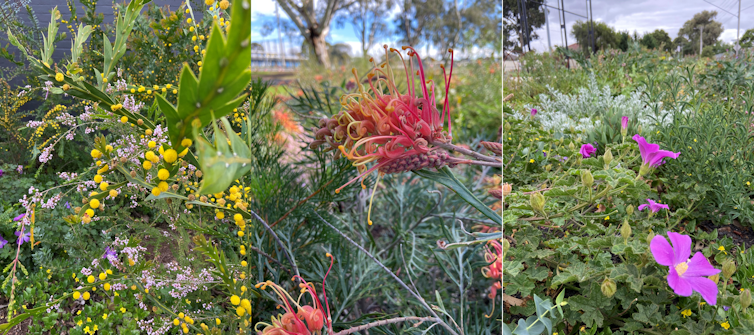
Australian native flowering plants
Woody Meadows in flower. University of Melbourne, Author provided (no reuse)

Living laboratories

The popularity of woody meadows reflects the huge demand for cost-effective ways to green urban areas.

Each meadow serves as a living laboratory, with data on plant performance and maintenance informing future designs. Historically, most public landscapes have been designed without considering maintenance, so involving horticultural crews and bringing their expertise into the design of woody meadows has been crucial to their success.

Installation costs for woody meadows are comparable to business-as-usual plantings of low-diversity, low-functioning monocultures such as massed plantings of strappy leaf plants such as Lomandra or Dianella species or shrubs. But they require 75% less maintenance over time. Their adaptable design has overcome barriers to planting in hostile urban sites and transport corridors.

A man with a power tool cuts plants
Coppicing involves pruning all plants down to a low height every two to four years to remove excess material and regenerate the plant. University of Melbourne, Author provided (no reuse)

Plant it yourself

If you are keen to plant a woody meadow of your own, we have condensed 15 years of research and testing into free Woody Meadow Guidelines outlining how to design, install and maintain them.

New woody meadow plantings can be registered on our website so we can continue to gather data on what works best.

Authors: Claire Farrell, Associate Professor (Green Infrastructure) School of Agriculture, Food and Ecosystem Sciences, The University of Melbourne


Read more https://theconversation.com/we-planted-two-woody-meadows-a-decade-ago-to-see-what-would-thrive-now-the-concept-is-popular-across-australia-269611

The Best Overseas Adventure Holidays for Australians Who Love the Outdoors

Australia offers no shortage of incredible outdoor experiences, but sometimes the best way to satisfy your sense of adventure is to head overseas. A...

Cape Town Wine Shuttle: Winelands Tasting & Tours

Embark on an unforgettable journey through the picturesque Cape Winelands, where world-class wines and breathtaking scenery await. Our Cape Town Win...

Why Giant Rats Tail Grass Keeps Coming Back After Spraying

Giant Rats Tail Grass (GRT) is one of the most frustrating pasture weeds for farmers and lifestyle property owners. You spray an infested area, see th...

When Custom Cardboard Boxes Make Sense for Your Business

Custom cardboard boxes can be useful when a standard carton does not fit a product, packing method or presentation requirement particularly well. A ...

Virtual Livestock Fencing and GPS Tracking: Improving Visibility Across Cattle Properties

What Virtual Livestock Fencing Means for Modern Cattle Management Managing cattle across extensive properties requires more than knowing where anim...

Sydney Pawnbrokers Explained: How Hocking Your Car Actually Works

Sometimes you need cash, and you need it soon. If you own a car, you may already have a way to get it. That's what people mean when they say they've...

Moving Interstate from the Gold Coast to Brisbane (or Back)? What Removalists Wish You Knew First

Have you talked to anyone who’s done the move? They say the same thing: the drive up the M1 is the easy part. It's everything around it that catches...

Why the Spring School Holidays Are a Great Time to Visit Coffs Harbour

The spring school holidays are a good time to spend a few days on the Coffs Coast. The weather is starting to warm up, there is plenty to do outdoor...

What to Do When an Older Car Is No Longer Worth Keeping in Melbourne

Ever looked at another repair quote and wondered whether your old car is still worth the trouble? It is a common turning point for Melbourne motoris...

Your Baby's First Year: A Local Guide to Feeding, Sleep, and When to Get Extra Support

Ask ten parents in a Brisbane mothers' group how their baby is feeding or sleeping, and expect ten different answers.  Someone's baby sleeps throug...

Kitchen and Laundry Makeover Ideas That Don't Require a Full Renovation

Full kitchen renos are expensive — and most people don't actually need one.  They need the kitchen to stop looking like it's stuck in 2009, or they...

How Technology Is Reshaping the Modern Australian Commercial Kitchen

The commercial kitchen has always been shaped by technology. Refrigeration changed how ingredients could be stored, modern ventilation transformed k...

The Number on a Roller Blind Fabric That Nobody Explains

Somewhere in the fabric book, next to the colour name, there is a percentage. Three per cent. Five per cent. Ten per cent. Nobody explains it, most c...

What’s Trending in Men’s Jewellery This Father’s Day!

Finding a Father’s Day gift that feels personal, stylish and genuinely wearable is not always easy. While socks and novelty mugs have traditionally ...

Road Signs: Understanding Their Role in Clear and Effective Signage

Effective signage and display hardware can help businesses communicate information, promote products and organise customer or visitor movement. Road...

Bottle Label Printing: Key Factors to Consider Before Your Next Packaging Run

Effective packaging begins with understanding the product, bottle material, artwork and production requirements when planning bottle label printing. H...

Planning a Long-Distance Move With Interstate Movers Melbourne

Moving between states involves more planning than a typical local relocation. Along with packing and transporting household belongings, you need to...

Understanding the Role of an I/O Controller in Industrial Automation

Modern industrial systems depend on accurate communication between sensors, machines and control systems. An I/O controller can help manage this commu...















