

is Donald Trump reviving the ancient crime of lèse-majesté?
- Written by: Garritt C. Van Dyk, Senior Lecturer in History, University of Waikato
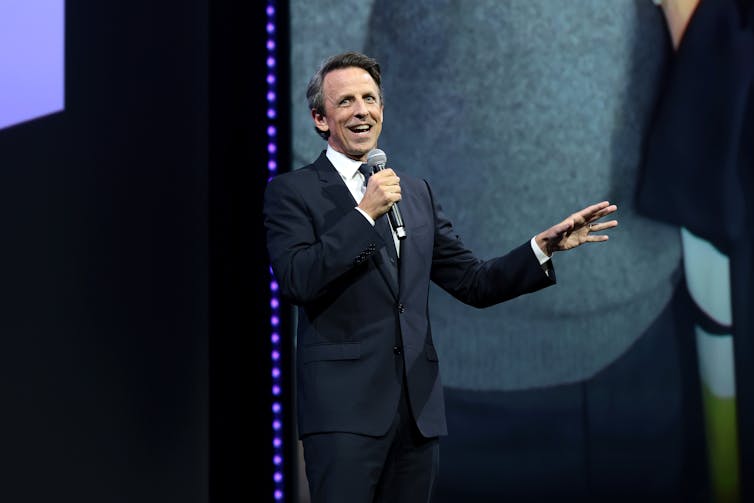
Donald Trump has a problem with comedian Seth Meyers and it fits a consistent pattern of hyper-sensitivity to criticism and satire.
Early this month, Trump declared in a post on Truth Social that a Meyers monologue was “100% ANTI TRUMP, WHICH IS PROBABLY ILLEGAL!!!” (His capitals, not mine.)
More recently, he called for broadcaster NBC to fire Meyers in a post that was then reposted by the chair of the Federal Communications Commission.
Meyers is just the latest target. Trump has repeatedly clashed with entertainers and comedians, from Taylor Swift and Bruce Springsteen to Jimmy Kimmel and Stephen Colbert, over their criticism of his administration.
Funny on one level, worrying on another. With next year’s 250th anniversary of the Declaration of Independence, one of the basic tenets of American democracy, freedom of speech, is under threat.
Trump’s attack on Meyers prompted a resolution from Democrat Senator Edward Markey, rebuking the president for suggesting criticism is illegal:
Let me be clear: in America, criticizing the President is not a crime. It is a constitutional right. It is a democratic duty. It is essential for a free society.
Markey went on to point out the principle is enshrined in the first amendment contained in the Bill of Rights, which guarantees Congress “shall make no law abridging the freedom of speech, or of the press”.
Alas, Republicans blocked the resolution, and Trump’s apparent desire to be above criticism or mockery now recalls the ancient law of “crimen maiestatis” which protected the dignity of Roman emperors.
This later became known as “lèse-majesté”, shielding European monarchs from insults, and it appears to be making a comeback in Washington.
Freedom of speech or freedom from criticism?
From the medieval period until the French Revolution, offending the monarch was considered an act of treason, sometimes punishable by being drawn and quartered. Lèse-majesté once preserved the authority of absolutist rulers across Europe, Asia and Russia.
It is still a criminal offence in Thailand and Cambodia to criticise the royal family, and the idea generally aligns with Trump’s ambitious interpretation of unchecked executive power.
The No Kings movement and protests are a response to this overreach and its chilling effect on dissenting opinion.
Over time, societies have responded to the threat by guaranteeing freedom of the press. But these laws and conventions can never be taken for granted.
In 1766, Sweden issued the world’s first such declaration, which was also effectively a freedom-of-information act.
There were notable exemptions, however, including prohibitions on blasphemy and attacks on the king, royal family and civil servants. After a brief surge of political pamphlets promoting civil rights, King Gustav III reintroduced a policy of royal censorship in 1772 that wasn’t lifted until 1812.
The principle of the free press enshrined in the US Constitution was adopted in 1791, but suspended after only seven years during an undeclared war with France.
The Sedition Act of 1798 was an attempt by the majority Federalist Party to control the press, and criminalised “false, scandalous, or malicious writing” against the president and government.
The act expired in 1801 and had been so unpopular that John Adams lost the presidential election to Thomas Jefferson in 1800.
But another law, the Alien Enemies Act, had also been passed in anticipation of an uprising of French nationals if war broke out. In another strange historical echo, the Trump administration recently revived this old law to deport alleged Venezuelan gang members to prisons in El Salvador.
‘The price of leadership’
Jefferson was a champion of free speech in theory, but less enthusiastic when under personal attack.
In 1802, when a disgruntled former supporter reported Jefferson had fathered children with an enslaved woman, Sally Hemings, the president observed:
Indeed the abuses of the freedom of the press here have been carried to a length never before known […] but it is so difficult to draw a clear line of separation between the abuse and the wholesome use of the press.
In the end, Jefferson thought the public capable of making the distinction between real and fake news:
We have found it better to trust the public judgement, rather than the magistrate, with the discrimination between truth & falsehood, and hitherto the public judgement has performed that office with wonderful correctness.
Trump, on the other hand, seems to lean closer to the conventions of lèse-majesté. Addressing negative media coverage recently, he said:
When 97% of the stories are bad about a person, it’s no longer free speech […] They’ll take a great story and they’ll make it bad […] See, I think that’s really illegal.
No doubt Thomas Jefferson and Seth Meyers would disagree.
But perhaps the last word should go to Lyndon Johnson, president from 1963 to 1969.
Johnson had an adversarial relationship with the media, and blamed the US failure in Vietnam on negative television reporting. He particularly hated being the butt of relentless jokes by TV comedy duo the Smothers Brothers.
After Johnson decided not to run for reelection, the Smothers Brothers apologised for “going too far”. Johnson responded:
It is part of the price of leadership of this great and free nation to be the target of clever satirists. You have given the gift of laughter to our people. May we never grow so somber or self-important that we fail to appreciate the humor in our lives.
Authors: Garritt C. Van Dyk, Senior Lecturer in History, University of Waikato

















