

Perfectly preserved rock art site reveals 1700 years of Aboriginal string craft
- Written by Lynley Wallis, Professor, School of Humanities, Languages and Social Science, Griffith University
Imagine you’re in south-east Cape York Peninsula, heading north from the tiny town of Laura – population 133. You’re in a dusty four wheel drive, bumping over a rough gravel road to a remote location known only to traditional Kuku Warra custodians.
All too soon, the road becomes a station track winding through the woodland, leaving signs of civilisation behind.
You exit the vehicle, and start hiking up the rugged and spectacularly beautiful landscape in the heart of the National Heritage-listed Quinkan Country. Your final destination is a fascinating archaeological site that preserves more than 1700 years of unbroken Aboriginal traditions.
The perfect conditions
The most common archaeological objects in Australia are stone artefacts. These weren’t necessarily the things Aboriginal people made and used most often, but simply the ones that are preserved the best in most circumstances.
In reality, more than 90% of the artefacts Aboriginal people used in daily life were made from plant and animal materials that are unlikely to survive in archaeological sites.
But sometimes, very rarely, the environmental conditions align, allowing the survival of objects you would normally only find in a museum.
The site of Windmill Way is one place where the conditions for organic preservation are “just right”. Excavated in 2022, this fascinating rock shelter has revealed more than 500 fragments of string and string objects made from plant fibres.

After several years of detailed study as part of the Agayrr Bamangay Milbi Project, our team of researchers has published our findings on this remarkable assemblage.
How old are the objects?
The presence of a hooked piece of thick wire, and a strip of red cloth – both of which are European objects – shows Aboriginal people were still using the Windmill Way site in the so-called “contact period” after 1873. This was the year explorer William Hann discovered gold on the Palmer River. About 20,000 miners flooded in to the area over the following two decades.
Direct radiocarbon dating of 13 of the strings shows the oldest pieces were made 1700 years ago, and the most recent during the contact period. Dated fragments of charcoal from campfires at the site are even older, extending back 2100 years.
Following the contact period, a combination of Native Mounted Police, miners, pastoralists, disease and government policies decimated the local population in this region and forced most survivors into missions elsewhere or a fringe camp located just outside Laura.
Read more: How unearthing Queensland's 'native police' camps gives us a window onto colonial violence
String – such a useful thing
While most of the objects are now fragmented (as even the best preservation conditions haven’t allowed them to fully withstand the passage of time), it is still possible to identify what many of them once were.
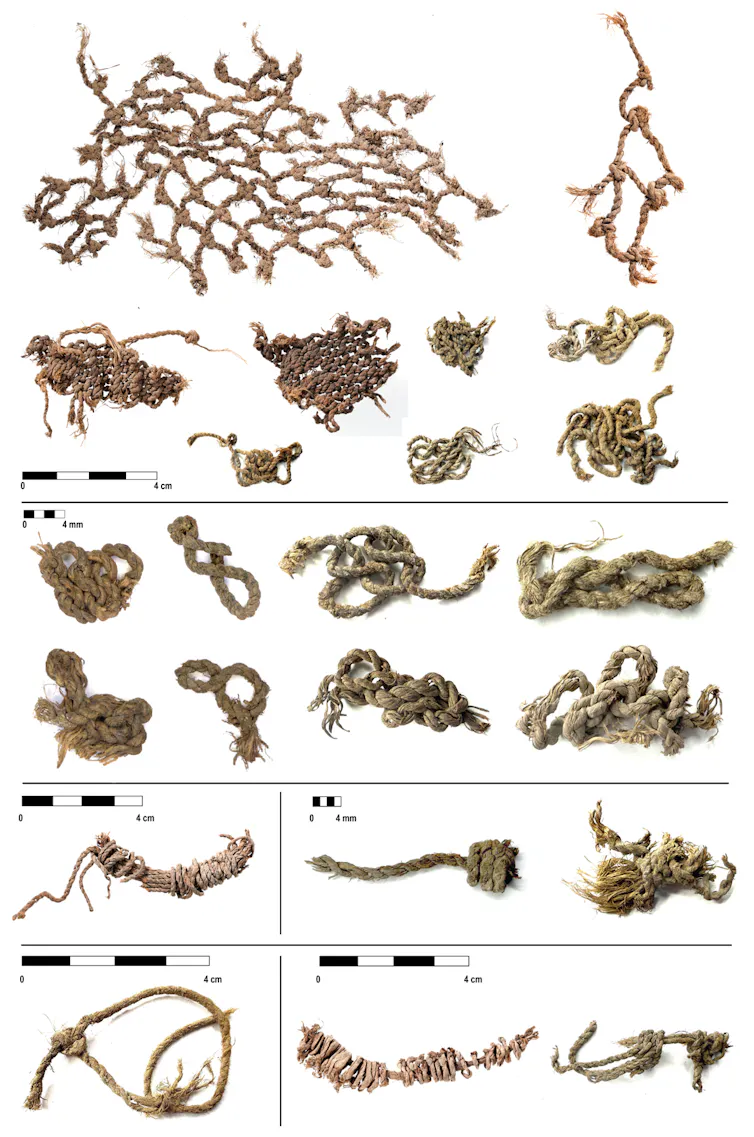
To do this, we compared our archaeological specimens to fibrecraft objects from the same region held in the Queensland Museum.
Such items were typically collected in the late 19th and early 20th centuries, before traditional Aboriginal ways of living were disrupted and cheap, mass-produced consumer goods replaced handcrafted items.
Queensland Museum’s acting Senior Curator of Archaeology, Nicholas Hadnutt (also a coauthor of this research) said:
This project enabled us to leverage the museum’s extensive collections to support Traditional Owners in telling their generations-old stories. In this way we were able to connect ancient artefacts with complete objects collected far more recently.
Many of the pieces of string clearly derive from dillybags, which often combine fibres from different plant species to create coloured stripes without the need for natural dyes. Dillybags were the equivalent of today’s backpacks, used by Aboriginal men, women and children to carry and store items.

Other pieces appear to be fragments of nets. While these were likely used for catching fish in the nearby Laura River, the presence of bird feathers caught up in many of them suggests they may have also been used for netting birds.
Rarer pieces are probably fragments of tassel string belts. Such objects were worn by adult men or women during ceremonies, or as ordinary pubic coverings. Young boys would occasionally also wear string belts as they went through various initiation stages.
Some fragments may be from mourning necklaces, which were traditionally worn by men and women as a part of traditional ceremonies after a death.
The form of the string – as well as the knots, mesh, gauge and loops created from it – changed little over time, showing how this craft was passed down through generations.
Objects from earlier stages of string production were also preserved, such as bundles of bark stripped into different components, which would have later been twisted into string.
These findings have led our team to think of the site as a kind of “string manufacturing” workshop.
Rock art also tells the story
Surprisingly, the walls of Windmill Way also reveal snippets of information about ancient string use. The shelter’s rock surfaces are adorned with vivid painted motifs, some of which show dillybags.
Other pictures depict women wearing tassel string belts, with mourning strings draped across their chests, and headbands decorating their foreheads. These images are typical of the Quinkan style, featuring solid bright-coloured interiors, white outlines and decorative infill.

With large swathes of the remote Cape York Peninsula now preserved in national parks, and potentially destined for World Heritage status, these unique finds from Windmill Way are an excellent example of exactly why this part of Australia deserves to be treasured by all.
Authors: Lynley Wallis, Professor, School of Humanities, Languages and Social Science, Griffith University

















