

A new study shows little kids who count on their fingers do better at maths
- Written by Jennifer Way, Associate Professor in Primary and Early Childhood Mathematics Education, University of Sydney
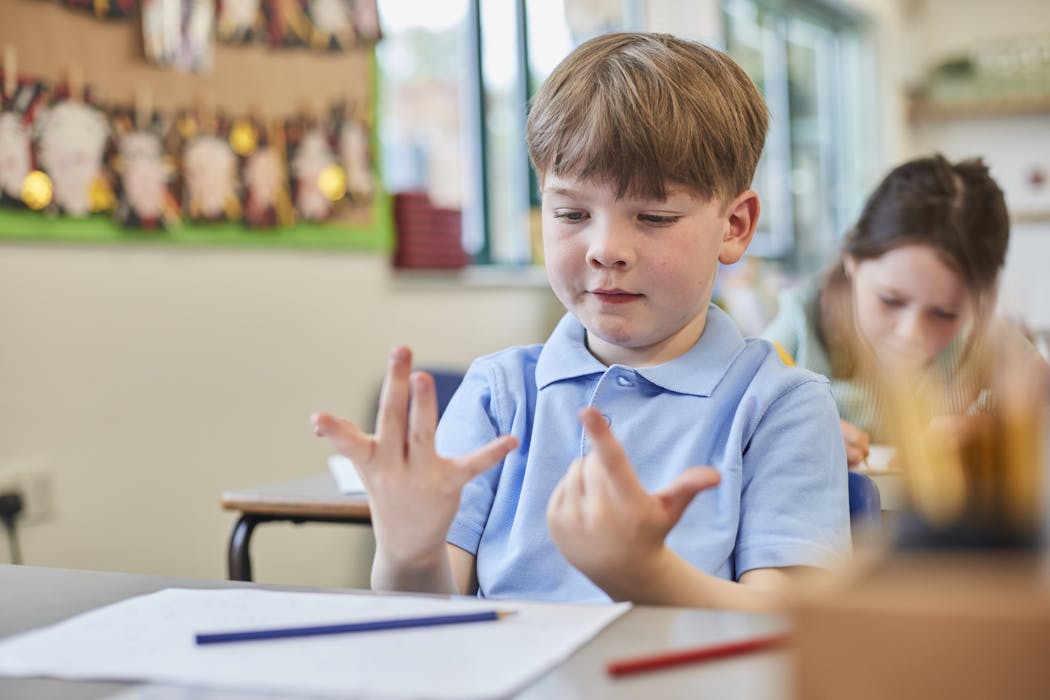
If you ask a small child a simple maths question, such as 4+2, they may count on their fingers to work it out.
Should we encourage young children to do this? This seemingly simple question is surprisingly complex to answer.
Some teachers and parents might say, yes, it seems to help young children learn about numbers. Others might discourage finger counting, arguing it might slow the development of mental strategies.
A new Swiss study, released on Friday, shows kids who use finger counting from a young age perform better at addition than those who do not.
What does the research say?
There is a rich debate among researchers about the value of kids using their fingers to count.
Education psychologists say finger counting helps children think through strategies without overloading their working memory (how our brains hold pieces of information for short time while we work something out), until more abstract strategies are mastered.
Researchers in embodied cognition (learning through actions) argue associating fingers and numbers is “doing what comes naturally” and so, should be encouraged. Neuroscientists might also note similar parts of your brain activate when you move your fingers and think about numbers, which helps memory.
Several previous classroom studies have shown children who use finger strategies to solve maths questions perform better than children who do not, until around seven when the opposite becomes true.
So, before age seven, finger-counters are better. After seven, non-finger-counters are better.
Why does this happen? What does this mean for mathematics education? This has been a point of debate for several years.
A new study followed 200 kids
A new University of Lausane study has taken an important step in settling this debate.
The researchers say previous studies have left us with two possible explanations for the apparent change in the benefits of finger counting at about seven.
One interpretation is finger strategies become inefficient when maths questions become more complex (for example 13 + 9 is harder than 1 + 3), so children who use finger strategies don’t perform as well.
The other possibility is the children who are not using finger strategies at seven (and performing better than those who do) were previously finger-users, who have transitioned to more advanced mental strategies.
To untangle these contrasting explanations, the researchers followed almost 200 children from age 4.5 to 7.5 and assessed their addition skills and finger use every six months.
Notably, they tracked if and when the children started and stopped using their fingers. So, at each assessment point, it was noted whether children were non-finger users, new finger-users (newly started), continuing finger-users, or ex-finger users (had stopped).
What did the study find?
The study found that by 6.5 years most of the non-finger users were indeed ex-finger users. These ex-finger users were also the highest performers in the addition questions and were still improving a year later. The significance of this finding is that in previous studies, these high performing children had only been identified as non-finger users, not as former users of finger-based strategies.
In the new Swiss study, only 12 children never used their fingers over the years, and they were the lowest performing group.
Additionally, the study showed the “late starters” with finger-counting strategies, who were still using finger strategies at the age of 6.5 to 7.5 years, did not perform as well as the ex-finger users.
What does this mean?
The findings from this unique longitudinal study are powerful. It seems reasonable to conclude both teachers and parents should encourage finger counting development from preschool through the first couple of years of school.
However, the Swiss study focused on predominantly white European children from middle to high socioeconomic backgrounds. Would we find such clear outcomes in the average multicultural public school in Australia? We suspect that we might.
Our own 2025 study found a wide variety of finger counting methods in such schools, but when teachers paid attention to the development of finger counting strategies it supported children’s number skills.
What can parents do?
Parents can show preschoolers how they can use their fingers to represent numbers, such as holding up three fingers and saying “three”.
Help them practice counting from one to ten, matching one finger at a time. Once they get started, the rest should come naturally. There is no need to discourage finger counting at any time. Children naturally stop using their fingers when they no longer need them.
Authors: Jennifer Way, Associate Professor in Primary and Early Childhood Mathematics Education, University of Sydney

















