

The politics of black hair: an Australian perspective
- Written by: Kathomi Gatwiri, Lecturer, Southern Cross University
When I was growing up in a village in Kenya, we kept our hair short. Sometimes my grandmother cut it with scissors, other times with a razor blade. “It’s manageable when it’s short,” my grandma insisted. We never questioned why we were not allowed to grow our hair; but at almost every school assembly, we were punished if we had not shaved our heads.
We were told it was to keep us looking tidy. The irony was not lost that our feet — bare, covered in dust after walking to school — were much more “untidy” than our heads ever were.
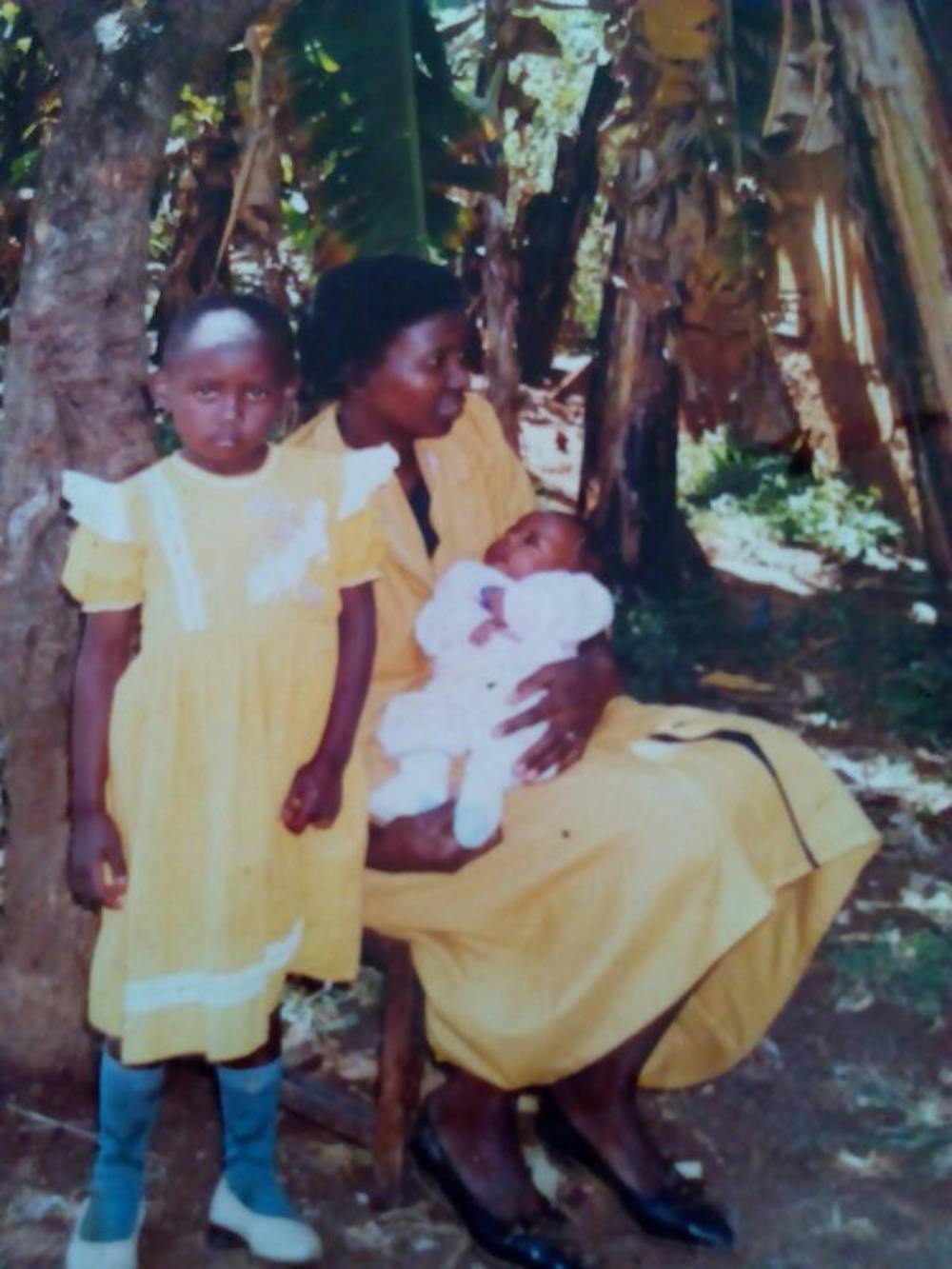 The author as a child.
Author provided
The author as a child.
Author provided
Revisiting that phase of my childhood now with fresh eyes reveals a problematic history. When colonial education started in Kenya, most schools were run by Christian missionaries who constructed a singular narrative about black hair: that it was unsightly, ungodly and untameable. They demanded that girls who attended their “godly” schools cut their hair to the scalp.
Cutting girls’ hair somehow minimised evidence of their womanhood. It was a covert move to reduce their desirability to African men, who were constructed as primal beasts with no sense of sexual control.
Artistic hairstyles were banned or criminalised in school and in church. By enforcing these rules, the missionaries were able to successfully sexualise hair and use it as a tool of control and punishment in a way that Africans had never done. Such historical understandings expose the political significance hair carries.
Hair and Black Panther
The meaning of hair to Africans extends beyond looks and sexuality. For example, in the Maasai community, hairstyles and braid patterns can be a signifier for marital status, class, age and other social roles in the community.
In the Marvel movie Black Panther, natural hair is used as a social identifier that defines characters. The queen and the older women wear elaborate dreadlocks, the warriors are bald and bold.
Nakia, a secret agent and a love interest of the king, wears Bantu knots, an artistic African hairstyle. Shuri, a young tech genius, wears braids, which are popular among younger black women. The film also uses black hair symbolically to show the rejection of both patriarchal and racial expectations shaping the standards of beauty.
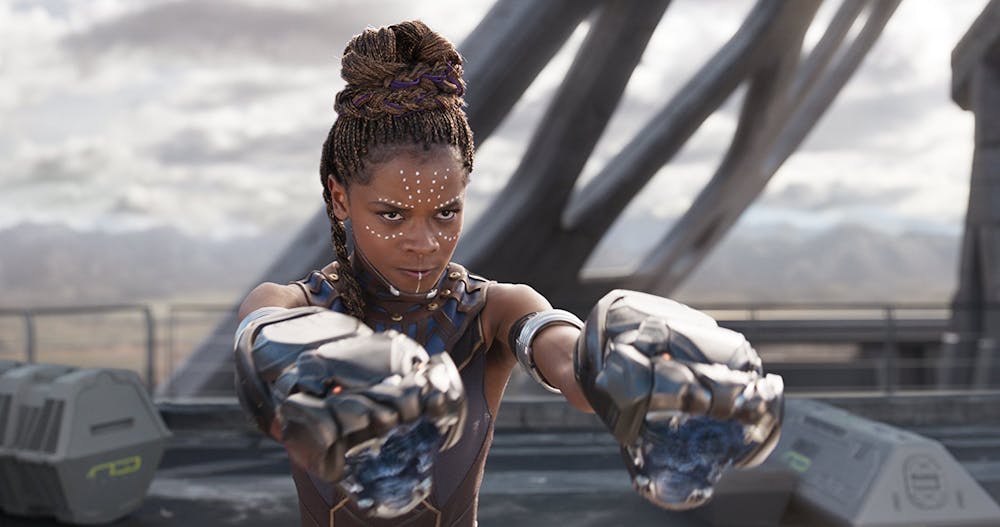 Letitia Wright (Shuri) in Black Panther (2018)
Marvel, Disney.
Letitia Wright (Shuri) in Black Panther (2018)
Marvel, Disney.
In a particularly powerful scene, Okoye, a warrior and army general, rips off her wig and throws it at an adversary during a fight. In doing so, she rejects such accessories, which are often used to soften the blackness of women by hiding their natural hair.
Policing black hair in Australian schools
In Australia, conversations about hair and blackness are coming to the fore. Last year in Melbourne, two Sudanese girls at Bentleigh Secondary College were told to remove their braided hair, as it did not comply with the school’s “strict uniform policy”. After media reports, the school’s principal later offered them an exemption from this policy.
Not long afterwards, it was reported that another student in Mildura was asked to cut his dreadlocks or face expulsion as they did not comply with his school’s uniform policy – which forbids “extreme styles”. These kinds of incidents reveal the need to revise uniform policies and draft new ones that are more conscious of Australia’s growing diversity.
Over the last few years, salons catering solely to black hair have started to emerge in Australian cities, particularly in Sydney and Melbourne. Yet despite the growing presence of black hair in Australia, it continues to be threatening – a symbol of difference – or an object of curiosity.
Black hair is political
Black hair is personal, but it is also political. It shows how black consciousness and identities of race, gender and sexuality are constructed, reinforced and represented. The ’fro is particularly interpreted as a statement of resistance to white supremacism due to its association with the US-based Black Panther political movement.
A simple Google search of “unprofessional hair styles” is dominated by black women‘s kinky and “nappy” hair. A search for “professional hair styles” is populated by white women’s straight hair. Social and cultural messaging about hair and beauty has been clear: to be presentable, attractive, professional, black women need to tame their hair.
In her book Hair Matters: Beauty, Power and Black Women’s consciousness, Ingrid Banks argues that “for Black women, desirable and undesirable hair is measured against white standards of beauty”. To date, black women lament the ongoing hair bias they face during interviews or in the workplace when they wear their hair in its natural form. Policing and prohibiting black hair is a way of enforcing conformity with white beauty standards.
Due in part to these messages and the internalised hatred for their “nappy” hair, black women resort to using harsh chemicals and extreme heat to tame their “unruly” hair. These methods can not only damage hair but also cause physical discomfort and pain. Just like skin-lightening creams, hair-straightening products have overpopulated the market — with companies capitalising on the message that black women are in need of fixing.
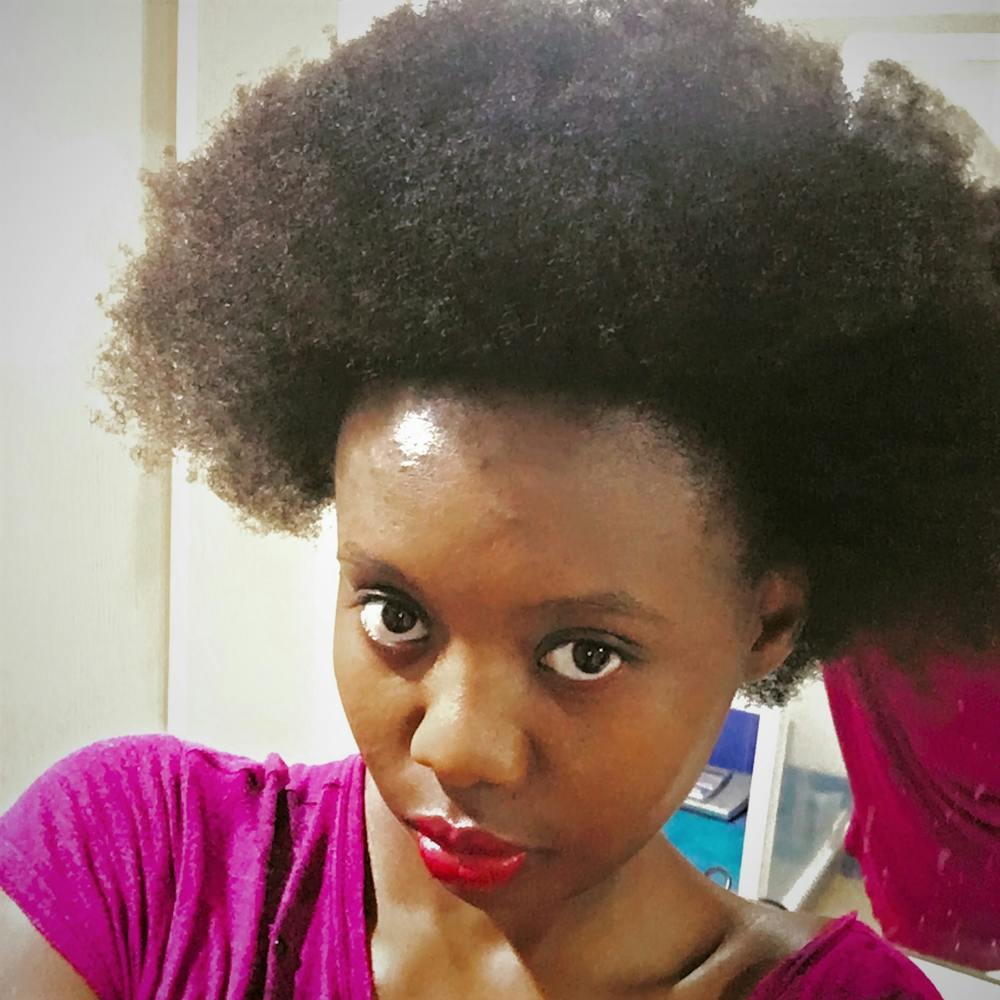 The author with her ’fro today.
Author provided
The author with her ’fro today.
Author provided
Random hair touching
My hair now reflects my developing black consciousness. Two years ago, I cut my chemically straightened hair to the scalp – and for the first time in my life, I allowed it to grow naturally. My different artistic expressions through my hairstyles are now often met with questions and curiosity.
Perhaps the most interesting aspect of growing hair that looks “different” in Australia is learning how to negotiate the constant attention it draws to me – from the unwarranted touch “just to feel my hair” to the unending questions about whether it is “real”.
The random and constant touching of my hair (and by extension my body) reveals how white privilege can function in hair politics. There is almost an unspoken expectation that black hair should be available to the white audience as an object of curiosity through touching and interrogation of its authenticity.
Hopefully, through powerful and positive imagery such as that shown in Black Panther, black hair will stop being interpreted as a threatening symbol or an exotic “mark of difference” – because representation matters.
NB: The author refers to black hair to mean hair of Afro-descent.
Authors: Kathomi Gatwiri, Lecturer, Southern Cross University
Read more http://theconversation.com/the-politics-of-black-hair-an-australian-perspective-93270


















