

Beyond Triple Zero: towards a digital, proactive emergency response
- Written by: Ivano Bongiovanni, Postdoctoral Research Fellow - Adam Smith Business School, University of Glasgow
Imagine you’re camping in the Australian outback. Your friend falls and breaks a leg, and you call Triple Zero (000) – but you’re panicking, and can’t remember which roads you took to the rocky outcrop where the accident took place.
Getting help in this sort of situation may soon be simpler, with Apple recently announcing that the iOS 11.3 update (available in coming months) will support Advanced Mobile Location technology (AML). With AML, when an emergency call is made from a mobile phone, the location of the caller is automatically sent to the emergency communication operator.
But one vital step is missing for this to work in Australia. AML also has to be supported by the operator that manages the emergency communication service in that country. At the moment, this happens only in United Kingdom, Estonia, Lithuania, Austria, Iceland, Belgium, Ireland, Finland and New Zealand.
Read more: Snakebites are rarer than you think, but if you collapse, CPR can save your life
In June 2017, the Australian government announced that a request for tender will be issued to deliver a new Triple Zero (000) service (Telstra has been the service provider since 1961).
This new service will need to support location-based data, with AML indicated as the preferred solution. Further, the government indicated that the new service will need to be flexible enough to support alternative technologies in the future.
The timing of the tender process is currently not clear. Still, Apple’s announcement means that the majority of mobile phones around the world will have AML by default – news welcomed with enthusiasm by emergency communication professionals.
Close to 100% of Android phone users already have a similar setup, with AML capability automatically incorporated from July 2016 (from their Gingerbread version onwards). Android’s AML is called Emergency Location Service, or ELS.
Emergencies in Australia
Research by the Australian Communications and Media Authority shows that in Australia in 2017, around 70% of emergency calls came from mobile phones, with 14% of Australians making at least one call to Triple Zero (000) between January and June 2017.
To dispatch the appropriate emergency services (Police, Fire or Ambulance), the emergency operator has to know the caller’s location with an appropriate level of accuracy.
This can be problematic, especially in a situation of extreme distress, and when the caller is unfamiliar with their surroundings – for example, in a remote area or where a street number is not immediately visible.
Read more: Seven ways to protect your pets in an emergency
To tackle this issue, in 2015 the Push Mobile Location Identification (Push MoLI) was introduced in Australia. This system identifies the caller’s location based on the proximity to telecommunications cellular towers and automatically sends it to the operator.
However, the Push MoLI only provides an area within which the caller is located. The accuracy of location largely depends on the proximity to, and the number of, nearby cell towers. In remote regions, such area can have a radius of up to 100 kilometres.
To address such issues, in 2014 Australia’s Triple Zero Awareness Group launched Emergency+. Once downloaded, the app uses a mobile phone’s internal GPS to calculate latitude and longitude and show them on the screen. When prompted, the emergency caller can read their coordinates to the operator. Emergency+ has already exceeded 1 million downloads.
Examples of Emergency+‘s effectiveness are reported in the media.
Nonetheless, some limitations have been highlighted. As of June 2017, 15.45 million Australian adults owned a smartphone, which indicates that, at best, not more than 6.5% of them have the app.
Also, the process of reading one’s latitude and longitude introduces chances of human error, either by the caller or the operator. Further, some users may be unfamiliar with spelling their coordinates from a mobile app (e.g. the elderly). AML is intended to address these issues.
The future of emergency communication
The future of emergency communication is expected to be digital-friendly, flexible and diversified.
We can already see public acknowledgement of the growing importance of digital technologies for emergency communications. In the UK, the Merseyside Police has recently launched an initiative for citizens to report non-urgent crimes through social media.
However, it has been pointed out that social media should not be considered a replacement for more traditional (and sometimes reliable) forms of communication.
Read more: The role of social media as cyclones batter Australia
The National Emergency Communication Working Group - Australia and New Zealand (NECWG-A/NZ) consists of Australia and New Zealand representatives from emergency service organisations, public safety organisations, emergency call persons (the initial triage points for emergency callers, currently Telstra in Australia and Spark in New Zealand) and carrier representatives.
In 2014, NECWG-A/NZ produced the Next Generation Triple Zero Strategy (NG000). This document describes a vision for a Next Generation Emergency Call Service enabling:
(…) any person requiring emergency assistance to use any device anywhere anytime to connect to emergency services.
The vision consists of a multichannel approach, with inter-operable systems (allowing the different emergency agencies to be connected upon a single request) and that enables digital technologies.
Being proactive rather than reactive is another focus for future Triple Zero (000) and emergency communications. This idea was described in a recent report from NECWG-A/NZ working with the Chair in Digital Economy at QUT and Pricewaterhouse Coopers.
The emergency communication centre envisaged in this report uses data coming in from different sources (calls, videos, SMS, social media, sensors, etc.) and converts them into information used to prepare for, and possibly prevent, future emergencies. It has a constant presence of staff members from different emergency service and public safety organisations, with profiles ranging from data analysts to robotics experts and more.
NECWG-A/NZ is currently working on a roadmap to guide future development across three key aspects of emergency management: response, preparedness, and prevention.
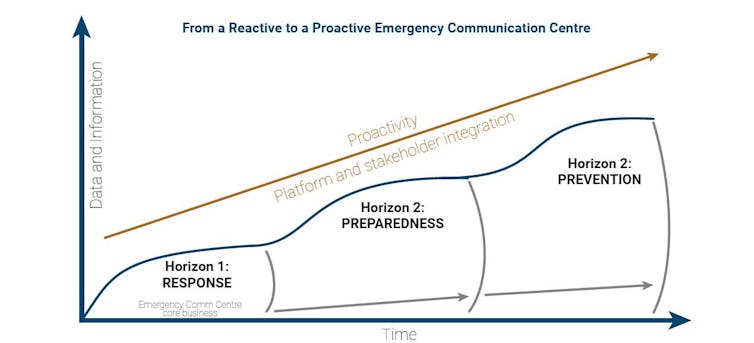 Building a proactive emergency communication centre.
Authors
Building a proactive emergency communication centre.
Authors
The Triple Zero (000) emergency service has saved the lives of many Australians. With the advent of digital technologies, it is now ready for its “Next Generation”. AML is the next step to accomplish. Beyond, lie numerous possibilities for a proactive emergency communication centre.
The author would like to recognise a significant contribution to this article from Chris Beatson, Director, PoliceLink Command, NSW Police Force.
Authors: Ivano Bongiovanni, Postdoctoral Research Fellow - Adam Smith Business School, University of Glasgow
Read more http://theconversation.com/beyond-triple-zero-towards-a-digital-proactive-emergency-response-92264


















