

100 years on, T.S. Eliot’s The Hollow Men is a poem for our populist moment
- Written by Luke Johnson, Senior Lecturer in Creative Writing, University of Wollongong
In 1927, at 38 years of age, the expatriated American poet T.S. Eliot was baptised and confirmed in the Anglo-Catholic tradition. The celebrated author of The Waste Land (1922) – that literary paragon of abject nihilism – had pivoted away from the liberal, philosophical underpinnings of his upbringing and education, the urbane prejudices of his peers, and the near-blasphemous despondency of his marriage, to become a man of faith.
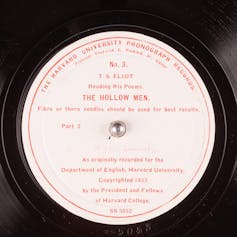
Eliot’s change of heart and mind did not happen overnight, nor without warning. Published 100 years ago, his 1925 poem The Hollow Men provides something of a bridge between the wastelands of 1922 and the spiritual rebirth of 1927.
Alternating between the choral “we” and the more personal “I”, The Hollow Men is by turns outward-facing and inward-facing. It is diagnostic and symptomatic, accusatory and culpable, communal and personal. It is a poem about that which ails society at large, and about that which gnaws at the soul of the poet.
The Hollow Men both precipitated and explains Eliot’s rather unfashionable turn toward religion in a climate of vehement intellectualism. It is a shift that anybody interested in, say, the rise of religious nationalism or the backlash against elitism in the current moment might just find noteworthy.
Intellectual and spiritual paralysis
The Hollow Men begins with a pair of epigraphs. The first is taken from Joseph Conrad’s slender novel, Heart of Darkness: “Mistah Kurtz – he dead.” The second makes reference to Guy Fawkes.
The figures of Kurtz and Fawkes – as well as Shakespeare’s Brutus, from whose mouth the phrase “hollow men” is directly taken – are keys to understanding many of the impulses and themes driving not only the poem but the mindset that shaped it. Eliot was in a very dark place when he wrote The Hollow Men – in his own words, “the blackest moment in my life”. Think of Kurtz up the Congo River, Fawkes stocking the parliamentary cellars with gunpowder, Brutus mulling over his decision to partake in the assassination of Julius Caesar.
The source of his despair was the spiritual paralysis and cultural decay that he had come to associate, through personal experience, with the the intellectualism of the modern era.
Eliot studied at Harvard and Oxford, completing his dissertation on the idealist philosophy of F.H. Bradley in 1916. But he was never awarded his doctorate from Harvard because he did not show up to defend it.
The simple explanation for this was that he was not in North America to do so; he was living in Europe by this stage. Given the direction he was heading, however, a different explanation might well be put forward: Eliot had lost the strength of his earlier convictions and was in no mood to put on a show of defending what he would ultimately come to view as indefensible. In a letter to his mother from 1929, he wrote:
I am sure that I should have made a very poor professor of Philosophy, because, after my first enthusiasm, I found modern philosophy to be nothing more than a logomachy [an argument about words], believed in by its professors, chiefly because they had to make their living out of it.
Rise of the hallowed men
At a recent event hosted by the conservative think tank, American Compass, the organisation’s founder Oren Cass introduced Vice President J.D. Vance with the following comments:
I am thrilled to have this opportunity to talk with you and so grateful that the work you’re doing and, in a sense, so in awe of it because there are politicians out there who are – they’ve just been politicians. But you are someone who was an intellectual first.
Some people don’t like the word “intellectual”. But I mean it in the good sense of the term. You were writing for National Review. You were at the bar late at night arguing about and helping shape these ideas that you are now …
It was at this point that Vance interrupted Cass and, with an admittedly satirical inflection, said:
I come here for free and you insult me. And you call me an intellectual. Remind me that I wrote for National Review. What an asshole this guy is!
The audience cheered approvingly.
National Review was founded in 1955 by conservative intellectual William F. Buckley and is very much associated with the American right. Vance’s performative umbrage was not that of a conservative being reminded about his liberal college days, or even a MAGA loyalist being reminded about his tamer conservative days; it was that of a populist being reminded about his overtly cerebral days.
For the man who converted to Catholicism in 2019, two years before openly embracing the Trumpism he had once derided, the word to feign embarrassment over was “intellectual”.
Populism is on the rise, as it was in 1925. Mussolini was ruling over Italy. The Weimar Republic of Germany was faltering and providing opportunity for a strongman figure to sweep in seize control. In Spain, the dictator Primo de Rivera was still in power following the military coup of 1923, despite having originally proclaimed that he would only hold the position for 90 days.

The enigma of populism today, as then, is not that it should appeal to the apolitical masses in times of upheaval (it offers simple solutions to complex problems – what’s not to like!), but rather that it should appeal to an engaged political intellect like Vance.
It is drawing too long a bow to characterise Eliot as a populist. Politically, he was critical of all the competing ideologies of his time, including fascism, communism and liberalism. Instead, he would come to advocate a form of government grounded in Christian principles and practices.
Eliot’s conversion was not epiphanic – he was still grappling with a tendency toward disbelief in his 1930 poem Ash Wednesday. But he was decidedly less uncertain about the dead end that he perceived in secularism, liberalism and specious intellectualism.
In his 1934 book After Strange Gods: A Primer of Modern Heresy, Eliot wrote:
The number of people in possession of any criteria for discriminating between good and evil is very small; the number of the half-alive hungry for any form of spiritual experience […] is considerable. My own generation has not served them very well. Never has the printing-press been so busy, and never have such varieties of buncombe and false doctrine come from it.
Sentiments of this variety are shared by leading figures in today’s Christian nationalist movement in the US. In a recent appearance on the Making Sense podcast, American theologian and pastor Doug Wilson, who counts United States Secretary of War Pete Hegseth among his flock, defined Christian nationalism as “the conviction that secularism is a failed project”.
Wilson sees the growing movement as a response and remedy to the “liberal, secular, democratic heyday” of the 1960s, which led to today’s “dregs-level […] basement-level […] low-trust society”.
Like more extreme forms of religious fanaticism, the discourse of political populism is rife with incendiary appeal. It is a language of action and empowerment, and it tends to oppose secular liberalism, which it views as weak and corrosive.
One does not need to dig very deep to find historical examples. In The Doctrine of Fascism, Mussolini states: “The right to national independence [arises] from an active, self-conscious, political will expressing itself in action and ready to prove its rights.”
Similar passages can be found in Hitler’s Mein Kampf: “He who would live must fight. He who does not wish to fight in this world, where permanent struggle is the law of life, has not the right to exist.”
Eighty years from the end of World War II, we know what such invocations look like when they are followed to their natural conclusions.
Yet consider these remarks by William Wolfe, a senior official in the first Trump administration, who said as recently as 2023 that the time to take up arms is “getting close”:
Even though as Christians we seek peace, when the enemy is pressed upon us, if we fail to heed the call to arms, then we are acting as cowards.
Or remarks made by current US Homeland Security Advisor Stephen Miller at the memorial service of Christian nationalist “martyr” Charlie Kirk in September of this year: “You have no idea the dragon you have awakened.”
Populist poetics
This brings us to the opening stanza of The Hollow Men, where Eliot presents aspiring religio-nationalist torchbearers with an effigy of liberal secularism, ready for immolation.
We are the hollow menWe are the stuffed menLeaning togetherHeadpiece filled with straw. Alas!Our dried voices, whenWe whisper togetherAre quiet and meaninglessAs wind in dry grassOr rat’s feet over broken glassIn our dry cellar
Shape without form, shade without colour,Paralysed force, gesture without motion;
Those who have crossedWith direct eyes, to death’s other KingdomRemember us – if at all – not as lostViolent souls, but onlyAs the hollow menThe stuffed men.
The scene is reminiscent of the “desolate plain lying between Hell’s portal and the river Acheron” in Dante’s Divine Comedy. When Dante asks his guide why the souls here lament so bitterly, he is told that it is because they were, while on earth, neither spiritually alive nor spiritually dead, neither good nor evil.
As such, they are forbidden from entering Hell proper. They are damned to an eternity of ineffectual fence-sitting, so to speak. Eliot ratifies the assignation elsewhere, when he determines: “So far as we are human […] it is better, in a paradoxical way, to do evil than to do nothing: at least, we exist.”

Dante’s comedy is commonly thought of as a religious poem, one of the great examples of medieval Christian art, which it undoubtedly is. But it is also, like The Hollow Men, a stridently political poem. Dante, who wrote it in exile from his native Florence, proves that no one holds a grudge quite like a poet. He constructs a metaphysics of revenge that would make a summoner-of-dragons like Stephen Miller blush with embarrassment.
But the Divine Comedy is political in other ways too. The poem is composed in Florentine dialect, Dante’s native tongue, as opposed to Latin, the language of serious literature and scholarship. It is a lyrical middle finger in the face of medieval elitism: a poem for the people in the language of the people.
Eliot offers a similar gesture in The Hollow Men, where he appropriates children’s nursery rhymes to suggest that the antidote to existential despair might just as well take the form of puerile disregard as philosophical postulation:
Here we go round the prickly pearPrickly pear prickly pearHere we go round the prickly pearAt five o’clock in the morning.
The rhetorical manner calls to mind a certain president’s schoolyard approach to domestic and international diplomacy via Truth Social. There is, however, something dark and serious lurking beneath this childish veneer. The Hollow Men ends with what have been called the four most quoted lines in 20th century poetry:
This is the way the world endsThis is the way the world endsThis is the way the world endsNot with a bang but a whimper.
Critics have tended to read this passage as dismally prognostic, which I think is misguided. Given that we know the turn Eliot’s life would take shortly afterwards, it strikes me as more of a rallying cry. These are the words of someone willing himself to action.
“This is the way the world ends” isn’t so much a prophecy as a provocation. It says, this is how worlds end: through dispirited apathy, and if you don’t want that to happen, then you’d better pull yourself up by your bootstraps and do something about it. Far better to go out with a bang than a whimper: a painfully prescient sentiment given the war that, in 1925, was still to come.
Plain and simple
The passage in Shakespeare’s Julius Caesar from which Eliot takes his title reads:
There are no tricks in plain and simple faith.But hollow men, like horses hot at hand,Make gallant show and promise of their mettle.
By comparing the “hollow men” to show horses, who “like deceitful jades, / sink in the trial”, Brutus decries those who compensate for a lack of spirit with lofty diction, who disguise their fear of truth with sophistry, and who rely on tricks where “plain and simple faith” sets the gold standard.
There is little doubt that Eliot has a younger version of himself in mind when he deploys the epithet. On this front, The Hollow Men is reactionary and confessional. It reinforces the adage that there is no zeal like the zeal of the convert.
To close a loop and bring us back into the 21st century, this again calls to mind the aforementioned vice-president. In a 2020 essay titled How I Joined the Resistance, Vance charted his own Eliot-like conversion to Catholicism, disavowing his former worldview with accusations of intellectual and emotional arrogance. “Much of my new atheism,” he writes of his pre-converted self, “came down to a desire for social acceptance among American elites.”
He follows this renunciation with a quote from Saint Augustine, whose excoriation of Roman hedonism is “the best criticism of our modern age” Vance claims to have ever read.
The point here is not merely to draw parallels between historical examples of anti-elitist sentiment and contemporary ones, but to acknowledge the enduring potency of its spiritually-infused language and reactionary disposition – its poetics, if you will.
The Hollow Men disregarded many of the liberal shibboleths of its time. In doing so, it communed with a populist, religio-nationalist mindset that was beginning to establish a foothold. One hundred years on, it is a poem that feels very much of our time.
Authors: Luke Johnson, Senior Lecturer in Creative Writing, University of Wollongong


















.jpg)
