

How tree bonds can help preserve the urban forest
- Written by: Joe Hurley, Senior Lecturer, Sustainability and Urban Planning, RMIT University
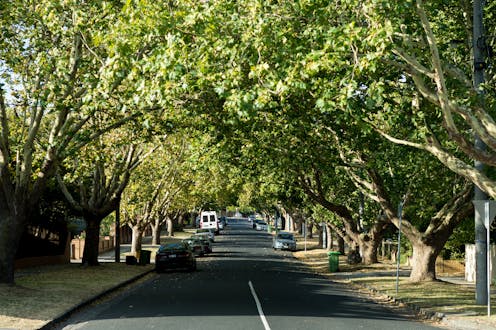
Great cities need trees to be great places, but urban changes put pressure on the existing trees as cities develop. As a result, our rapidly growing cities are losing trees at a worrying rate. So how can we grow our cities and save our city trees?
Tree bonds have recently been proposed by Stonnington City Council as a way to stop trees being destroyed in Melbourne’s affluent southeastern suburbs.
Tree bonds are a common mechanism for protecting trees on public land, but have so far had limited use on private land. A tree bond requires a land developer to deposit a certain amount of money with the local authority during development. If the identified tree or trees are not present and healthy after the development, the funds are forfeited.
The size of the bond can be established based on estimated tree replacement costs, and/or set at a level that is likely to achieve compliance (likely to be thousands or tens of thousands of dollars).
Why are trees important in cities?
The concept of an “urban forest” includes all the trees and plants in cities. This includes tree-lined city streets as well as parks, waterways and private gardens. The urban forest contributes substantially to the quality of life of all urban dwellers, both human and non-human, and is increasingly used to adapt cities to climate change.
Read more: Does higher-density city development leave urban forests out on a limb?
Trees cool the streets, filter the air and stormwater, and create a sense of place and character. They provide food and shelter for insects, birds and animals.
There is growing research evidence for the physical, mental and social health benefits of urban trees and green spaces. Many local councils such as Brimbank and Melbourne are investing substantially in tree planting to increase these benefits.
However, despite new tree planting on public land, tree canopy on private land is declining.
What can we do to protect trees?
There are a range of existing policy and land use planning measures focused on landscaping requirements for new development. Recently, the Victorian government introduced minimum mandatory garden area requirements. Some Melbourne councils, including Brimbank and Moreland, have also included planning scheme requirements for tree planting for multi-dwelling developments.
Other mechanisms for protecting urban trees on private land include heritage and environmental overlays within local planning schemes, and listings of significant trees and heritage trees.
However, penalties, monitoring and enforcement of tree protection bylaws have not kept pace with the pressures of urban change.
If penalties are insignificant relative to development profits, developers can easily absorb the costs. If monitoring is weak and removal has a good chance of going undetected, tree protection is more likely to be ignored. And if enforcement is weak, or there is a history of successful appeal or defeat of enforcement, many trees may be at risk of removal.
Even when it is successfully pursued, after-the-fact planning enforcement action is a particularly unsatisfactory recourse for tree removal. Replacement trees may take decades to match the quality of mature trees that were removed. What is needed, then, are mechanisms that prevent tree removal in the first place.
Increasing use of tree bonds
The advantage of tree bonds is that they place the onus of proof of retention on developers, rather than the onus of proof of removal on local councils. If a tree is removed, the mechanism is already in place to monitor (the developer needs to demonstrate the tree is still there) and penalise (the financial penalty is already with the enforcing body).
Read more: Concrete jungle? We'll have to do more than plant trees to bring wildlife back to our cities
However, tree bonds still do not guarantee tree protection. Some mechanisms used to impose tree bonds may be vulnerable to challenge. For example, historically in Victoria, the planning appeals body VCAT has struck out conditions imposing tree bonds, arguing that punitive planning enforcement measures should be used where trees are removed.
Even where bonds can be imposed and enforced, developers may still be able to demonstrate that trees are unsafe or causing infrastructure damage, and thus need to be removed. In these circumstances, it is often hard to prove otherwise once the tree has been removed.
Nurturing an urban forest
Ultimately, if a landowner is hostile to a tree on their land, that tree’s health and survival can be imperilled, whether through illegal removal, neglect, or applications for removal based on health and safety grounds. It is therefore important that building layout and design realistically allow space for trees to flourish and be valued by landowners.
The urban forest needs protecting and enhancing. This calls for a range of policy mechanisms that work together to retain mature trees, maintain adequate spacing around them, and encourage residents to value and protect the trees around their homes.
Tree bonds provide an attractive solution for local governments in the absence of a strong land use policy framework for protecting trees.
Authors: Joe Hurley, Senior Lecturer, Sustainability and Urban Planning, RMIT University
Read more http://theconversation.com/how-tree-bonds-can-help-preserve-the-urban-forest-93420


















