

Modern Australian
The Times

The tiny clue that reveals if an animal has been illegally smuggled

  • Written by Ricky Spencer, Professor, Western Sydney University

If someone mentions criminal gangs, you might think of drug trafficking or financial crime. But one of the most persistent illegal trades in the world flies largely under the radar: wildlife smuggling.

The illegal wildlife trade drains plants and animals from their ecosystems and fuels organised crime. Australia is now considered a global hotspot for reptile smuggling. Enforcement agencies scramble to answer the most basic question — has an animal been taken from the wild? In courtrooms, that question often determines whether a prosecution succeeds or falls apart.

Our latest research suggests there might be a way to determine where an animal came from with scientific confidence. By examining the chemical traces inside a turtle’s claw, we can tell whether the animal grew up in the wild or in captivity. The claw is a small piece of tissue, but it carries an environmental signature that’s surprisingly difficult to fake. And this is potentially transformative for smuggling law enforcement.
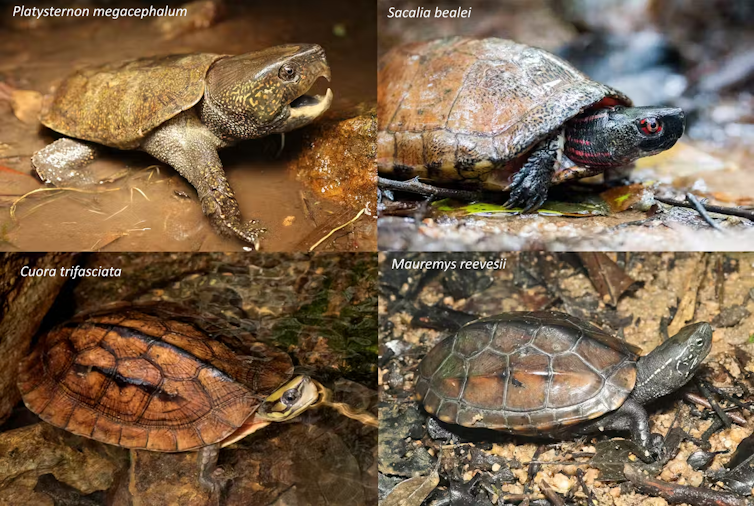
The tiny clue that reveals if an animal has been illegally smuggled
Four endangered turtle species from Asia — their claws could reveal the true origins of traded animals. Author supplied, CC BY-ND

A claw is a chemical diary

Stable isotope analysis is a technique used across fields as varied as archaeology, climate science and forensic anthropology.

It allows us to measure the ratios of different isotopes (atoms with the same number of protons but different numbers of neutrons) in bones or teeth. Using scientific knowledge about how these isotopes occur in nature, we can trace them to their source. Animals absorb those chemical markers through what they eat and drink.

Keratin — the material that forms hair, nails, feathers and claws — preserves this chemical history especially well. Because it grows slowly, it records the conditions an animal has lived in over many months. For turtles, claws are an ideal window into their past. This technique could be used in other animals too.

Wild turtles forage widely, eating insects, plants and crustaceans. They move through landscapes like wetlands and billabongs, which have their own chemical imprint. In comparison, captive turtles are generally fed a narrow diet of pellets or farmed fish, and drink treated water. Those differences show up in the isotopes of carbon, nitrogen, hydrogen and other elements in their claw keratin.

so for other animals could we use their claws too?

The tiny clue that reveals if an animal has been illegally smuggled
When the chemical signatures are plotted on a graph, captive (blue) and wild turtles fall into clearly separated groups — a pattern strong enough to classify an animal’s origin from a single claw trimming. Author supplied, CC BY-ND

Admissible in court?

Any forensic method has to be reliable. Courts expect a sound scientific method, reproducible results, and a clear chain of custody — proof that the sample tested is the same one taken from the seized turtle.

Stable isotope analysis already meets the first two requirements. It’s a mature field grounded in decades of peer-reviewed research. The equipment used — isotope-ratio mass spectrometers — is standard in many research and forensic labs. Our testing methods have been documented in detail so the test can be reproduced anywhere the right equipment exists.

The legal side is equally important. A claw trimming is easy for wildlife officers to collect, label and preserve without harming the animal. In a courtroom, isotope results could sit alongside DNA evidence, seizure records and expert testimony, providing a clearer picture of where an animal actually came from.

A close up shot of a turtle's claw
Ricky Spencer, CC BY-ND A problem for Australia Australians tend to think of wildlife trafficking as something that happens elsewhere — African ivory, South-East Asian pangolins, South American parrots. But Australia is now considered a global hotspot for reptile smuggling. Official data show the number of live animals seized by the Australian government has tripled since 2017. And researchers emphasise that seizure records capture only a small fraction of the real trade. Global analyses suggest seizures may represent less than 10% of all illegal wildlife trafficking, meaning most animals smuggled from Australia are never detected at the border. Australian reptiles – including freshwater turtles – are highly sought in the international pet trade. A recent analysis found 170 Australian reptile and amphibian species for sale overseas, particularly in Asian markets. Australian authorities note native reptiles are highly prized in the Hong Kong illicit pet trade, and attract far higher prices than locally. The tiny clue that reveals if an animal has been illegally smuggled
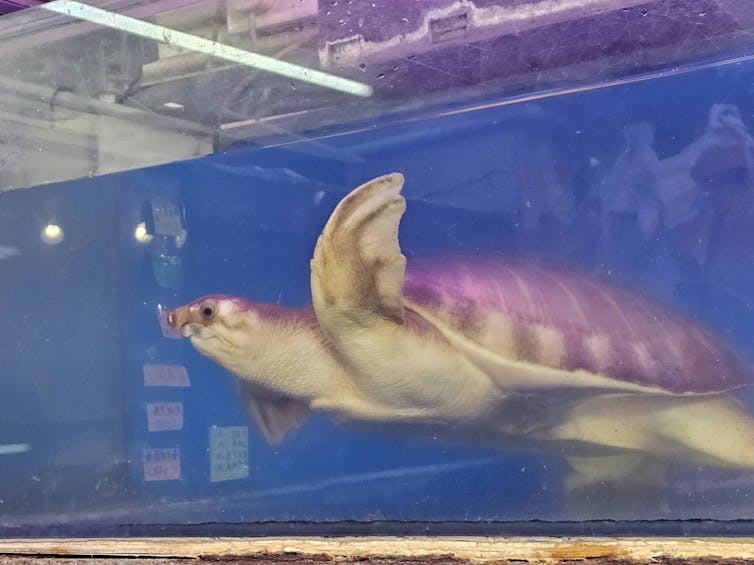
A large adult pig-nose turtle in poor conditions in a Hong Kong pet store. Ricky Spencer, CC BY-ND

Prosecutions are rare

Hong Kong is a major destination and transit hub for smuggled wildlife. One case involved 658 pig-nosed turtle hatchlings (a species native to northern Australia and New Guinea) worth about HK$500,000 (A$100,000) seized from a traveller’s luggage.

Despite this, prosecutions in Australia are rare. Globally, smugglers often insist their animals were legally bred — a claim that is almost impossible to challenge without scientific evidence. This is precisely the gap isotope forensics can fill. A claw sample that reveals a wild origin undermines the “captive-bred” defence and gives prosecutors a stronger case.

This matters for another reason. Australia invests heavily in turtle conservation, such as nest protection, wetland restoration and community science networks like 1 Million Turtles. When breeding adults are poached from rehabilitated habitats, these efforts are undermined. A tool that can trace animals back to the wild strengthens enforcement and conservation.

Where to next?

Australia’s laws are strong, and permits are required for any movement of native reptiles. The problem is proving origin once animals leave the country. A stable-isotope database would let authorities overseas show that animals sold as “captive-bred” were actually removed from Australian environments. Funding could come from the federal environment portfolio, ideally in partnership with forensic laboratories and academic institutions that already have the equipment.

What has been missing is the link between field ecology and courtroom evidence. A turtle’s claw, it turns out, may provide this. In a trade that has depended on secrecy and false paperwork, a chemical signature that cannot easily be altered may give authorities a fighting chance.

Wildlife crime is notoriously difficult to prove. For species that take decades to reach maturity, losing even a few adults to illegal trade can erase years of conservation gains. But a technique that reveals an animal’s true provenance has the potential to reshape enforcement in Australia and beyond.

Authors: Ricky Spencer, Professor, Western Sydney University

Read more https://theconversation.com/the-tiny-clue-that-reveals-if-an-animal-has-been-illegally-smuggled-269818

Bottle Label Printing: Key Factors to Consider Before Your Next Packaging Run

Effective packaging begins with understanding the product, bottle material, artwork and production requirements when planning bottle label printing. H...

Planning a Long-Distance Move With Interstate Movers Melbourne

Moving between states involves more planning than a typical local relocation. Along with packing and transporting household belongings, you need to...

Understanding the Role of an I/O Controller in Industrial Automation

Modern industrial systems depend on accurate communication between sensors, machines and control systems. An I/O controller can help manage this commu...

How the Right Mining Hose Supports Demanding Operations

Mining environments place considerable demands on equipment used for material transfer, water management and processing. Hoses operating in these co...

Simple Ideas for Making Social Gatherings More Memorable

We have all been to those parties where everyone just stands around the kitchen island, staring at their phones, waiting for someone else to make a mo...

Outdoor Wall Lights: Improving Exterior Lighting Around Your Home

Lighting can influence how a room looks, feels and functions, so the right fitting should be selected according to both appearance and practical req...

Commercial Office Cleaning: Combining Routine Office Cleaning With Melbourne Service

Keeping a workplace clean requires a service that can accommodate everyday tasks as well as the particular needs of the business. Professional comme...

Caravan Sales in Queensland: How to Find the Right Caravan for Sale QLD

Caravan ownership is about more than having somewhere to sleep while travelling. For many Queenslanders, it is one of the best ways to explore regio...

What Sir Walter Buffalo Turf Actually Costs in 2026 (And Why Quotes Vary So Much)

Two quotes landed on a Hills District homeowner's kitchen table last spring for the exact same 80-square-metre backyard. One said $12 a metre. The o...

Nearly 1,300 NSW Hospital Beds Are Occupied By People Who Are Ready To Go Home

1,276 people in NSW hospitals have been medically cleared for discharge but remain in hospital because they're still waiting for NDIS or aged care sup...

National Survey Launched to Measure Operational Impacts of Federal NDIS Policy Reforms

The effects of recent NDIS reforms are beginning to move beyond policy papers and into day to day service delivery. A new national survey is asking ...

Beyond the Nappy Cake: Baby Shower Gifts That Get Used

What new Australian parents unwrap, keep, and quietly thank you for months later. Six weeks after my daughter was born, I did an audit of the baby sh...

Parent-Advocates Are Reshaping Frontline Disability Service Delivery

Parents have always been part of the disability sector. They advocate, coordinate services, challenge decisions and often become the person holding ev...

Vista Cruises Enters "Two-Flagship Era" as Vista Aurora Completes Inaugural Voyage

Vista Aurora Sets Sail along the Yangtze. (Photo courtesy of the company)YICHANG, China — August 5, 2026 — Vista Aurora, a high-end interprovinc...

A Digital Preparation Checklist For International Medical Conferences

An international medical conference compresses many responsibilities into a few days. A delegate may need to present research, move between venues, ...

The Growing Popularity of Lab Grown Diamonds in Sydney and Hong Kong

The diamond industry has changed significantly in recent years as more buyers seek ethical, affordable, and sustainable alternatives to mined diamon...

Modern AI SEO Agency vs Traditional SEO: What’s the Difference

Search engine optimisation has changed dramatically over the past few years. Search engines have become smarter, user behaviour has evolved, and bus...

Caravan Travel for Modern Australian Getaways: Plan a Comfortable Holiday

A family road trip is one of the best ways to explore Australia together. And, travelling by caravan gives you the freedom to take your time, stop a...
















