

What does a 'Leb' look like?
- Written by: Sherene Idriss, Research associate, Western Sydney University
In 2012, I was interviewing a young man, Hamid*, as part of my research on the creative vocational aspirations of Lebanese-Australian young men. I asked him whether he had anything else to add, the usual courtesy given by researchers to interviewees. He paused, then said:
Well, your study is about creative identities and Lebanese young men, right? But the thing is you can’t be a Leb and be creative – it doesn’t make sense.
The interview was clearly not over.
In what followed, Hamid explained to me in great detail the defining stylistic elements of a “Leb”:
They wear Nike TNs and Dry Fit [shirts] … They walk around in their wannabe gangs and piss on everyone else, go to the gym, listen to Tupac or gangsta rap – that kind of thing.
A very similar image emerged when I asked the question, “What does a Leb look like?”, of the rest of my 20 informants, interviewed between 2011 and 2014. One young man said:
It’s not about being Lebanese; like me for example, I am Lebanese but I’m not a Leb. I have respect for people and I don’t walk around like I’m about to smash shit and graffiti the school.
The “Leb” embodies a type of hyper-masculinity that the young men in my study rejected entirely. One of the goals in my research was to uncover why this was the case and how ideas about masculinity can constrain aspirations.
Wassim*, an avid fan of Parkour, said all the Lebs at his school mocked him for riding his skateboard to school. “I hated the Lebs,” he said, without any concern that he might be mistaken for one – despite having been born and raised in a Lebanese migrant family.
In the public high schools in southwest Sydney, Leb style and attitude were dominant among the male students in the late 1990s and 2000s, giving them a certain sense of power in a society that consistently treated them as a source of moral panic.
In the book based on my research, Young Migrant Identities, I detail how every young Lebanese-Australian man I interviewed called himself a “non-Leb” at varying life stages. They had creative vocational aspirations in fields such as film, media, music and literature. They aspired to escape the stigma of their ethnic and working-class neighbourhoods in and around Bankstown; one of the ways they could articulate this to me was to distance themselves from the “Lebs” at their schools.
This is the reality that serves as the starting point for Michael Mohammed Ahmad’s provocative new novel, The Lebs.
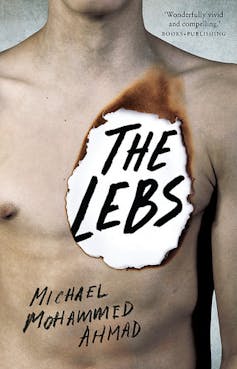 In it, he takes us on the fictional journey of Bani Adam, a Lebanese-Australian boy who is friends with, but doesn’t always like, the Lebs at his under-resourced, all-boys public high school in Sydney’s southwest. He tells us directly: “I hate maths like I hate being Lebo – I am above it.”
Through Bani’s narration in this insightful, and funny, novel we are reminded that “Leb” is not shorthand for Lebanese. Rather, The Leb emerges out of Western Sydney and a cocktail of racial profiling, relentless negative media representation of Arabs and Muslims after 9/11, and local familial conditions of poverty and underemployment.
The Lebs is scary because it does something other stories about Arabs growing up in Australia don’t – it is unapologetic in its rebellion against the institutions that have consistently told young ethnic-minority men that they have destroyed the moral fabric of our society. While Bani is a model student at school, he is acutely aware, at just 15, of how he is lumped together with the troublemaking boys on the outside. One of those kids is Mustafa Fatala who puts no effort into school, and yet Bani feels that the world sees them as one and the same:
sand niggers, rejected and hated and feared. Cops and transit officers target us and chicks and Skips avoid us. There’s nothing I can do about it.
Beyond addressing racism, The Lebs reveals the dialogue, tensions and disputes young Lebanese-Australian have among themselves. Bani aspires to be a “great novelist”, which doesn’t sit well with the NRL Bulldogs supporting “Lebos” at his school.
What came through in my research is that there are rigid masculine templates for Lebanese-Australian young men within their communities, such as completing further education in business or finance, or becoming a successful self-employed entrepreneur. Despite their aspirations for a creative life, these young men felt pressure to fulfil the dreams of their parents – often without the necessary financial support and resources. Similarly, many of the other students in Mohammed Ahmad’s book are “as poor as kebabs”.
The “mullets, the tattoos and the TNs”, which my informants describe as the cornerstone of Leb style, are not some universal feature of “Lebaneseness” or “Arabness”, but a hybridised and temporary form of masculine protest. It is also an identity position that can, to a degree, be outgrown, in a similar fashion to a former punk swapping a mohawk for a collared shirt.
At the heart of The Lebs is a story about how marginalised young people deal with racial and religious prejudice and a burning sense of injustice. For young people of Western Sydney, but especially those of Lebanese-Australian backgrounds, this is a story they can relate to far too well.
*Not his real name
In it, he takes us on the fictional journey of Bani Adam, a Lebanese-Australian boy who is friends with, but doesn’t always like, the Lebs at his under-resourced, all-boys public high school in Sydney’s southwest. He tells us directly: “I hate maths like I hate being Lebo – I am above it.”
Through Bani’s narration in this insightful, and funny, novel we are reminded that “Leb” is not shorthand for Lebanese. Rather, The Leb emerges out of Western Sydney and a cocktail of racial profiling, relentless negative media representation of Arabs and Muslims after 9/11, and local familial conditions of poverty and underemployment.
The Lebs is scary because it does something other stories about Arabs growing up in Australia don’t – it is unapologetic in its rebellion against the institutions that have consistently told young ethnic-minority men that they have destroyed the moral fabric of our society. While Bani is a model student at school, he is acutely aware, at just 15, of how he is lumped together with the troublemaking boys on the outside. One of those kids is Mustafa Fatala who puts no effort into school, and yet Bani feels that the world sees them as one and the same:
sand niggers, rejected and hated and feared. Cops and transit officers target us and chicks and Skips avoid us. There’s nothing I can do about it.
Beyond addressing racism, The Lebs reveals the dialogue, tensions and disputes young Lebanese-Australian have among themselves. Bani aspires to be a “great novelist”, which doesn’t sit well with the NRL Bulldogs supporting “Lebos” at his school.
What came through in my research is that there are rigid masculine templates for Lebanese-Australian young men within their communities, such as completing further education in business or finance, or becoming a successful self-employed entrepreneur. Despite their aspirations for a creative life, these young men felt pressure to fulfil the dreams of their parents – often without the necessary financial support and resources. Similarly, many of the other students in Mohammed Ahmad’s book are “as poor as kebabs”.
The “mullets, the tattoos and the TNs”, which my informants describe as the cornerstone of Leb style, are not some universal feature of “Lebaneseness” or “Arabness”, but a hybridised and temporary form of masculine protest. It is also an identity position that can, to a degree, be outgrown, in a similar fashion to a former punk swapping a mohawk for a collared shirt.
At the heart of The Lebs is a story about how marginalised young people deal with racial and religious prejudice and a burning sense of injustice. For young people of Western Sydney, but especially those of Lebanese-Australian backgrounds, this is a story they can relate to far too well.
*Not his real name
Authors: Sherene Idriss, Research associate, Western Sydney University
Read more http://theconversation.com/what-does-a-leb-look-like-93367


















