

What is Hanukkah and how is it celebrated?
- Written by: David Slucki, Loti Smorgon Associate Professor in Contemporary Jewish Life and Culture, Monash University
Last night, two gunmen fired on a crowd of more than 1,000 Australian Jews at Bondi Beach, who had gathered to celebrate the first night of the Jewish festival Hanukkah (also spelled Chanukah). Fifteen civilians were killed and dozens more injured. For many Australians, the significance of this attack’s timing may not be fully understood – like Hanukkah itself.
Hanukkah is a festival built around the act of kindling light in public, as a declaration that Jewish life will endure despite attempts to extinguish it.
Often referred to as the Festival of Lights, it recalls a moment in history, almost 2,000 years ago, when Jews were targeted for their Jewish practices and identity.
It celebrates the brief period in which they managed to overcome attempts to suppress their faith and culture, rededicating the Jewish Temple in Jerusalem, which had been desecrated, and restoring a measure of Jewish leadership and autonomy in the land of Israel.
Today, Hanukkah is one of the most widely celebrated Jewish festivals around the world. Its proximity to Christmas led American Jews in the 20th century to elevate it as a major Jewish holiday.
Hanukkah takes place from the 25th of Kislev till the 2nd or 3rd day of Tevet on the Jewish calendar. This year, that falls from sunset on Sunday 14 December and continues through nightfall on Monday 22 December.
The holiday is marked most visibly through the lighting of the chanukiah, a nine-branched candelabra with eight equal branches for the nights of Hanukkah and a ninth candle, the shamash, used to light the others.
The festival begins with the lighting of a single candle on the chanukiah. A defining feature of the practice is that the number of candles increases each night, so that each night’s light builds on what came before.
Across Jewish communities worldwide, Hanukkah is celebrated through nightly candle-lighting, blessings, songs, shared meals, games, gift-giving and communal gatherings. While the core ritual is consistent, local customs vary widely, shaped by the many places Jewish life took root – from Morocco to Poland, from Iraq to India, and across the world.
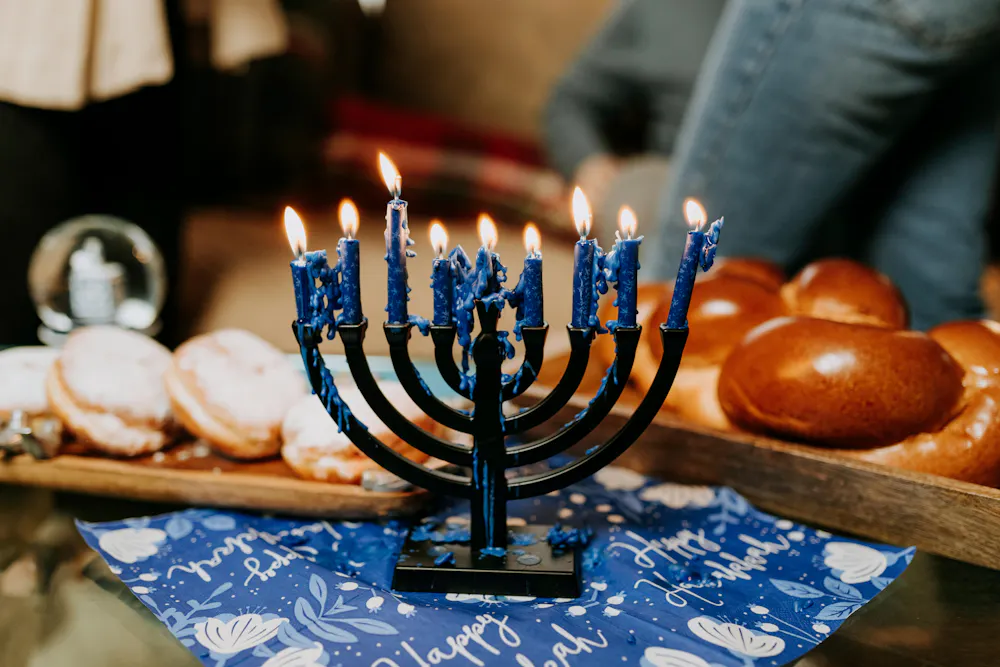
Each night begins with a blessing over the act of lighting the candles. A second blessing recalls the events Hanukkah commemorates and the deliverance remembered in Jewish tradition. On the first night only, a third blessing is added, giving thanks for living to celebrate the holiday once again. It’s a standard blessing said on the first night of every holiday, to welcome it in for the first time.
Taken together, these blessings serve as a reminder that Hanukkah is not only about what happened in the past, but about the responsibility to carry history and tradition forward.
The origins of Hanukkah date to the second century BCE, when Judea was ruled by the Seleucid Greek Empire. Under King Antiochus IV Epiphanes, Jewish religious practice was outlawed and the Second Temple in Jerusalem was desecrated. In response, a small group of Jewish rebels known as the Maccabees, led by Judah Maccabee, rose up against overwhelming odds.
After reclaiming Jerusalem and rededicating the Temple, rabbinic tradition recounts that only one day’s worth of ritually pure oil was found to relight the Temple’s menorah, a seven-branch candelabrum which provided light to the ancient Temple. According to this tradition, the oil burned for eight days, long enough to prepare a new supply.
In Jewish law, Hanukkah is considered a minor festival. It is not mentioned in the Torah and does not involve restrictions on work. Yet it has endured precisely because its rituals are portable, community-oriented, and centred in the home.
Traditionally, the chanukiah is placed in a window or doorway to fulfil the principle of pirsumei nisa, publicising the miracle – sometimes in the face of danger.
The themes of Hanukkah are articulated in two key religious texts: Al HaNisim and Ma’oz Tzur. Al HaNisim, added to daily prayers during Hanukkah, does not focus on oil or candles. Instead, it centres on a reversal of fortune: the many defeated by the few, the powerful by the vulnerable. What was at stake, the prayer suggests, was the ability to live according to Jewish values. The miracle it describes is ethical as much as historical.
Ma’oz Tzur, traditionally sung after lighting the candles, places the Hanukkah story within a longer history of persecution and endurance. It recalls repeated attempts to destroy Jewish life and responds not with triumph, but with persistence. Remembering becomes an act of defiance and hope.
Reflecting on this endurance, Rabbi Jonathan Sacks has argued Hanukkah commemorates not only the supernatural, but also the human story: a small and vulnerable people refused to surrender intellectually, spiritually, or morally, and hope endured because people chose to act.
Hanukkah is often understood as a reminder that even a small flame can be consequential. A common Jewish saying captures this idea: me’at min ha’or doche harbeh min ha’choshech – “a little light drives out much darkness.”
As we grieve for the victims of the Bondi shooting, Hanukkah calls on us to insist on light nonetheless – and, in doing so, to ensure Jewish life is never extinguished.
Authors: David Slucki, Loti Smorgon Associate Professor in Contemporary Jewish Life and Culture, Monash University
Read more https://theconversation.com/what-is-hanukkah-and-how-is-it-celebrated-272057


















