

How the myth of ‘aqua nullius’ still guides Australia’s approach to groundwater
- Written by Sarah Bourke, Lecturer, The University of Western Australia
Indigenous people have coexisted with Australia’s vast and ancient groundwater systems for thousands of generations. Their knowledge extends back through deep time, before our current climate and waterways. It offers insights that Western science is only beginning to quantify.
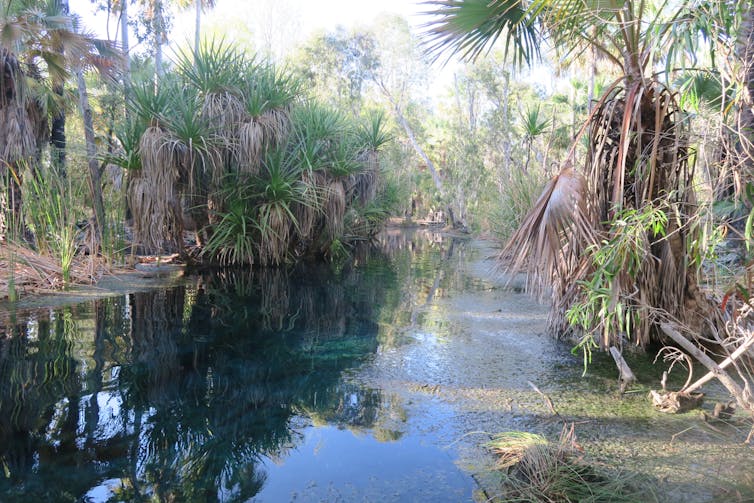
When rain falls, some can seep into the ground, becoming groundwater. This water can remain underground for as little as a few months, or for millions of years. Eventually it is taken up by plants, or flows into springs, rivers and the ocean.
Australia’s groundwater resources underpin the economic growth and prosperity of the country. But they are under greater pressure than ever before. Legal battles over water in the NT, including extraction licences, highlights the rapid pace at which decisions over the future of water are being made.
Our new paper shows the “business as usual” approach to groundwater science and management risks perpetuating colonial injustices. And it compromises our ability to manage water sustainably as the climate grows warmer and population increases.
Most Australians are aware of terra nullius, the legal fiction that Australia belonged to no-one before European settlement. But very few know about aqua nullius, – “water belonging to no-one”. This is a similar fiction suggesting Traditional Owners had no rights to the water they had used for millennia.
We show how the legacy of aqua nullius remains embedded within contemporary groundwater science. And urge Australia to take a different approach.
Indigenous care of groundwater
Indigenous knowledge systems embody many thousands of years of groundwater monitoring. This includes tracking spring behaviour and soil moisture, animal movement and vegetation cues.
Australia’s colonial expansion used the water knowledge of Indigenous peoples to support economic and agricultural development. This came at the expense of Indigenous peoples’ water, food, and culture.
Indigenous voices ignored
For too long, and too often, Indigenous perspectives on groundwater have not been heard or acted upon. In many instances, Indigenous people bear the impacts of groundwater decline or contamination. And yet, they have limited power to influence the development approvals that create these pressures.
For Indigenous communities who have cared for these waters for tens of thousands of years, rapid decision-making over the future of groundwater represents a profound risk to cultural obligations and the living systems that hold songlines, identity, and law.
Western scientific approaches are prioritised, while Indigenous groundwater expertise is dismissed and neglected in decision-making. When Indigenous perspectives are considered, there can be backlash from industry. There is often an expectation the government will prioritise economic development.
Accelerating pressures from industry and agriculture are superimposed onto the existing inequalities in water access. Many Aboriginal homelands communities still facing water insecurity.
Australia’s recent critical minerals agreement with the United States will lead to more water-intensive production and processing and substantial long-term environmental impacts.
Mine closure is rare in Australia. Mine rehabilitation often falls short of societal expectations. The legacy of decisions made now is likely to last for thousands of years. And they will disproportionately affect Indigenous communities.

Rights vs legal obligations
In 2009, Australia endorsed the UN Declaration on the Rights of Indigenous Peoples. But these rights are not reinforced by current approaches to groundwater science and management.
Article 25 states Indigenous Peoples have the right to maintain their relationships with traditional lands and waters. Yet over-extraction is leading springs in Australia to dry out. Springs are places of ceremony, law, healing and identity. A dry spring not only has an environmental impact but causes cultural harm, with intergenerational consequences.
The UN declaration also says states should obtain consent before any project, including the exploitation of water. Yet in most states and territories there is only a legal obligation to “consult” with Indigenous peoples.
Country as a living relative
Better outcomes require the colonial settler community to make genuine efforts to understand and incorporate Indigenous perspectives and knowledge in groundwater science and management.
The deconstruction of colonial legacies must be facilitated by people working within government agencies and regulatory authorities, and water scientists, in partnership with Aboriginal communities. Genuine relationship building is not just an “engagement activity”. It should be grounded in respect, reciprocity and an understanding of the obligation to care for Country as a living relative.
This process takes time and will not necessarily progress according to a particular schedule. This creates a tension between existing approvals mechanisms and best-practice engagement with Indigenous communities. Some governments and companies are working towards improving relationships with Indigenous communities. But this is not a requirement of existing systems for groundwater management. Our cultural heritage continues to be lost.
We must work together for a better future so our precious water is protected, not just for the next 50 years but for the next 5,000. This requires a holistic understanding that weaves together Western and Indigenous perspectives to ensure that both people and Country can thrive. A future where Indigenous laws, sciences and decision-making authority are embedded in, not appended to, water science and governance.
Authors: Sarah Bourke, Lecturer, The University of Western Australia


















.jpg)