

Modern Australian
Men's Weekly

.

Ancient African bedrock reveals the violent beginnings of life on our blue planet

  • Written by Simon Lamb, Associate Professor in Geophysics, Te Herenga Waka — Victoria University of Wellington

You have probably seen the images of the surface of Mars, beamed back by NASA’s rovers. What if there were a time machine capable of roaming Earth during its remote geological past, perhaps even going right back to its beginnings, beaming back pictures of similar quality?

This is not science fiction. In remote corners of the world, geologists have found tiny relics of Earth’s very ancient surface.

I have been part of this scientific endeavour, looking at the treasure trove of information in the bedrock of the Makhonjwa Mountains in South Africa and the adjacent small kingdom of Eswatini.

These rocks reach back more than three quarters of the way through our planet’s long history of nearly 4.6 billion years. In my new book, The Oldest Rocks on Earth, I describe the graphic images “beamed back” by this geological time machine.
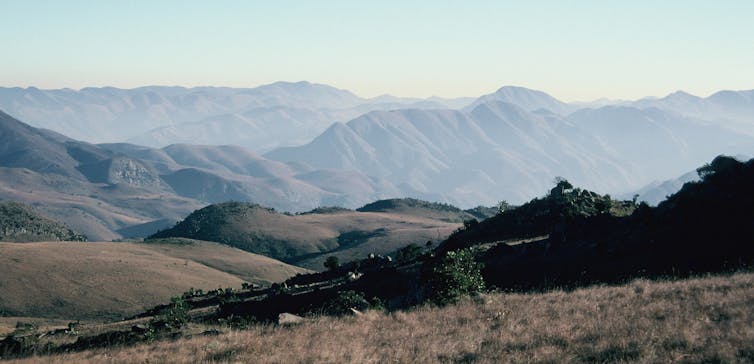
A hilly landscape that holds some of Earth's oldest bedrock
Beneath the remote and rugged landscape of the Makhonjwa Mountains, in Eswatini, is a bedrock that holds a record of Earth’s surface from 3.2 to 3.5 billion years ago, when our planet was about a quarter of the way through its history. Simon Lamb, Author provided (no reuse)

World of oceans

The ancient rocks reveal a world with extensive oceans and intense volcanic activity on the sea floor.

Deep beneath the crust, Earth was much hotter than today, giving rise to an unusual white-hot magma, rich in elements from its interior. Huge volumes of super-heated water continually gushed out of underwater cracks, building up chimneys of valuable metals. And life was thriving around these undersea vents.

Volcanic islands rose up from the ocean depths. These were dangerous places. Pools of hot bubbling mud dotted their shores, and clouds of volcanic ash periodically exploded from volcanic craters.

Life was already there, forming microbial mats in the sheltered nearshore waters.

Periodically, large earthquakes violently shook the bedrock, triggering submarine avalanches that cascaded down into the deep ocean, creating vast jumbles of rock on the sea floor. Giant asteroid impacts disturbed this world, but crucially, did not extinguish it.
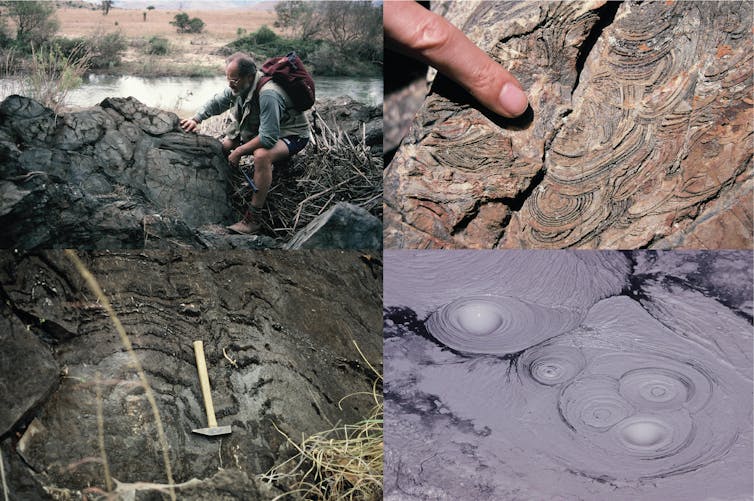
Ancient African bedrock reveals the violent beginnings of life on our blue planet
The ancient rocks speak (clockwise from top left hand corner): Geologist Maarten de Wit pointing out the remains of underwater eruptions of pillow lava, 3.4 billion years old; the swirly remains of bubbling mud pools, 3.3 billion years old; modern bubbling mud pools among volcanoes in the Bolivian Andes; mounds created by microbial mats, 2.7 billion years old. Simon Lamb, Author provided (no reuse)

Deep-seated forces were pushing up new land, creating the early continents.

Ocean waves moved back and forth on sandy beaches along coastlines with bays, lagoons, inlets and estuaries, with tides similar to those today.

During floods, large rivers brought muddy water from the continental interior. Farther in the distance, their headwaters drained a mountainous terrain, often enveloped in thick cloud.

It was a blue planet because, like today, the oceans scattered light in the blue part of the colour spectrum.

But the atmosphere contained a lethal cocktail of gases, including high concentrations of methane and carbon dioxide. These greenhouse gases kept the surface at the right temperature for liquid water, at a time when astrophysicists calculate the Sun was much weaker. But there was no oxygen.

The earliest life forms were anaerobic microbes, although brightly coloured – pink or purple have been proposed.
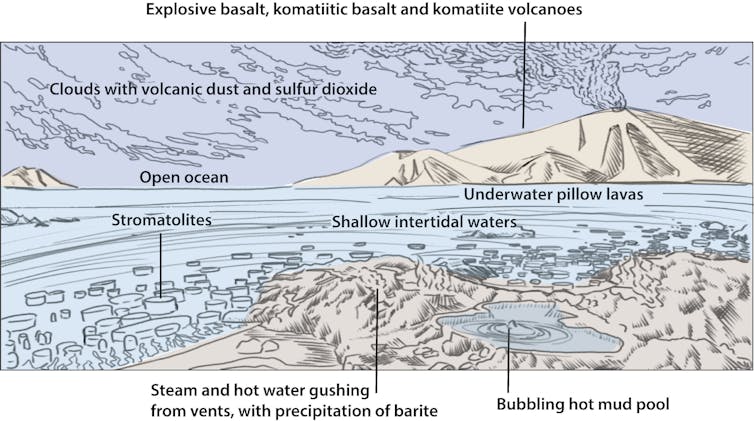
Ancient African bedrock reveals the violent beginnings of life on our blue planet
Shores of a volcanic island, about 3.3 billion years ago, based on the geological record in the Makhonjwa Mountains, southern Africa. Simon Lamb, Author provided (no reuse)

Oceania today

Oceania, in the southwestern Pacific, may illustrate best what this early world was like. Here, the ocean is peppered with volcanic islands and small continents, rocked by great earthquakes where tectonic plates rub against each other. There are even clues to how life began.

The 2022 eruption of the Hunga volcano, near Tonga, created a mushroom cloud of ash that burst out of the ocean and reached up into space with an estimated energy of a 60-megaton atomic bomb. It generated more than 200,000 lightning strikes and left behind a deep underwater crater filled with a chemical soup derived from numerous underwater hot vents.
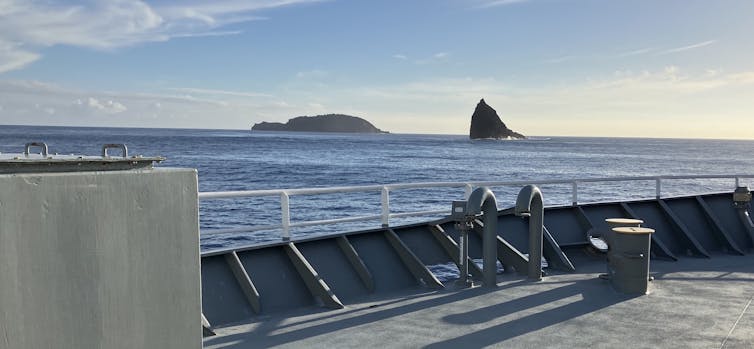
Ancient African bedrock reveals the violent beginnings of life on our blue planet
The aftermath of an eruption similar to those on early Earth. The view from a research vessel of the emergent remains of the January 2022 volcanic eruption near Tonga. Simon Lamb, Author provided (no reuse)

Experiments show that lightning strikes can trigger the synthesis of basic organic molecules needed by living organisms. Millions of Hunga-like eruptions on early Earth would have created myriad opportunities to kick start the chemistry of life in underwater volcanic craters – life was born out of extreme geological violence.

Staying blue

Going back in time beyond the Makhonjwa Mountains, we still find evidence for oceans, life and, I argue, plate tectonics. Earth became blue within the first tenth of its history.

Mars and Venus may have started this way, too. But our planet uniquely lies in the so-called Goldilocks Zone, receiving just the right amount of solar energy to avoid becoming a boiling Venusian hell or freezing Martian world.

It is also big enough to have a magnetic field and pull of gravity sufficient to retain its atmosphere. And right at the start, a dramatic collision with a Mars-sized asteroid spalled off our Moon, stabilising Earth’s spin axis so that day and night were less extreme.

Finally, the biochemistry of living organisms may have played a key role in keeping Earth this way by helping the bedrock absorb greenhouse gases in the face of a steadily warming Sun.

We must not be the first to let Earth lose its distinctive life-giving blue, a colour so wonderfully referred to in the Siswati language of Eswatini as luhlata lwesibhakabhaka, literally “green like the sky”.

Authors: Simon Lamb, Associate Professor in Geophysics, Te Herenga Waka — Victoria University of Wellington


Read more https://theconversation.com/ancient-african-bedrock-reveals-the-violent-beginnings-of-life-on-our-blue-planet-268365

Winter Hairstyling Tips to Prevent Dryness

Winter can be particularly harsh on your hair. Cold air outside, dry indoor heating, and frequent temperature changes can strip moisture from the ha...

Short Term Loans in Australia: Practical Insights for Borrowers and Finance Professionals

Short term loans play a crucial role in Australia’s personal finance landscape. They are designed to cover short-term expenses, unexpected bills, ...

Best EPD Consultants in Australia

Environmental Product Declarations (EPDs) play an increasingly important role in the Australian construction, manufacturing, and infrastructure sect...

I/O Controller And Its Role In Modern Industrial Automation

Industrial automation relies on a range of advanced technologies to ensure precision, speed, and reliability in day-to-day operations. Among these t...

Hydraulic Systems And Their Importance In Modern Industry

A hydraulic system plays a vital role in powering machinery, controlling movement, and delivering high-force performance across countless industrial...

Why Australian Businesses Are Having a Second Think About Digital Growth

Running a business these days is a whole lot different to how it was even a few short years ago. Customers are better informed, there's more competi...

Restaurants Risk Compliance Issues Amid Commercial Plumber Shortage

As demand for housing, roads and facilities increases, so does the demand for trade workers. According to Infrastructure Australia, the construction i...

The Importance Of A Professional Medical Fitout Melbourne For Modern Healthcare Facilities

Healthcare environments must operate with precision, efficiency, and a strong focus on patient comfort. A well-planned medical fitout Melbourne hel...

Top Safety and Comfort Features to Consider in Family Off Road Caravans

Exploring Australia’s coastline, bush tracks or outback locations is far more enjoyable when travelling in a caravan designed for both comfort and...

“Logistical Nightmare” – Rural and Remote Communities Supply Chain Nightmares

Australia’s road logistics need major reform to counteract the supply chain issues that are hitting rural and regional communities hard. With 80% of...

The Importance Of Quality Bait Boards For Boats To Enhance Fishing Efficiency And Comfort

Fishing enthusiasts understand that having the right equipment on board makes every trip smoother and more enjoyable. One essential accessory for an...

The Essential Safety Gear Every Tradesman Needs

Across industries like construction, electrical work, plumbing, carpentry, and welding, workers face hazards every single day. For tradesmen, having...

Best POS System Features That Boost Customer Experience

Source: Unsplash Starting and scaling a retail business is unlikely possible without an effective Point of Sale (POS) system. It is the tech heartbe...

Understanding SMSF Setup Online and Why More Australians Are Choosing Digital Fund Establishment

liManaging your own superannuation gives you greater control over investments, retirement planning, and long-term financial decision-making. As inte...

Double Carport: Complete Guide to Design, Cost, and Installation

A double carport provides practical, cost-effective protection for two vehicles whilst adding value and functionality to your property. Whether you're...

How External Blinds and Awnings Improve Comfort, Privacy, and Energy Efficiency

Outdoor comfort and protection are essential for homes and commercial properties, especially in regions with strong sunlight, high UV exposure, and ...

Worksite Comfort Upgrades That Boost Team Productivity

Jobsite productivity doesn’t depend solely on tools, training, or scheduling. It also hinges on something often overlooked: worker comfort. When e...

NDIS Occupational Therapy: Your Complete Guide to Accessing Support and Services

Occupational therapy plays a crucial role in helping NDIS participants achieve their goals and improve their daily living skills. For people with disa...















