

little-known fantastic beasts that live everywhere on Earth
- Written by: Mark Stevens, Adjunct Associate Professor, School of Biological Sciences, Adelaide University
In virtually every piece of land on Earth – from near the summit of Mount Everest to Antarctica to caves nearly 2,000 metres underground – live tiny critters that have shaped the health of our planet for hundreds of millions of years.
They are known as springtails – an ancient group of invertebrates that evolved along with mosses and lichens dating back to more than 400 million years ago.
By taking a trip into their magical world, you will emerge from the forest with a newfound appreciation of the tiny and easily overlooked wonders that live with us.

What exactly are springtails?
It appears that the earliest written record of springtails is from 350 BCE by the ancient Greek philosopher Aristotle in his published notes History of Animals.
Our knowledge of springtails increased from the 1600s thanks to the improvement in microscopes that allowed scientists to take a closer look at these tiny animals. However, it was not until 1758 that Swedish biologist Carl Linnaeus published the first formal scientific description of springtails.
At first glance these under-appreciated creatures might seem like insects. But they are quite distinct from insects due to their internal mouthparts, less defined body segments, lack of wings, and no real metamorphosis. They range in size from less than a millimetre up to the largest recorded at 17 millimetres.

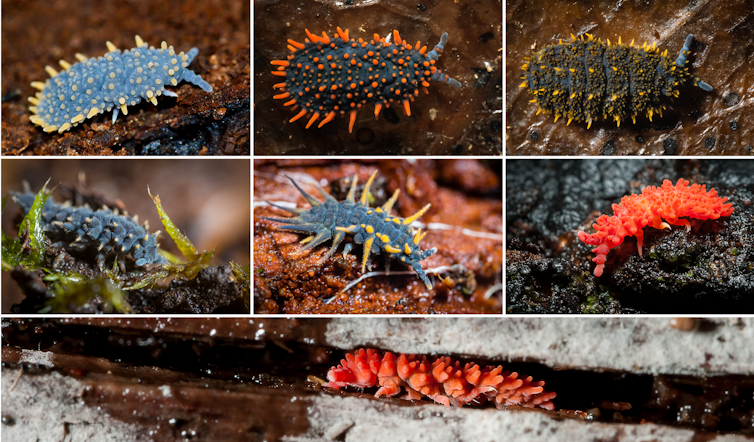
The largest and most colourful bear a strong resemblance to the “fantastic beasts” of the Harry Potter franchise. They come in lurid red, bright purple and fluorescent yellow, among other colours, and have tiny bumps and hairs covering their bodies, making them look more like colourful sea slugs.
Springtails got their common name from their amazing ability to spring using an organ called the “furcula”. The furcula is a spring-loaded appendage found on the underside of the abdomen and ranges greatly in size. This ability to launch into the air, like a catapult, is incredibly useful to help springtails escape predators.
Their scientific name at the taxonomic level of class – Collembola – is derived from another organ specific to springtails, known as a “collophore”.
The collophore is present in all Collembola and helps them absorb moisture from their environment, which helps with dehydration. This and other adaptations means springtails can live in the driest places on Earth, including hot and cold desert environments.
 Diversity of Collembola with the four Orders: Symphypleona (Dicyrtomina), Entomobryomorpha (Pogonognathellus, length 4-5mm), Poduromorpha (Neanura, length 3mm) and Neelipleona (Neelus, length 0.6mm).
Cyrille D'Haese
Diversity of Collembola with the four Orders: Symphypleona (Dicyrtomina), Entomobryomorpha (Pogonognathellus, length 4-5mm), Poduromorpha (Neanura, length 3mm) and Neelipleona (Neelus, length 0.6mm).
Cyrille D'Haese
Maintaining Earth’s ecosystems
Springtails are found in their many thousands in all environments around us, such as forests mangroves, caves, deserts and grasslands. They’re also found in all habitats, such as canopies, surfaces of ponds, soil, leaf litter, mosses and rotting wood. You will even find them in your household compost, gardens, potplants and terrariums.
But for many, their survival can depend on ecosystems being saturated with humidity.
In these environments they are crucially important in regulating bacteria and fungal populations, processing organic matter, as well as prey for other animals.
This makes them vital to maintaining the health of almost all Earth’s ecosystems. As a major element of most habitats on Earth they are found on all continents, including Antarctica.
The evolutionary success of Collembola as a major contributor to healthy ecosystems means they have the potential to indicate when ecosystems are out of balance. That’s why some have been referred to as “canaries in the undergrowth”.
 Neotropiella carli, a Collembola from the Amazon region in leaf litter.
Cyrille D'Haese
Neotropiella carli, a Collembola from the Amazon region in leaf litter.
Cyrille D'Haese
The largest springtails
The Collembola that live within rotting wood are truly spectacular and have been recorded as the largest globally at 17 millimetres.
They were nicknamed “giant Collembola” due to their striking colours and size. In these forest environments they lack a furcula (the spring organ). That may seem odd for a group commonly known as “springtails”, but they have nowhere to spring to in these environments.
Our recent study, published in the Zoological Journal of the Linnean Society, is the largest study to date of Collembola. It was only possible from 25 years of collecting from around the world.
The study proposes major changes within the Neanuroidea superfamily that giant springtails belong to. It dissolves one subfamily (“Uchidanurinae”) that was only aligned by convergent evolution – when species are unrelated but evolve similar features and functions because they occupy similar habitats.
In its place, the study creates two new subfamilies and considers the assignment of almost 200 genera within the Neanuroidea superfamily.
The study shows that the superfamily survived through the KT-boundary mass extinction event about 66 million years ago that wiped out nearly all of the dinosaurs.
It also reveals a distinct divide between groups found in the northern versus southern hemisphere. Our two new subfamilies were dominated by southern hemisphere forest species – Gondwanan remnants that were much more abundant in the past than they are today.
 Springtails are crucial to the health of our forests, including this ancient Gondwanan beech forest in Mount Field National Park, Tasmania.
Cyrille D'Haese
Springtails are crucial to the health of our forests, including this ancient Gondwanan beech forest in Mount Field National Park, Tasmania.
Cyrille D'Haese
Risking a ‘silent’ mass extinction
Giant springtails living in rotting wood are critically threatened by warming and drying climates in Australia and New Zealand.
While ancient forests continue to disappear or become unsuitable habitat, we continue to lose incredible invertebrate species – many before they have been given scientific names.
This is a “silent” mass extinction – one that threatens the fantastic diversity of life on Earth.
Authors: Mark Stevens, Adjunct Associate Professor, School of Biological Sciences, Adelaide University


















