

how Maggie O'Farrell’s Hamnet takes from – and mistakes – Shakespeare
- Written by Kate Flaherty, Senior Lecturer (English and Drama), Australian National University
In her eighth novel Hamnet, Maggie O’Farrell imagines the short life and tragic death of Shakespeare’s only son, aged 11, in 1596. Although it is not known how Hamnet died, O’Farrell attributes his death to the plague. She creates a visceral and affecting portrait of his swift decline and the powerlessness of those around him, particularly his mother, to save him.
A critical and commercial success, the novel’s popularity was aided by its connection with Shakespeare, whose enduring reputation as a literary genius ensures that, as the scholar John Sutherland once asserted, “where there’s a Will there’s a payday”.
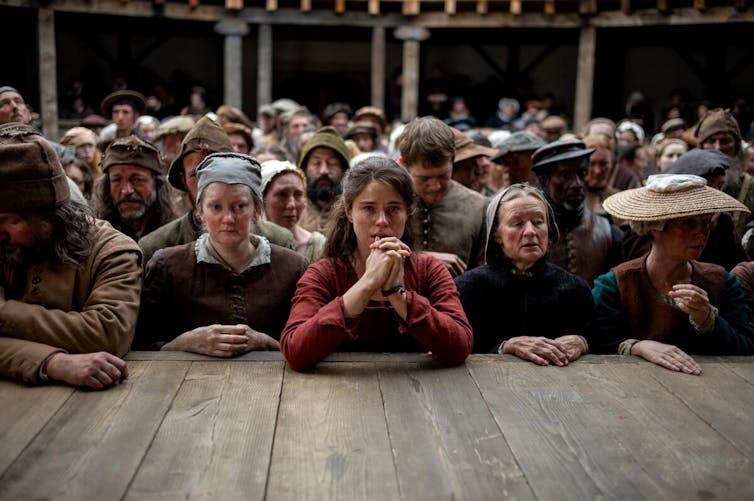
The death of Hamnet is one creative trigger for this bestselling novel, but is it the main source? And was Hamnet’s death really the source for Shakespeare’s Hamlet? With the film adaptation, co-authored by O’Farrell and director Chloé Zhao, arriving in Australian cinemas this month, it is timely to consider the broader influences on O’Farrell’s novel and Shakespeare’s play.
The inspirations are not singular in either case. Shakespeare was influenced by clear creative precursors, while O’Farrell’s depiction of maternal grief is haunted by her personal experience.
A rescued wife?
O’Farrell has repeatedly stated in interviews that she had two motivations for writing Hamnet: to “rescue” Shakespeare’s wife Anne Hathaway from negative representations in biographies of Shakespeare, and to “correct” what she perceives as the lack of acknowledgement of the significance of Hamnet’s death to Shakespeare’s art.
Her former concern manifests in her representation of Anne as a quietly wilful character, who engineers her husband’s escape from his overbearing father in Stratford to London, where his career can take flight. The novel’s third-person narrative is increasingly filtered through Anne’s perspective as the story progresses, placing her grief centre stage.
In a pointed intervention, O’Farrell names her “Agnes”. This is the name she is given in her father Richard Hathaway’s will, though the assertion that Agnes is her “true” name is problematic, due to a lack of other documentary sources and because spelling was variable at the time.

A well of maternal grief
Reading Hamnet primarily in relation to Anne Hathaway, or Shakespeare, or his play Hamlet, is limiting. On the other hand, O’Farrell’s biography yields some illuminating links with her novel’s depiction of maternal grief.
In her memoir I Am, I Am, I Am (2017), O’Farrell writes about her experiences of pregnancy loss and her powerlessness in the face of her elder daughter’s life-threatening medical condition. In the mid-2000s, following the traumatic birth of her first child, a son, O'Farrell experienced multiple miscarriages.
She eventually conceived a daughter through IVF. This daughter lives with an immunological disorder, which leaves her vulnerable to ordinary illnesses, such as the common cold, and prone to anaphylaxis triggered by exposure to a variety of everyday substances. Consequently, O’Farrell and her family live “in a state of high alert”.
 O’Farrell describes how the lack of vocabulary and rituals around miscarriage compounded her grief. She laments that children lost before they are born are “so invisible, so evanescent” that “our language doesn’t even have a word for them”. She also admonishes the “school of thought […] that expects women to get over a miscarriage as if nothing has happened, to metabolise it quickly and get on with life”.
In Hamnet, the absent presence of lost children is vividly portrayed. The novel evokes a matrix of loss that goes beyond Hamnet’s death. It references Shakespeare’s siblings who died in childhood, including his sisters Anne and the renamed “Eliza” (Joan). In the novel, one of Shakespeare’s surviving sisters is also called Eliza, a living memorial to her dead sibling.
In her own life, O’Farrell has been deprived of the opportunity to name and mourn, but she has meticulously populated Hamnet with lost children who continue to demand the attention of the living.
In O'Farrell’s memoir, death stalks the child who has lived when many before her did not. O'Farrell and her family must be always prepared for her daughter’s anaphylaxis. They must never leave the house without an emergency kit; they must weigh up the risks posed by a simple walk in the park or a play date. Then, when the world strikes, “you are reduced to a crystalline point, to a single purpose: to keep your child alive, to ensnare her in the world of the living, to hang on to her and never let her go”.
O’Farrell describes an attack in disturbing detail: hives leads to swelling of the airways, which, without emergency treatment, can be followed by cardiac arrest. Meanwhile, the victim is “clawing at their throat, hoarse with panic and fear,” and feels cold to the touch as their blood pressure drops.
There is more than a shade of this terror in the novel’s descriptions of Hamnet’s decline. As the fever takes hold, he is transported to a snowy landscape “he doesn’t recognise”, which tempts him to “surrender himself, to stretch out in this glistening, thick white blanket: what relief it would give him”.
One cannot fail to think of O’Farrell’s efforts to keep her daughter alive as Agnes watches Hamnet in his death throes, pleading with him not to go.
As a beautifully affecting portrait of grief, Hamnet achieves what Hamlet never set out to do: it inscribes the memory of children taken too soon and testifies to the necessity of mourning and remembrance. As readers, playgoers or film fans, it makes for a richer experience to weigh each work by its own merits, because it takes many different kinds of ghosts to make a story.
Authors: Kate Flaherty, Senior Lecturer (English and Drama), Australian National University
O’Farrell describes how the lack of vocabulary and rituals around miscarriage compounded her grief. She laments that children lost before they are born are “so invisible, so evanescent” that “our language doesn’t even have a word for them”. She also admonishes the “school of thought […] that expects women to get over a miscarriage as if nothing has happened, to metabolise it quickly and get on with life”.
In Hamnet, the absent presence of lost children is vividly portrayed. The novel evokes a matrix of loss that goes beyond Hamnet’s death. It references Shakespeare’s siblings who died in childhood, including his sisters Anne and the renamed “Eliza” (Joan). In the novel, one of Shakespeare’s surviving sisters is also called Eliza, a living memorial to her dead sibling.
In her own life, O’Farrell has been deprived of the opportunity to name and mourn, but she has meticulously populated Hamnet with lost children who continue to demand the attention of the living.
In O'Farrell’s memoir, death stalks the child who has lived when many before her did not. O'Farrell and her family must be always prepared for her daughter’s anaphylaxis. They must never leave the house without an emergency kit; they must weigh up the risks posed by a simple walk in the park or a play date. Then, when the world strikes, “you are reduced to a crystalline point, to a single purpose: to keep your child alive, to ensnare her in the world of the living, to hang on to her and never let her go”.
O’Farrell describes an attack in disturbing detail: hives leads to swelling of the airways, which, without emergency treatment, can be followed by cardiac arrest. Meanwhile, the victim is “clawing at their throat, hoarse with panic and fear,” and feels cold to the touch as their blood pressure drops.
There is more than a shade of this terror in the novel’s descriptions of Hamnet’s decline. As the fever takes hold, he is transported to a snowy landscape “he doesn’t recognise”, which tempts him to “surrender himself, to stretch out in this glistening, thick white blanket: what relief it would give him”.
One cannot fail to think of O’Farrell’s efforts to keep her daughter alive as Agnes watches Hamnet in his death throes, pleading with him not to go.
As a beautifully affecting portrait of grief, Hamnet achieves what Hamlet never set out to do: it inscribes the memory of children taken too soon and testifies to the necessity of mourning and remembrance. As readers, playgoers or film fans, it makes for a richer experience to weigh each work by its own merits, because it takes many different kinds of ghosts to make a story.
Authors: Kate Flaherty, Senior Lecturer (English and Drama), Australian National University 
















