

Trump’s Greenland grab is part of a new space race – and the stakes are getting higher
- Written by: Anna Marie Brennan, Senior Lecturer in Law, University of Waikato
US President Donald Trump’s position on Greenland has shifted almost daily, from threats to take it by force to assurances he won’t. But one thing remains consistent: his insistence the Arctic island is strategically vital to the United States.
Within hours of the president’s speech at this week’s Davos summit, Reports began circulating that Washington and Copenhagen had quietly discussed giving the US small, remote patches of Greenland for new military sites. Nothing confirmed, everything whispered, but the speed of the speculation said a lot.
What once felt like Trumpian theatre suddenly looked like a real geopolitical move. It was also a hint Arctic power plays are now bleeding into the politics of outer space.
This all happened very quickly. The notion the US might buy Greenland from Denmark (which resurfaced in 2019) was at first treated like a late-night comedy sketch.
But behind the jokes lay a growing unease the Trump administration’s fixation with Greenland was part of a wider geostrategic ambition in the “western hemisphere” – and beyond.
That’s because Greenland sits at the crossroads of two fast-shifting frontiers: a warming Arctic that will change shipping routes, and an increasingly militarised outer space.
As global tensions rise, the island has become a geopolitical pressure gauge, revealing how the old international legal order is beginning to fray.
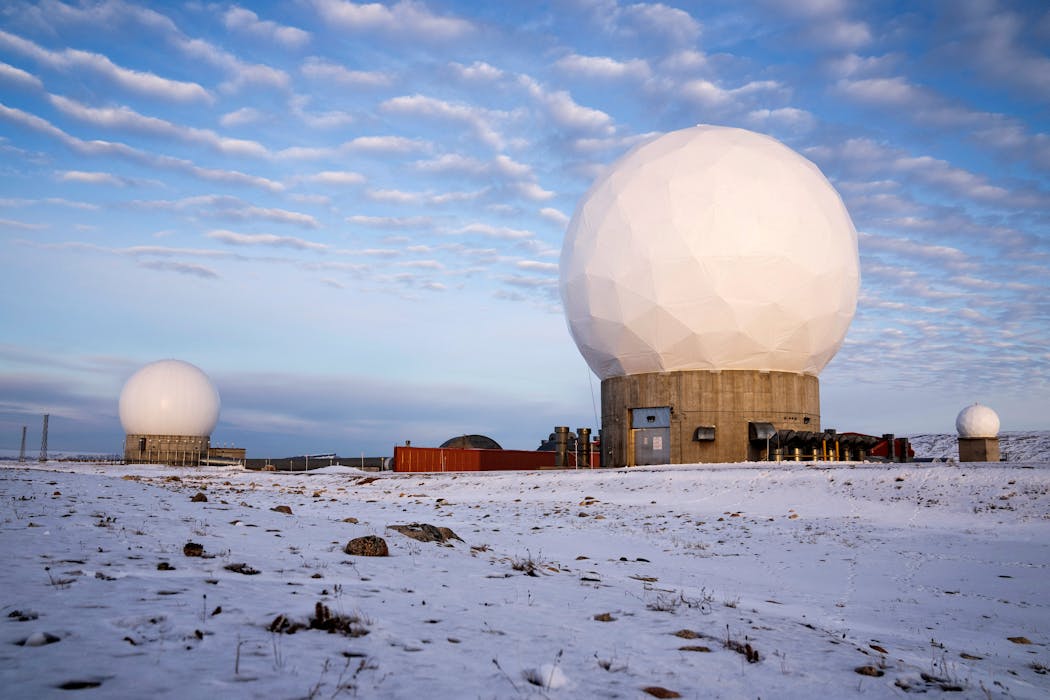
At the centre of it all is Pituffik Space Base, formerly known as Thule Air Base. Once a Cold War outpost, it’s now a key part of the US military’s Space Force hub, vital for everything from missile detection to climate tracking.
In a world where orbit is the new high ground, that visibility is strategic gold.
Space law in a vacuum
Trump has leaned hard into this logic. He’s repeatedly praised Thule as one of the most important assets for watching what happens above the Earth, and has urged the US to “look at every option” to expand its presence.
Whether by force, payment or negotiation, the core message hasn’t changed: Greenland is central to America’s Arctic and space ambitions.
This is not just about military surveillance. As private companies launch rockets at record pace, Greenland’s geography offers something rare – prime launch conditions.
High latitude sites are ideal for launching payloads into polar- and sun-synchronous orbits. Greenland’s empty expanses and open ocean corridors make it a potential Arctic launch hub. With global launch capacity tightening due to fewer available sites and access problems, the island is suddenly premium real estate.
But American interest in Greenland is rising at the same time as the post-war “rules-based international order” has proved increasingly ineffective at maintaining peace and security.
Space law is especially vulnerable now. The 1967 Outer Space Treaty was built for a world of two superpowers (the US and Soviet Union) and only a few satellites, not private satelliete mega constellations, commercial lunar projects, or asteroid mining.
It also never anticipated that Earth-based sites such as Thule/Pituffik would decide who can monitor or dominate orbit.
As countries scramble for strategic footholds, the treaty’s core principles are being pushed to breaking point. Major powers now treat both the terrestrial and orbital realms less like global commons and more like strategic assets to control and defend.
Greenland as warning sign
Greenland sits squarely on this fault line. If the US were to expand its control over the island, it would command a disproportionate share of global space surveillance capabilities. That imbalance raises uncomfortable questions.
How can space function as a global commons when the tools needed to oversee it are concentrated in so few hands? What happens when geopolitical competition on Earth spills directly into orbit?
And how should international law adapt when terrestrial territory becomes a gateway to extraterrestrial influence? For many observers, the outlook is bleak. They argue the international legal system is not evolving but eroding.
The Arctic Council, the leading intergovernmental forum promoting cooperation in the Arctic, is paralysed by geopolitical tensions. The United Nations Committee on the Peaceful Uses of Outer Space can’t keep pace with commercial innovation. And new space laws in several countries increasingly prioritise resource rights and strategic advantage over collective governance.
Greenland, in this context, is not just a strategic asset; it’s a warning sign.
For Greenlanders, the stakes are immediate. The island’s strategic value gives them leverage, but also makes them vulnerable. As Arctic ice melts and new shipping routes emerge, Greenland’s geopolitical weight will only grow.
Its people must navigate the ambitions of global powers while pursuing their own political and economic future, including the possibility of independence from Denmark.
What started as a political curiosity now exposes a deeper shift: the Arctic is becoming a front line of space governance, and the laws and treaties designed to manage this vast icy territory and the space above it are struggling to keep up.
The old Thule Air Base is no longer just a northern outpost, it’s a strategic gateway to orbit and a means to exert political and military power from above.
Authors: Anna Marie Brennan, Senior Lecturer in Law, University of Waikato


















