

Many people feel lonely in the city, but perhaps 'third places' can help with that
- Written by: Tony Matthews, Lecturer in Urban and Environmental Planning, Griffith University
Loneliness is a hidden but serious problem in cities worldwide. Urban loneliness is connected to population mobility, declining community participation and a growth in single-occupant households. This threatens the viability of our cities because it damages the social networks they rely on.
One response to these trends involves “third places”. These are public or commercial spaces that provide informal opportunities for local people to mix socially on neutral ground.
Read more: We are living alone together in today's cities – and that calls for smart and 'bolshie' moves
The concept of third place, developed by Ray Oldenburg, is distinct from first and second places. A first place is the private space of home. Second places are where people spend significant time, often formally. These include schools, universities and workplaces.
Common examples of third places in cities include community gardens, libraries, public swimming pools, cafes, men’s sheds, farmers’ markets and dog parks.
Researchers at the Cities Research Institute are investigating whether these “third places” can reduce urban loneliness. Here, we report and discuss some insights from that work.
How can third places reduce loneliness?
There is growing understanding of the negative outcomes and costs associated with loneliness. These include fractured communities, declining trust, stress, depression and disease. Clearly this is neither desirable nor sustainable.
Read more: Loneliness is bad for your health
More than a century ago the sociologist George Simmel observed how mobility disrupts social connection and creates isolation. The urban migrant leaves behind their own social ties and often struggles to connect to their new community. This challenges both the migrant and their new neighbours.
Third places can help by creating or enhancing a sense of community on a smaller, more human scale – a relief from the overwhelming sensory experience of a large and unfamiliar city. The village-like feeling of third places can reduce people’s anxieties and make them more comfortable with trying a new social experience.
Read more: Neighbourhood living rooms – we can learn a lot from European town squares
Third-place interactions encourage conversation in a homely atmosphere. Regulars who are local to the area often help with this.
In third places, people are free to come and go without obligation. The status and backgrounds of users are largely irrelevant. These places are generally designed to be accessible, accommodating and inviting for all ages, low-profile, comfortable and conversational.
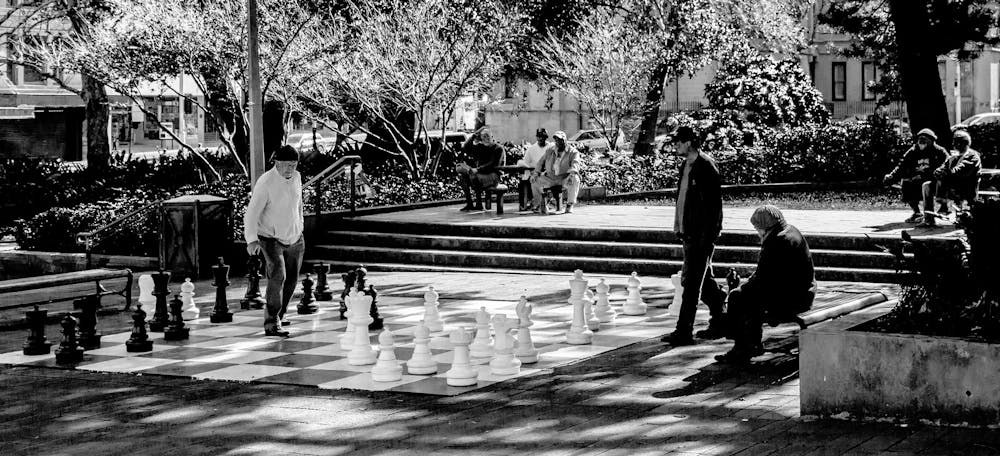 Third places that offer opportunities for shared activities, such as a game of outdoor chess, provide reasons to strike up a conversation.
alexmerwin13, CC BY-NC-ND
Third places that offer opportunities for shared activities, such as a game of outdoor chess, provide reasons to strike up a conversation.
alexmerwin13, CC BY-NC-ND
Third places bring people together based on shared spaces, which become more important than individual histories. This can reduce wariness of strangers and create social connections. Third places can lead to more resilient and better-connected communities, building up social capital, while reducing loneliness.
Providing quality third places
There are steps that can be taken to design and safeguard third places. Local councils and urban planners have important roles, given their central place in directing land uses.
Perhaps the most important thing is to understand the valuable social capital that successful third places offer. Once planners understand the value of third places, they can actively work to support them.
Walkability is an important factor. Third places encourage familiarity through repeated incidental interactions between locals, both regulars and newcomers. Ideally, people connect within their local neighbourhoods. Being able to visit without needing a car can encourage more people to use a place.
Space for third places can be designed into neighbourhoods and urban areas. Sections of parkland can be given over to public facilities such as outdoor gym equipment, dog parks or skate parks. Dedicated trading areas can be provided for farmers’ markets.
Third places are most effective when they encourage interactions between locals. Providing facilities and activities creates a purpose to interactions and reasons to start chatting.
Local councils can support citizen-led activities such as community gardens and men’s sheds. They can also provide activities such as Tai Chi classes.
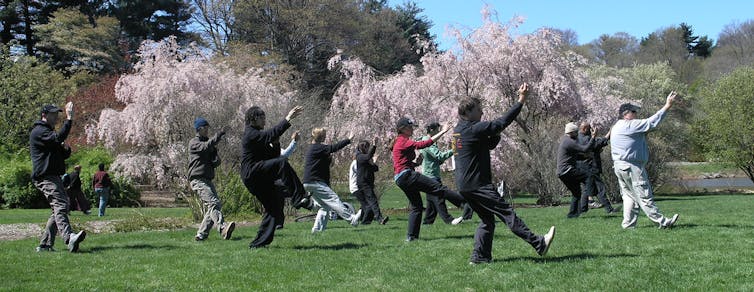 Outdoor Tai Chi classes turn green spaces into third places.
Brian Robinson/Flickr
Outdoor Tai Chi classes turn green spaces into third places.
Brian Robinson/Flickr
Protecting existing third places is as important as providing new ones. For example, a local council may be tempted to allow housing to take over the site of a community garden. While there may some be reasons to support that idea, it should be carefully considered against the loss of social capital and the risk of entrenching social isolation.
Valuing and promoting third places
We live in an age of urban mobility with no historical comparison. Many of us have been strangers in a new city. Loneliness is an unwelcome and growing feature of this urban mobility. Third places offer a useful and tested model for reducing loneliness by improving community.
Yet many city dwellers see these spaces but don’t use them. In this sense, perhaps the biggest barrier is our willingness to make the time to seek out and participate in third places. For those people who do, banishing loneliness could be one of the greatest benefits.
Read more: Planners know depressingly little about a city's impacts on our mental health
Authors: Tony Matthews, Lecturer in Urban and Environmental Planning, Griffith University


















