

Google AI


Modern Australian

In his last book, Julian Barnes circles big ideas and reflects on his shortcomings

  • Written by: Patrick Flanery, Chair in Creative Writing, Adelaide University

Julian Barnes, author of 14 previous novels, ten volumes of nonfiction, and three collections of short stories under his own name, plus four crime novels under the pseudonym Dan Kavanagh, has announced that his new novel, Departure(s), will be his last. The narrator – who both is and is not Barnes – tells us this directly and the information has accompanied advance notice from his publisher. This kind of framing necessarily invites the reader to judge the book as a capstone to his career.

Review: Departure(s) – Julian Barnes (Jonathan Cape)

For more than four decades, in ways distinct from near contemporaries like Martin Amis and Ian McEwan, Barnes has tried to awaken the English novel from its long fantasy of isolation, reminding it of its relation to European – and particularly French – literature.

For many years, his novel Flaubert’s Parrot (1984) was a foundational work in undergraduate courses in postmodern literature. But it has always felt to me as though this obscured the importance of the intervention Barnes was making.

His close reading of French literature translated formal experiment from the continental into the late-20th century English novel. Doing so, he opened the avant-gardism of anglophone late-modernism once again to the possibilities of a more European sensibility.

Illness and memory

It is no surprise to open Departure(s) and find Barnes employing fragmentation, lists, notes and quasi-philosophical musings, while refusing almost entirely to engage with any narrative structure that might resemble a plot.

There is a story of sorts, and the narrator tells us early on that one will be coming, though it is, he says, a story with no middle. Indeed, the five-part form of Departure(s) bookends and bisects the “story”. There is a central section about Barnes himself, and meditative opening and closing sections that reflect on larger questions – not only in relation to literature, but life more broadly.
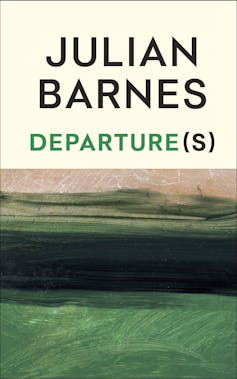
In his last book, Julian Barnes circles big ideas and reflects on his shortcomings
This makes sense for a writer whose life over the past 25 years has been marked by great career successes – including the Booker Prize for The Sense of an Ending (2011), after a succession of shortlistings – as well as the tragedy of his wife Pat Kavanagh’s sudden death from brain cancer in 2008 and, more recently, his own chronic illness. In 2020, Barnes, and the semi-fictional Barnes who narrates Departure(s), learned he had a form of blood cancer. He tells us that it will be with him until the end of his life, even if it is not the disease that kills him. Grappling with this new condition, he turns to last things: to an accounting of his own shortcomings and to memory more generally. Here we have reflections on Proust’s madeleine-induced stream of recollection, alongside Barnes’s thinking about the phenomenon of Involuntary Autobiographical Memory, or “IAM”. Barnes notes the case of a stroke victim, who claimed that eating a piece of pie released recollections of every pie he had ever eaten in order of consumption. He is at first horrified by the prospect of experiencing such a thing, until he realises that “IAMs would certainly help with autobiography”, particularly when recalling “moral actions and inactions”. The novel’s “story” proper, when we get to it, concerns the narrator’s role in twice bringing together a couple: Stephen and Jean. He met them when all three were students at Oxford in the 1960s, and they met again 40 years later. Their “friendship”, such as it was, lasted little more than two periods of a year and a half either side of that 40-year gap. The Barnes character had once been Jean’s lover, and his “moral actions and inactions” come to the fore in his account of these friends, now dead, for he promised Stephen and swore to Jean on a Bible that he would never write about them. There is here a return to some of Barnes’s longstanding interests as a novelist. Gaps in characters’ knowledge of one another become points of fixation or rupture. One of the fears besetting some novelists is that they may fall victim to their own Rumsfeldian “unknown unknowns”. We know what we know about characters, story, theme, and so on. And we think we know what we don’t know (the discernible limits of our knowledge). But there is always the risk of a work being fractured internally by a force whose presence has remained beyond thinkability. This might be as simple as a hole in a plot, or as significant as an ideological blind spot. Tics and irritants Though I suspect Barnes would assert that he was in total control of this book, there were moments when I wondered. For instance, odd tics create a distancing effect where they might have been intended to do the opposite. Barnes has a habit of addressing the reader with self-conscious asides (“don’t you find?”) that feel more conversational than writerly. There is also a curious refusal to name the male anatomy by its proper terms (though not so with the female). He uses schoolboy constructions such as “bum cancer”, rather than, say, “colon” or “rectal”. This is despite his being medically precise about his actual illness, its names, and its diagnosis and treatment. There are also a few uncomfortable moments referring to homosexuality. We have “old Muckface, who turned out gay in the end”. The narrator suggests it would have been especially disturbing to find “a collection of dildos with dried blood on them” in Stephen’s home and refers to “schoolmasters we thought dodgy”. The latter are the only examples of gay people the narrator claims to have encountered as a child. In his last book, Julian Barnes circles big ideas and reflects on his shortcomings
Julian Barnes. Urszula Soltys/Penguin Random House

Barnes hastens to welcome progress that makes society more accepting, but this does not, for this reader, counterbalance the implied equation of “dodgy” character or predatory habits with homosexuality, nor his vivid and horrified amusement when imagining his friend might have a secret inclination towards anal eroticism.

In another vein, we have the narrator choosing to call Uluru by its colonial name, almost intentionally, it seems, to irritate a certain kind of reader.

These demurs might suggest significant irritation, but this is not the case. What I want from a writer of Barnes’s intelligence, however, is a handling of identity and representation worthy of his mind and talent.

I’m on Barnes’s side for much – though certainly not all – of the book. It is refreshing to open a contemporary novel in English and find that story and plot are second-order concerns, and that revealing the story in a review would not risk ruining the pleasure – and interest – of reading the book. Spoilers spoil nothing here.

But then I reach a conundrum, for Barnes offers this summary of a writer’s aims:

All writers want their words to have an effect. Novelists want to entertain, to reveal truth, to move, to provoke reverie. And beyond? Do they want their readers to act as a result of their words? It depends.

This seems to sketch the limits of Barnes’ aspirations for his art, assuming he thinks of his novels as art and not as mere entertainments. What, for me, is missing from that list is the possibility that a novelist might want to make readers think about the larger questions in more than a state of “reverie”, a word that implies the amorphousness of daydream.

Barnes appears to be placing himself in a tradition running parallel to but separate from that of British novelists-of-ideas of an earlier generation like Iris Murdoch, or his contemporary Ian McEwan, and younger writers like Zadie Smith. For all of these writers, I suspect that provoking serious thought is as important – and likely more important – than producing an emotional response (its own kind of thought, to be sure) or simply to entertain.

It is an odd final manoeuvre because Barnes is a novelist interested in thinking and thought. He has made a career of circling big ideas. But in the end, assuming this is truly the end, it is hard not to feel that he seems embarrassed to find himself so seriously interested in those larger questions, or so interesting to the readers who may continue to turn to his books for more than mere reverie.

Authors: Patrick Flanery, Chair in Creative Writing, Adelaide University

Read more https://theconversation.com/in-his-last-book-julian-barnes-circles-big-ideas-and-reflects-on-his-shortcomings-270652

Understanding a dental implant Melbourne Treatment Plan

A dental implant Melbourne patients may consider is one option for replacing a missing tooth, but suitability depends on oral health, bone support a...

How 3PL Logistics Australia Supports Faster and More Efficient Supply Chains

Why Has 3PL Logistics Become Important for Growing Businesses?  Gone are the days when supply chains were simpler and in minimal quantity. Now, the...

Common Skin Concerns and Treatment Options Available in Melbourne

Skin concerns can develop gradually or become noticeable following changes in age, lifestyle, sun exposure or hormonal factors. Pigmentation, rednes...

Why a Code-Compliant Home Can Still Feel Uncomfortable

When people build or renovate a home, they usually expect that meeting current building requirements will also produce a comfortable place to live. ...

Breach of Contract in Business: What Are Your Options?

Contracts are essential to business relationships. They establish expectations, allocate responsibilities and provide a framework for delivering goods...

How Pest Control Companies Can Rank for the Problems Customers Search First

Introduction SEO for Pest Control needs to start with the customer’s problem. Most people do not search for pest services in a neat or technical wa...

What Are the Benefits of Renovating an Older Home in Sydney?

Sydney has plenty of character homes, from Federation cottages to mid-century brick homes. Renovating rather than rebuilding can preserve what makes t...

Pool and Deck Design: How to Plan the Perfect Outdoor Living Space for Your Sydney Home

For many Australians, the backyard is where life happens. Summer barbecues, weekend swims and long evenings outdoors are all part of the lifestyle, ...

Is Solar Pool Heating Worth It? What Sydney Homeowners Should Know

There's nothing quite like a backyard pool on a hot Sydney day. But once autumn rolls in, many pools sit unused for months because the water is simp...

Planning a Luxury House Move: A Week-by-Week Timeline for Prestige Sydney Homes

Selling or buying a prestige home is a major milestone. Whether it's a waterfront residence in Birchgrove, a grand Federation home in Haberfield or ...

Downsizing or Upgrading Your Caravan? Here's How to Sell It Without the Hassle

Selling a caravan can feel like a major task, especially when you are unsure about its value, paperwork, or how to find a buyer. Whether you are dow...

The Best Overseas Adventure Holidays for Australians Who Love the Outdoors

Australia offers no shortage of incredible outdoor experiences, but sometimes the best way to satisfy your sense of adventure is to head overseas. A...

Cape Town Wine Shuttle: Winelands Tasting & Tours

Embark on an unforgettable journey through the picturesque Cape Winelands, where world-class wines and breathtaking scenery await. Our Cape Town Win...

Metal Fabrication: Choosing Metal Fabrication Melbourne Services for Custom Projects

What Modern Metal Fabrication Involves From individual components to complete structures, metal fabrication brings together processes such as desig...

Why Giant Rats Tail Grass Keeps Coming Back After Spraying

Giant Rats Tail Grass (GRT) is one of the most frustrating pasture weeds for farmers and lifestyle property owners. You spray an infested area, see th...

When Custom Cardboard Boxes Make Sense for Your Business

Custom cardboard boxes can be useful when a standard carton does not fit a product, packing method or presentation requirement particularly well. A ...

Full-Height vs. Pop-Top Caravan: Which Is Better for Family Travel across WA?

A pop-top caravan is an excellent choice for travellers who want the comfort of a caravan without committing to a larger, bulkier setup. With a lowe...

Bottle Label Printing: Key Factors for a Professional Finish

Why the Printing Method Matters When businesses need packaging or printed containers developed for a particular application, the right supplier can m...

















