

After the firestorm: the health implications of returning to a bushfire zone
- Written by: Fay Johnston, Associate Professor, Environmental Epidemiology, Menzies Institute for Medical Research, University of Tasmania., University of Tasmania
Australia has a long history of bushfire disasters. The loss of almost 70 homes in Tathra, New South Wales, and 18 homes in southwest Victoria this week has again reminded us of the risks and huge personal costs of living in a fire-prone country. The risk is increasing as fires the world over are expanding in every dimension – in their timing, with extended seasons of favourable fire weather, frequency and severity.
Emergency services, communications and community support during fire disasters have become increasingly sophisticated to meet these growing challenges. An often overlooked aspect of bushfire management is post-fire risk. Many people will be returning to uncertainty. They will need to evaluate the immediate impacts on their homes and property, and the implications for their future.
Read more: Smoke from bushfires poses a health hazard for all of us
After the firestorm has passed, the risks to health remain. These include physical and chemical hazards associated with damaged structures, contaminated air, food and water, and the well-documented risks to mental health and well-being.
Preparing to return
There are many potential hazards in burnt properties. Returning requires caution and preparation.
It is important to check if the relevant emergency services have declared an area safe enough to allow residents to return and to seek guidance. Most jurisdictions provide resources relevant to their area. The Western Australian Department of Fires and Emergency Services provides particularly comprehensive information.
When entering a fire-affected property for the first time, use a face mask and wear protective clothing, including sturdy footwear, heavy-duty gloves, overalls with long sleeves and trousers – preferably disposable. The best face masks to use are “P2” masks, available from hardware stores. Ordinary paper dust masks, handkerchiefs or bandanas do not filter out the very fine ash and dust particles or hazards such as asbestos fibres. Bring plastic bags big enough to contain dirty clothing, which should be removed before entering a vehicle.
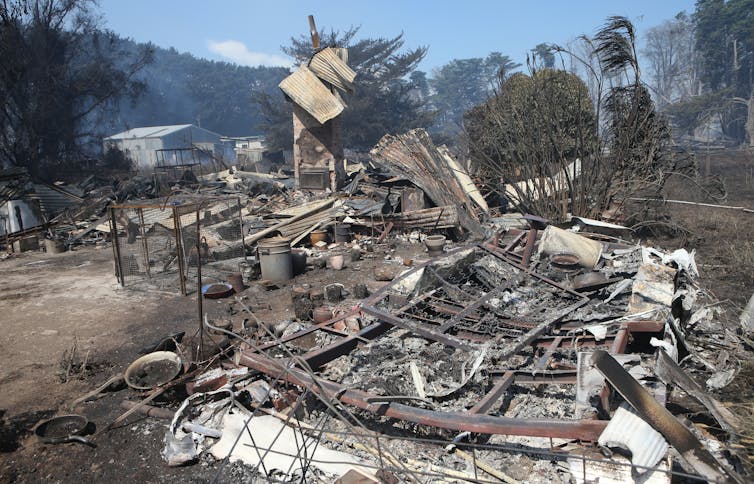 A burnt-down house south of Cobden in Victoria. There are many potential hazards in burnt properties and returning requires caution and preparation.
AAP/David Crosling
A burnt-down house south of Cobden in Victoria. There are many potential hazards in burnt properties and returning requires caution and preparation.
AAP/David Crosling
Checking for hazards
The list of potential hazards includes falling trees, branches and live power lines. Leaking gas may produce an odour or a hissing noise. Septic tanks can be damaged, leak sewage or collapse. The tank covers are at ground level and might not be visible.
Hot embers and smouldering vegetation can be present and ignite further fires. If there is a risk of major structural damage to buildings, a building inspector should check these before entry.
Fires can release potential toxins from some building materials. For example, ash from CCA-treated wood, commonly used in decking, fencing and landscaping, is harmful and skin contact and inhalation should be avoided. It is recognisable as green-coloured ash.
Houses built before 1990 might have asbestos cement sheeting and exposure to asbestos fibres can occur if people actively disturb ashes. If asbestos is likely to be present, a licensed asbestos removalist must do the clean-up work.
Other hazards can come from gas cylinders, garden chemicals, cleaning products and other burnt residues.
Air quality
Smoke might be present in the area from the recent fires or local smouldering debris. Smoke is toxic and can worsen heart and lung problems for some people. Those most at risk are children including unborn babies, the elderly, smokers and people with heart and lung diseases, including asthma.
Portable generators are another source of air pollution. These should always be used in well-ventilated areas to avoid the risk of carbon monoxide poisoning.
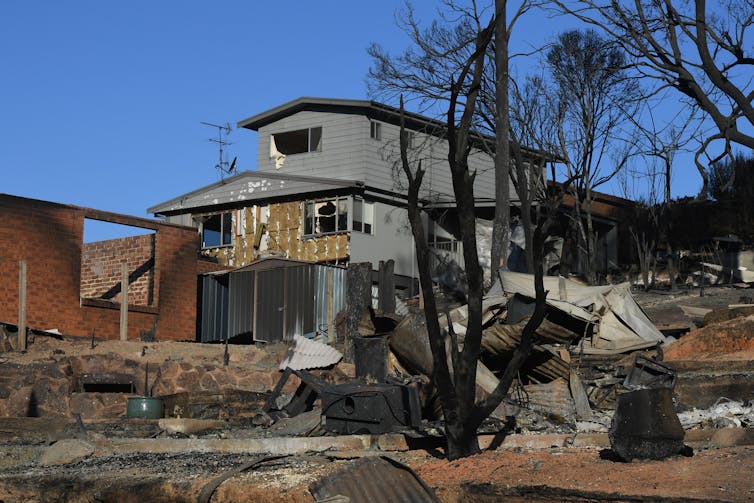 Houses, regardless of whether they were damaged by fire, are likely to have had a period without power.
AAP/Dean Lewins
Houses, regardless of whether they were damaged by fire, are likely to have had a period without power.
AAP/Dean Lewins
Food and water safety
Houses, regardless of whether they were damaged by fire, are likely to have had a period without power. Once cold or frozen food has warmed or thawed, it should be thrown out. Food, drinks or medicines that have been exposed to heat, smoke and water damage are also no longer safe for consumption.
If rainwater tanks are intact and the water has no abnormal look, smells or taste, the water should be safe to use, although it’s wise to boil untreated water. However, if firefighting foams or animal carcasses have contaminated water in a tank it should be drained and refilled with clean water. It’s also important to clear the house roof of carcasses or other contaminants that could end up in rainwater tanks.
Personal impacts
The psychological trauma of experiencing a fire can be overwhelming for adults and children alike. It is possible they are grieving for a spectrum of losses, including friends and neighbours, pets and livestock that have been killed or injured in the fire, loss of treasured personal effects and even the wider sense of loss of place that has been called solastalgia.
While most people do recover from the traumatic experience, the emotional toll can be serious and long lasting for some, with symptoms such as depression, anxiety, anger, fatigue, nightmares and difficulty concentrating. It is possible that people are no longer able to live in surrounds they once cherished and must move away.
Read more: The age of solastalgia
The onset of mental health issues can sometimes be delayed months and even years after the event. Help from a counsellor or family doctor can manage and reduce these impacts. Involvement in community activities and social connections can help promote resilience and be protective.
It is important to note that post-traumatic stress has a more positive counterpart, post-traumatic growth, and it is possible that individuals and communities can become stronger and more resilient as a consequence of rebuilding and recovery following a bushfire.
Prompt rebuilding of community centres and restoration of community services and activities are keys to helping individuals and communities recover. For this reason firefighters will prioritise protection of community assets.
Community support vital
Returning to fire-affected areas can be hazardous and traumatic. Residents should be prepared and equipped for protection from potential hazards, and seek advice from appropriate authorities such as emergency services, local councils and public health agencies.
Ongoing social connections and community support are essential for reducing the personal and psychological impacts. This support needs to continue long after the disaster has been forgotten by the news media.
In the affected communities in NSW and Victoria, this work has already begun. Community meetings are taking place to start the process of support that will be crucial in the long journey of rebuilding lives and communities.
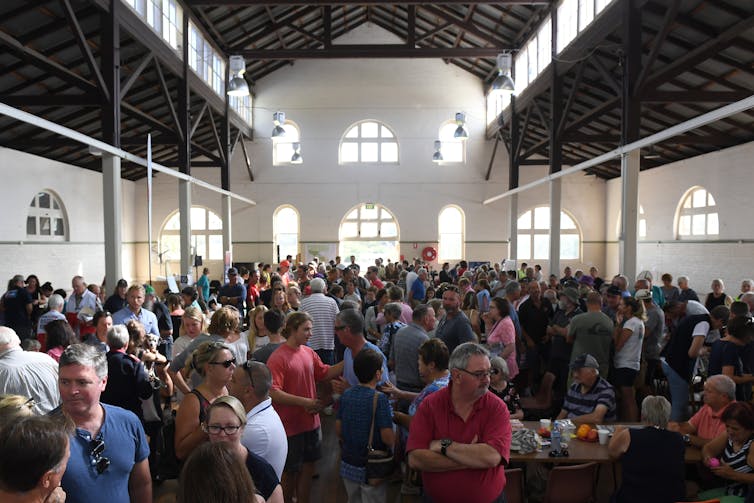 Hundreds of residents gathered at the evacuation centre at Bega Showground this week after a bushfire destroyed more than 70 homes in the coastal town of Tathra, NSW.
AAP/Dean Lewins
Hundreds of residents gathered at the evacuation centre at Bega Showground this week after a bushfire destroyed more than 70 homes in the coastal town of Tathra, NSW.
AAP/Dean Lewins
Authors: Fay Johnston, Associate Professor, Environmental Epidemiology, Menzies Institute for Medical Research, University of Tasmania., University of Tasmania


















