

One family’s ocean paddle almost ended in tragedy. It reminds us coastal weather is notoriously changeable
- Written by Samuel Cornell, PhD Candidate in Public Health, School of Population Health, UNSW Sydney
The extraordinary rescue this week in Geographe Bay, Western Australia has been described as heroic. A 13-year-old boy swam four hours to shore in rough seas after his family was swept far from the beach. This boy’s bravery in raising the alarm is to be commended.
For the public, it’s useful to consider how the family found itself in this predicament. The boy’s mother told the ABC the weather conditions had rapidly changed. This is similar to other recent marine rescues.
According to the boy’s mother, conditions were calm when she and her three children set out on inflatable paddle boards and a kayak. But in a short time, strong winds and waves pushed them steadily out to sea, leaving them clinging to a board about 14 kilometres from shore.
How does weather change so quickly at sea – and why does it catch even careful people by surprise?
Read more: The ocean can look deceptively calm – until it isn’t. Here’s what ‘hazardous surf’ really means
Why ‘good’ weather can change rapidly
Coastal weather is notoriously dynamic. Unlike conditions on land, which are shaped by friction from terrain, the atmosphere over the ocean can change rapidly as wind systems move unobstructed across large distances.
In southern WA, afternoon sea breezes are a key factor, such as the Fremantle Doctor. On warm days, air rises over land and draws cooler air in from the ocean. These sea breezes can strengthen rapidly in the late afternoon or early evening, sometimes increasing by around 10 knots or more over a few hours.
In Geographe Bay, about 220 kilometres south of Perth, a strengthening afternoon south-westerly sea breeze could plausibly drive a light inflatable craft away from shore. Owing to the orientation of the Quindalup–Dunsborough coastline, prevailing summer sea breezes strike the coast obliquely, creating cross-shore drift that can steadily increase the distance from land once paddlers lose their ability to make headway.
Sudden wind shifts can also occur when cold fronts approach. Even if a front is hours away, pressure changes ahead of it can cause winds to freshen unexpectedly, particularly later in the day.
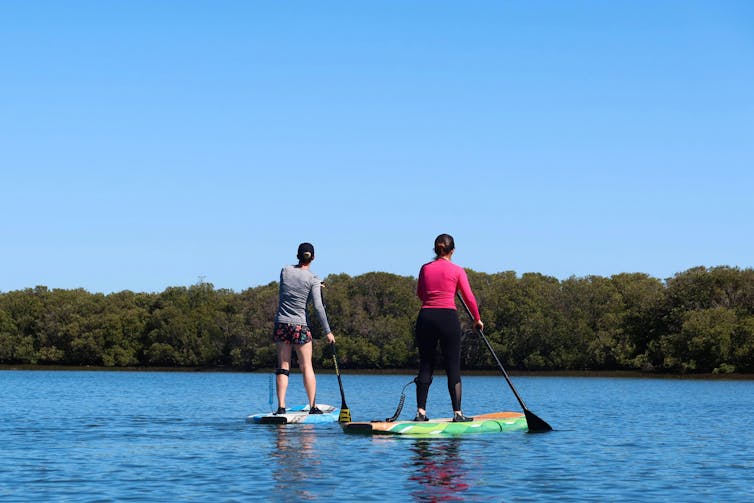
Winds, waves and currents
Wind alone is dangerous enough, but when combined with waves and currents it can dramatically reduce a person’s ability to return to shore, even with a craft.
Strong winds striking the coast obliquely create surface drift, pushing lightweight vessels – such as inflatable paddleboards and kayaks – steadily offshore. At the same time, wind-driven waves increase drag, making paddling or swimming far more exhausting.
Ocean currents compound the problem. Even modest currents of 1–2 knots can exceed a swimmer’s sustainable speed over long distances. Against waves and wind, fatigue sets in quickly, increasing the risk of panic, hypothermia and drowning.
Research consistently shows people overestimate their ability to swim or paddle against environmental forces. Once offshore drift begins, the distance to shore can increase much faster than people realise.
Inflatables – a boon and a potential bane
Inflatable craft, such as stand-up paddle boards, are increasingly popular as they’re often cheap, portable and easy to use.
But they’re also particularly vulnerable to wind, even light breezes.
Because inflatables sit high on the water and have little mass, they act like sails. Even moderate winds can overpower a paddler’s strength, especially when conditions deteriorate. Marine safety agencies repeatedly warn inflatables should only be used close to shore, in light winds, and with constant attention to changing conditions.
In coastal Australia, large-scale wind changes often unfold over hours, but conditions on the water can feel dramatically worse within minutes once waves build and fatigue sets in. The weather can shift from benign to hazardous within minutes, particularly in the afternoon and early evening.
This is why marine forecasts often emphasise timing, not just wind strength.
A forecast of “10–15 knots increasing to 20 knots in the afternoon” may sound manageable. But for paddlers and swimmers, that increase can mark the difference between control and crisis.
Clouds developing, rising wind, whitecap waves forming further offshore and a sudden drop in temperature are all warning signs that conditions are changing, and a cold front is approaching.
What to do if caught out
First, stay calm. Staying with the craft, such as the inflatable paddle board, is imperative. It provides flotation and – crucially for rescue – visibility. If you have a life jacket, you should keep it on.
If you don’t have a flotation device, you should float on your back. Remember, Float to Survive. Floating on your back, keeping limbs relaxed, and pacing your effort can extend survival time significantly.
If you must swim, swimming diagonally across waves or with the waves, rather than directly against them, may help reduce exhaustion. Crucially, raise the alarm as soon as possible. Early notification gives rescue crews a far greater chance of success.
How to avoid this situation
Prevention remains the most effective safety strategy.
Before heading out, check marine forecasts – not just general weather apps – and pay close attention to wind strength, direction and timing. Avoid inflatables when winds are forecast to increase later in the day.
Always wear a life jacket, even in calm conditions, and carry a waterproof communication device if possible.
Stay close to shore, set clear limits on how far you’ll go, and be prepared to turn back early. Always let other people know you’re heading out to sea, even if you plan on staying very close to shore.
The Geographe Bay rescue had a remarkable outcome, thanks to the extraordinary courage and determination of the young boy. But it also highlights a sobering reality: the ocean doesn’t need to be stormy to become dangerous. Sometimes, it just needs the weather to change – and it often does, faster than we expect.
Authors: Samuel Cornell, PhD Candidate in Public Health, School of Population Health, UNSW Sydney

















