

Can a bird be an illegal immigrant? How the White Australia era influenced attitudes to the bulbul
- Written by Simon Farley, Assistant Lecturer, History, The University of Melbourne
In early January, authorities from South Australia’s Department of Primary Industries took to the streets of Adelaide on the hunt for a suspicious individual.
This individual had been spotted several times in the preceding weeks: they had red cheeks, brown wings and a black crest. It was a red-whiskered bulbul — a non-native bird, often seen around Sydney and Wollongong but not normally present in SA. Most Australians have likely never heard of a red-whiskered bulbul, much less seen one. But these birds have been living here since the First World War.
A spokesperson for the state explained why one little bird was causing such a fuss:
the red-whiskered bulbul is a high-risk pest bird that can damage SA’s vineyards and orchards by eating soft fruit, flower buds and insects, potentially reducing yields or causing crop failure
Is this bulbul really a harbinger of catastrophe for SA’s fruitgrowers? As a historian who researches introduced species in Australia, I suspect there is more at stake here than a few grapes and cherries.
Australia is a country forged through suspicion and fear of outsiders – a theme still prevalent in politics today. The bulbul first arrived here in the heyday of the White Australia Policy, and at the time, its Asian origin influenced the way Australians reacted to it. Could this history still influence attitudes towards it today?

First bulbuls were likely escapees
The red-whiskered bulbul’s “natural range” — where it lived before humans transported it elsewhere — includes much of India, southern China and Southeast Asia. But humans have brought it to places as far apart as Mauritius, Hawaii and Florida, as well as Australia.
Many of the birds Australians see every day have been introduced since the beginning of colonisation. This is true of domesticated birds such as chickens and pigeons, brought here on the First Fleet in 1788. In the 19th century, “acclimatisers” — naturalists who made it their mission to move species of animal and plant across the globe — successfully introduced several species of wild bird, such as blackbirds and common (or “Indian”) mynas.
Bulbul populations appeared almost simultaneously in both Sydney and Melbourne in the late 1910s. The bulbul was a popular pet at the time, and it’s probable these populations arose from aviary escapees. (This seems to be how the bird became established in the wild in other regions such as Florida.)
At first, the bird prompted not much more than curiosity. Some warned its penchant for fruit would lead it to becoming a pest; others praised it for eating troublesome insects such as aphids.
Bulbul scrutinised in era of xenophobia
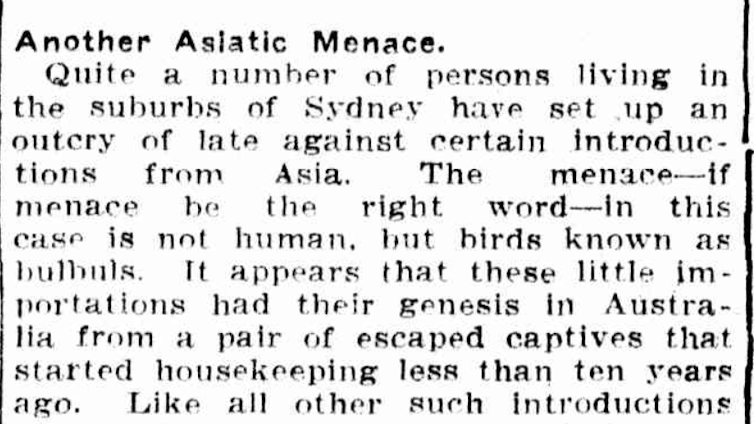
The bulbul arrived during the zenith of the White Australia Policy, and its Asian origin meant it received extra scrutiny. As early as 1922, commentators wrote about the bird under headlines like “Another Asiatic Menace”, “Asiatic Settler” and “Immigrant Bird”. A 1926 headline in the Melbourne Herald was even more explicit: “Mr. Bulbul: Asiatic Bird That Has Beaten the Migration Laws”. Farmers and gardeners wrote to newspapers to complain of bulbuls eating their fruit, calling the birds “undesirables” and “foreigners in feathers”.
Some people thought these responses were prejudiced, and said so. One correspondent of Sydney’s Evening News called on readers to give “the bul-bul a fair go”. There was no denying that the bird was charming and had a beautiful song, even if it did eat fruit and flowers. Some commentators argued the bulbul had become “naturalised” – that it had earned a right to belong in Australia, regardless of origin.
There is something hopeful in all this. Even at a time of intense and wide-ranging racism and xenophobia, an Asian bird could still “become Australian”.
But these voices were always a minority. As the species was never protected by law, orchardists and gardeners encouraged each other to shoot and trap bulbuls whenever possible. By 1935, an employee of the Sydney Botanic Gardens was shooting up to six bulbuls a day.
Much ado about nothing?
Today, bulbuls still thrive around Greater Sydney, their range stretching north to Newcastle and south to Nowra. But Melburnians rarely see them, according to publicly accessible data on the Birdata and Ebird platforms. Perhaps they have been muscled out by growing numbers of aggressive and adaptable native birds such as noisy miners and pied currawongs.
Like the recent visitor to Adelaide, bulbuls have been spotted occasionally in SA since the 1940s, but decades can pass without a single bulbul being seen in the state. Whether or not bulbuls someday form a viable population in SA remains to be seen. But if they did, would it really be so bad?
We know that some non-native birds, like starlings, cause immense problems for farmers and do compete with native birds for nesting sites. However, there is very little peer-reviewed research on the red-whiskered bulbul in Australia. In 2014, ecologist Matthew Mo wrote there was no evidence that competition between bulbuls and native birds is “ecologically significant”. Even the evidence for its impact on fruit crops and role in spreading weeds remains scant. At best, we have a deficiency of research. At worst, we’re getting worked up about a relatively harmless bird, just because it’s not native.
White Australians of the interwar period let their xenophobic attitudes towards Asian humans distort their view of an Asian bird. I’m not arguing those worried about the bulbul today are doing so because they are personally racist. But today’s anxieties about the bulbul do seem acute, given the lack of any hard evidence. After all, native birds can do enormous damage to fruit crops, too.
In many cases, we’re right to be concerned about the ecological and agricultural impacts of non-native wildlife — I’m not here to defend rabbits, brumbies or feral cats. But that doesn’t mean every introduced species is a catastrophe waiting to happen. The story of the bulbul in Australia should give us pause. During more than a century on this continent it has been, at worst, a minor nuisance. When the intensity of our emotions does not match the evidence, we need to ask ourselves why.
Authors: Simon Farley, Assistant Lecturer, History, The University of Melbourne


















.jpg)