

An illegal bioweapons lab was found in a Las Vegas garage. It’s a warning for Australia
- Written by Brendan Walker-Munro, Associate Professor (Law), Southern Cross University
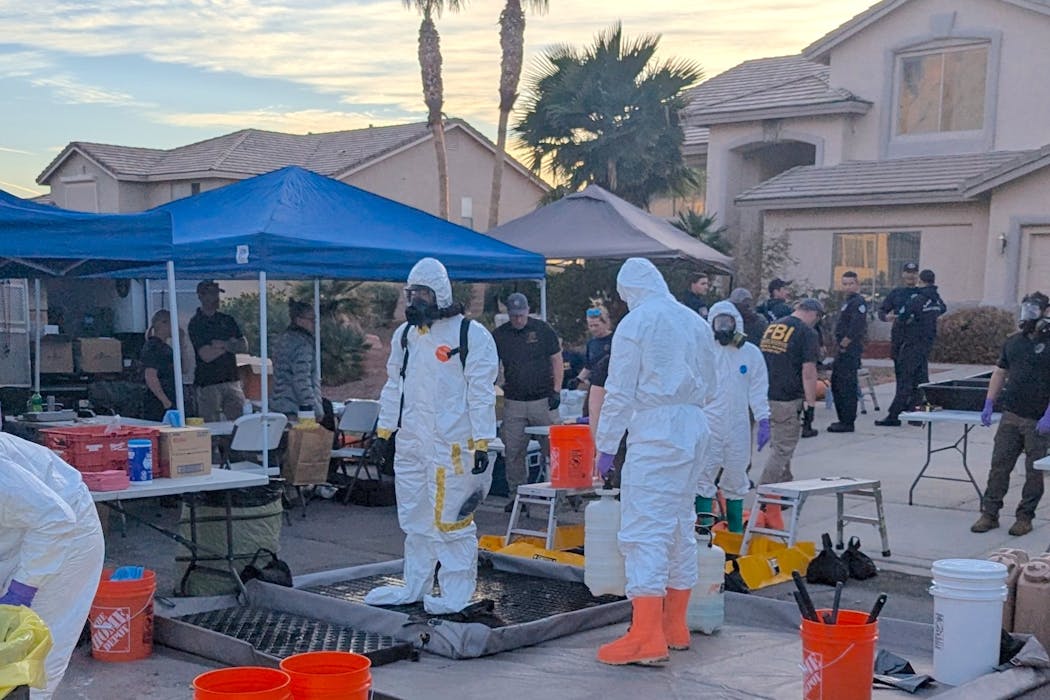
In Las Vegas last week, two people were admitted to hospital “deathly ill” after being exposed to “possible biological material, including refrigerators containing vials with unknown liquids” at a suburban home. Law enforcement quickly scrambled, taking down an illegal laboratory on the premises.
But this wasn’t a meth lab. Instead, it was allegedly filled with thousands of deadly pathogens.
The FBI has since opened an official investigation. It claims the Las Vegas lab is linked to another illegal lab in California that was shut down in 2023, which was investigated by US Congress. Congress found the California biolab had received millions of dollars from Chinese banks, and held more than 1,000 genetically modified mice as well as samples of diseases including HIV, malaria, COVID and even Ebola.
The US is now asking how many of these labs might exist. In Australia, we can’t really answer that question either.
Why are these labs emerging now?
New technologies such as artificial intelligence (AI) are putting advanced biological techniques into the hands of everyday people.
Once, you needed a doctorate’s worth of knowledge and years of experience to build a biological weapon. Now, AI may be able to teach you everything you need to know.
A study published last year showed a publicly available AI model outperformed 94% of PhD-holding virologists (on one benchmark, at least). More specialised AI systems can help you design proteins or genetic sequences in your living room. Engineers at Google have even created an entire AI-driven “virtual laboratory” to devise and synthesise new chemical compounds.
What’s more, the genetic sequences of deadly viruses are freely available online. Open-source databases such as NextStrain and PathoPlexus offer researchers the ability to share their work in the hope of developing new vaccines or antibiotics.
But those same resources can be used by malicious actors to “shop” for pathogens, then pay synthetic biology companies to build DNA sequences to order.
Some scholars fear this situation means “no disease-causing organism can forever be eradicated”. In 2020, for example, Swiss scientists created samples of the virus behind the COVID pandemic using DNA sequences emailed from China weeks before any human infections were reported in Switzerland.
For would-be terrorists, backyard biolabs may be a “low-risk, high-reward” option.
As the threat of politically motivated violence in Australia increases, so does the chance a sovereign citizen or far-right group, or any other kind of extremist, may look to use biology in an attack.
If the Bondi shooters or Perth Invasion Day attack had used disease instead of guns or bombs, many more people could have died.
What does this mean for Australia?
There are key gaps in Australia’s regulatory framework for pathogens made in backyard labs, as I outlined in 2024:
First, our laws only operate in the physical world. They don’t cover the virtual world, and struggle to apply to emerging technologies.
Second, Australia’s “security-sensitive agents” scheme controls specific pathogens by name. This means any newly invented disease is not covered. One observer suggested this is like “someone taking a hand grenade, painting it a different color, and walking it through an airport with no problem”.
And third, our regulatory scheme operates across ten different government departments, universities and funding agencies. With that much complexity, something is bound to get missed.
Another big problem is a lack of transparency, where even authorised laboratories in Australia operate under a cloud of secrecy. There is no publicly available list of who is authorised to handle these diseases.
While attempts to map such labs do exist, one study published last year estimated the number of labs in Australia working on highly hazardous diseases is anywhere between 15 and 40.
Even worse, despite increases in lab regulation and safety guidelines, mistakes happen. Labs leak viruses, infect their workers, and keep poor records, with a recent study showing “worldwide documentation and reporting of accidents are generally poor”.
Another potential risk is underpaid researchers and students willing to sell knowledge on the black market.
What can be done?
Australia needs to revisit its approach to regulating technology in life and medical science research. At the moment you can buy synthetic DNA online without even a permit, which introduces big risks.
The developers of AI tools used in medical and life sciences research also need to build in guardrails to prevent misuse. We need to make sure the researchers and students doing work on pathogens are trustworthy, too.
Further, Australia could also take a leadership role in pushing for a unified framework for regulating global access to dangerous diseases.
The newly established Australian Centre for Disease Control (CDC) also has a role to play. It can educate the medical profession and the general public about backyard biolabs and their threat to public health.
It can also coordinate the various government agencies who all have a hand in disease regulation. The centre could also drive more comprehensive public reporting of lab accidents and incidents. It will need to push adapting the “security-sensitive” agents scheme to modern research as well.
The public has a role to play, too: reporting suspected illegal labs, no matter what they are being used for. An anonymous tip-off from a member of the public was what led to last week’s raid on the Las Vegas lab.
Authors: Brendan Walker-Munro, Associate Professor (Law), Southern Cross University

















