How Indigenous ideas about non-linear time can help us navigate ecological crises
- Written by Philip McKibbin, PhD Candidate, Sydney Environment Institute, University of Sydney
It is common to think of time as moving in only one direction – from point A, through point B, to point C.
However, many Indigenous peoples – including Māori, the Indigenous people of Aotearoa New Zealand – experience time non-linearly.
Rather than picturing time as a straight line, we imagine it as recurring, spiralling, and recalling itself.
How we conceptualise time could impact how we respond to ecological crises.
Indigenous time/s
As Māori, we understand time – wā – non-linearly.
Researchers Hana Burgess and Te Kahuratai Painting contrast Māori time with colonial time, saying:
With settler colonial ontologies, time is flattened, made one dimensional, reduced to a linear process […] Along this arrow of time, the “present” is placed at the pinnacle of existence, disconnected from both the past and future.
Māori, however, do not place the present at the centre; as the same researchers put it, “there is no centre”.
We think with and as ancestors, and prophecy informs many of our movements.
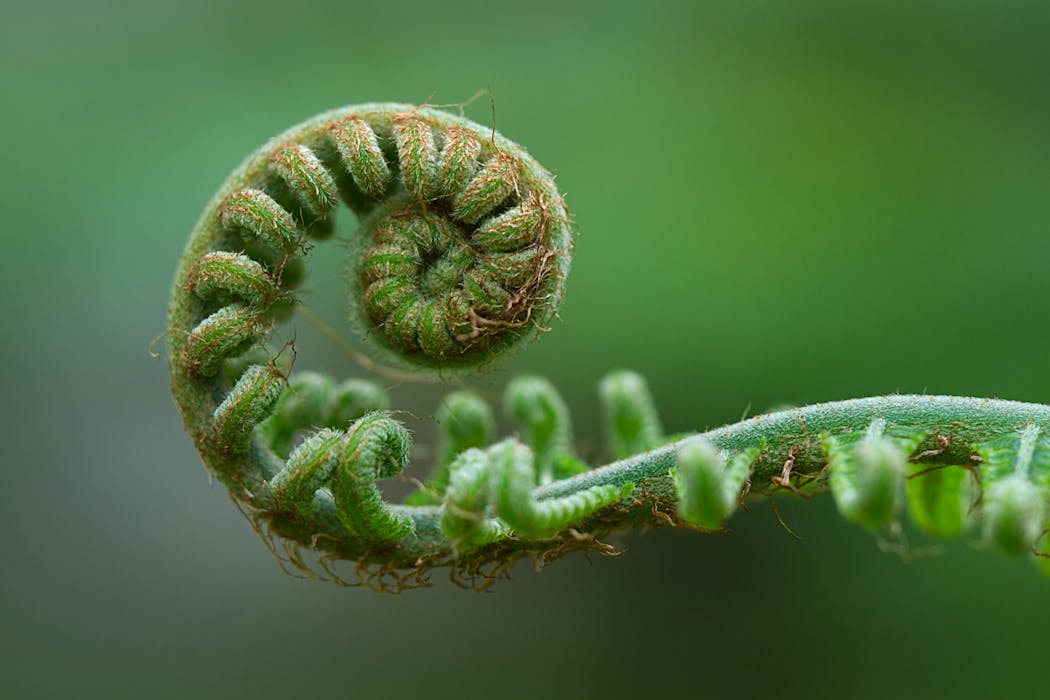
For us, non-linear time finds natural expression in a metaphor: the koru, or unfolding fern frond. Researcher Paula Toko King and colleagues note this represents
the continuous cycles of life and death and the unfolding of the cosmos, emerging from the realm of potentiality.
Spiralling time should not be confused with circularity.
As writer Makere Stewart-Harawira explains:
a circle invariably returns to the point of origin, [however] the spiral never returns exactly to the point of origin but moves progressively forward in a process of constant motion and expansion.
Significantly, as Potawatomi scholar Kyle Powys Whyte notes:
Spiraling time is an important topic of discussion when Indigenous persons compare their conceptions of temporality across different cultures.
Non-linear time
For many of us – Indigenous and non-Indigenous – non-linear time can be difficult to conceptualise, at first.
Consider memory, dream, imagination, and fantasy, all of which weave past, present, and future in ways that frequently impact how we act.
Think about your favourite season: every time it recurs, it is at once freshly present and reminiscent of past seasons. It may even prompt you to think about future ones.
We do not always realise that our experience of time is non-linear. And yet, for most – if not all – of us, it is. To experience time non-linearly is natural.
Importantly, as Kyle Whyte explains:
Spiraling time does not foreclose linear, future thinking.
This is true of non-linearity generally, which is closer to linearity than the prefix “non-” suggests (yet another way in which binaries constrain our thinking).
3 important insights
Non-linear time could help us to navigate compounding ecological crises, such as climate change, biodiversity loss, and mass extinction.
The common refrain, “we’re minutes to midnight” is often used to prompt a sense of urgency and push us to act quickly without considering all the consequences of doing so. Non-linear time subverts this, offering three important insights.
First, these crises will impact, and are impacting, people and peoples differently. Marginalised communities are closer to “midnight” than others. For those who are feeling the effects of these crises, it makes more sense to say, “we’re (already) minutes past midnight”. In recent years, for instance, my iwi (Māori tribe), Kāi Tahu, has had to discuss the possibility of a managed retreat from the coastline, as many of our marae (gathering places) are located on the coast.
Second, non-linear time encourages us to think about – and plan for – what comes “afterwards”. These crises are unlikely to lead to human extinction, and there will be non-humans who survive with us; so it benefits us all to think about how we might navigate collapse, and steps we could take now to transition to alternative ways of living.
Linearity leads us to place too much emphasis on static points, such as thresholds, which typically elevate humans over others. We might ask: what comes after “midnight”?
Third, non-linearity challenges us to imagine beyond anthropocentrism. We conceptualise time in human ways, but it is not only us who are threatened by, and forced to navigate, these crises. Breaking free of linear time helps us to think about the world beyond “the human”. It leads us to wonder.
And what do we learn? That we humans are not the only ones here; that it isn’t only us and “the environment”; that to reduce non-humans to dimensions of “the environment” – as we do when we treat others as exploitable resources – is, ultimately, oppressive; and that only by broadening our concern will we realise justice.
It’s true, “midnight” can be a dangerous time for humans; but by attending to non-humans – including nocturnal animals like kiwi, wētā, and the brushtail possums I love – we will continue to find the dawn, not alone but together.
Authors: Philip McKibbin, PhD Candidate, Sydney Environment Institute, University of Sydney