

How Iran’s current unrest can be traced back to the 1979 revolution
- Written by Mehmet Ozalp, Professor of Islamic Studies, Head of School, The Centre for Islamic Studies and Civilisation, Charles Sturt University
The recent unrest in Iran, with the third mass protests in the past six years, has left the theocratic regime wounded but not out.
Iran is no stranger to such unrest. In 1979, similar circumstances led to the Iranian revolution. However, Iranians soon became disappointed that the revolution did not deliver what they had been promised. So while the ideology of the revolution collapsed, the regime remains in place.
To understand this, we need to go back to the emergence of modern Iran.
Democracy or monarchy – whose choice is it?
The recent popular unrest reflects the Iranian people’s desire for self-determination, freedom and progress. The fight for self-determination goes back to the late 19th century and the rise of the Persian Constitutional Revolution.
In 1906, this push succeeded in forcing Qajar Shah to instate a constitution and one of the first parliaments in the Muslim world.
Later, in the turbulent aftermath of the first world war, Shah Mohammad Reza Pahlavi led a military coup establishing modern Iran. He was an authoritarian leader, in keeping with the trend of the 1920s and 30s. At the same time, he also tried to modernise Iran with a series of reforms and developments.
During the second world war, Pahlavi was deposed with the Anglo-Soviet invasion of Iran in 1941. Iran was too important geopolitically – for the war in Russia against the Nazis and Indian Ocean against the Japanese – with a constant and free supply of oil for the British war machine.
This importance did not wane after the war. Now, the Cold War dominated geopolitics and Muslim countries found themselves in the middle of it. Iran and Turkey were key countries where communist Soviet expansion efforts were intensified.
In response, the United States provided both countries with economic and political support in return for their membership in the democratic western block. Turkey and Iran accepted this support and became democratic in 1950 and 1951, respectively.
Later in 1951, Mohammad Mosaddeq’s National Front became the first democratically-elected Iranian government. Mosaddeq was a modern, secular-leaning, progressive leader who was able to gain the broad support of both the secular elite and the Iranian ulama (Islamic scholars).
He was helped by a growing public disdain for Pahlavi monarchy and rising Iranian anger at British exploitation of their oil fields. Iranians were only receiving 20% of the profits.
Mosaddeq made the bold move to address this issue by nationalising the British-owned Anglo-Iranian Oil Company (AIOC). This did not work out in his favour, as it attracted British and US economic sanctions, crippling the Iranian economy.
In 1953, once again, Iranian people were denied self-determination. The Mosaddeq government was replaced in a military coup organised by the CIA and British intelligence. The shah was returned to power and the Anglo-Iranian Oil Company became BP, British Petroleum, with a 50-50 divide of profits.
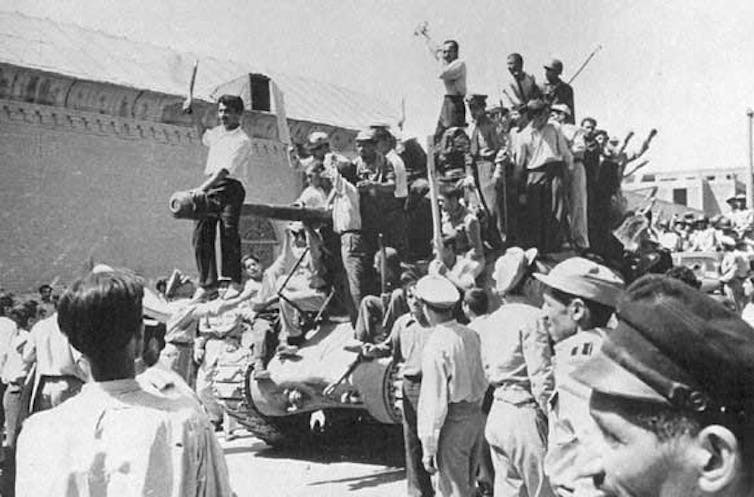
This intervention sent the unintended message that a democratically elected government would be toppled if it did not fit with Western interests. This narrative continues to be the dominant discourse of Islamist activists today, in Iran and beyond.
The Islamic Revolution
Between 1953 and 1977, the shah relied heavily on the US in his efforts to modernise the army and Iranian society, and transform the economy through what he called the White Revolution.
But it came at a hefty cost. Wealth was unequally distributed, with a large underclass of peasants migrating to urban centres. The economy could not keep up with the growing population, unplanned urbanisation and lack of an open economy.
Having tasted democracy for a brief period during 1951–53, many Iranians wanted democratic rights and economic progress. This uprising resulted in large-scale political suppression of dissent.
Disillusioned religious scholars, such as Ayatollah Ruhollah Khomeini, were alarmed at the top-down imposition of a Western lifestyle, believing Islam was being completely removed from society.
In a 1978 interview with a US news program, Khomeini characterised the shah’s regime as one that deprived Iranians of independence and freedom, stating that “we don’t have the true independence, we are suffering […] we want the liberty of our people.”
Read more: World politics explainer: the Iranian Revolution
What revolution promised but could not deliver
Ironically, Iranian protesters say almost the same things about the current regime created by Khomeini: that it is the cause of their suffering and lack of freedoms.
The revolution promised true independence, freedom, a more Islamic social and political order, and greater economic prosperity. The failure to deliver on these promises is at the heart of the popular unrest in Iran today.
The 1979 Islamic Revolution ended Iran’s strategic alignment with the US and the West, leading to decades of political and economic isolation. While the Islamic Republic maintained its ideological stance of “neither East nor West”, sustained Western sanctions gradually pushed Iran closer to Russia and China.
The 45 years of a theocratic regime have been equally or even more oppressive than the shah’s rule. People’s freedoms and rights have regressed significantly. While strict public dress codes for women remain in law and are still enforced — sometimes harshly, as seen in the 2022 protests following the death of Mahsa Amini — compliance has loosened over time, with many women pushing the boundaries in major urban centres.
The most important premise of Islamism – making society more religious through political power – has also failed. Nearly two-thirds of Iranians today were born after the 1979 revolution. Yet, a 2020 GAMAAN survey found state-driven Islamisation has not produced a more religious society. Identification with organised religion appears to have declined, particularly among younger people.
Khomeini and his supporters promised economic prosperity and to end the gap between rich and poor. Today, the Iranian economy is in poor shape, despite the oil revenues that hold it back from the brink of collapse. People are unhappy with high unemployment rates, hyper-inflation and never-ending sanctions. They have little hope for the country’s economic fortunes to turn.
As a result, Iranians have lost hope in the ruling elite’s ability to ensure a brighter future.
Will the theocratic regime collapse any time soon?
So, the main ideology of the revolution has collapsed. What about the regime itself?
For any regime to collapse, including the current one in Iran, four key forces and factors, or a combination of them, have to exert sufficient force: popular mass protests, an army coup, external interventions and division among the ruling elite.
Iran has seen many mass protests in the past 40 years. While these did not bring down the regime, their frequency is increasing.
The November 2019 protests, triggered by a sudden fuel price hike, rapidly spread across the country. The 2022–23 protests, sparked by the death of Mahsa Amini in morality police custody, evolved into a sustained nationwide movement under the slogan “woman, life, freedom”. Most recently, the 2025–26 protests have been driven primarily by a severe economic downturn.

But protests are not sufficient to cause a collapse of the regime. They are usually met with countrywide internet blackouts and violent crackdowns leading to hundreds of deaths. This happened again in the recent unrest, with the death toll reaching at least 5,000.
International interventions
Iran has been under extensive economic sanctions for decades, yet these have failed to bring about major political change or weaken the Islamic Republic’s hold on power. In the aftermath of the revolution, Iraq — backed politically and materially by United States and its allies — invaded Iran in 1980 in a bid to contain and possibly topple the new regime before it consolidated. After eight years of devastating war, this effort also failed to dislodge the Islamic Republic.
Other countries have launched short military interventions in the past, with the last one by the United States and Israel in June 2025 targeting the army headquarters and nuclear facilities. These did not lead to a regime change.
It seems anything short of a full-scale war or land invasion is unlikely to lead to a regime change in Iran. And we know from the experience in Iraq and Afghanistan that such interventions don’t end well.
Could Iran’s Islamic Revolutionary Guard Corps (IRGC) stage a coup? It seems highly unlikely. The IRGC is structurally oriented toward preserving and reshaping the system from within, not overthrowing it. Created as a parallel force to prevent coups, the IRGC is intentionally kept fragmented, bound by layered chains of command, and vertically loyal to the supreme leader, making unified action very difficult.
Then, there is the potential for a leadership struggle within the regime itself. For now, this is not a factor, but it could be soon if the elderly Supreme Leader Ali Khamenei dies.
Khamenei, who succeeded Khomeini in 1989, is Iran’s longest-serving leader. His power comes from being part of the original revolution, drawing respect within the leadership and supporters in the government.
He is 86 years old and has health issues. When he goes, there will be many vying for the role. Whoever becomes leader is likely to purge those who supported others, leading to political persecution and instability at the top.
It is very hard to predict when and if the current Islamic Republic will collapse. Iran may continue as is, but moderate over time. Such a trajectory is more likely to emerge through greater integration with the international community rather than continued isolation through sanctions.
Hard social, political and economic realities have an uncanny ability to test and smooth ideologies. If the regime stays hardline and unwilling to evolve, change is inevitable, and will probably occur at the least expected moment.
Authors: Mehmet Ozalp, Professor of Islamic Studies, Head of School, The Centre for Islamic Studies and Civilisation, Charles Sturt University

















