

Why your brain has to work harder in an open-plan office than private offices: study
- Written by Libby (Elizabeth) Sander, MBA Director & Associate Professor of Organisational Behaviour, Bond Business School, Bond University
Since the pandemic, offices around the world have quietly shrunk. Many organisations don’t need as much floor space or as many desks, given many staff now do a mix of hybrid work from home and the office.
But on days when more staff are required to be in, office spaces can feel noticeably busier and noisier. Despite so much focus on getting workers back into offices, there has been far less focus on the impacts of returning to open-plan workspaces.
Now, more research confirms what many suspected: our brains have to work harder in open-plan spaces than in private offices.
What the latest study tested
In a recently published study, researchers at a Spanish university fitted 26 people, aged in their mid-20s to mid-60s, with wireless electroencephalogram (EEG) headsets. EEG testing can measure how hard the brain is working by tracking electrical activity through sensors on the scalp.
Participants completed simulated office tasks, such as monitoring notifications, reading and responding to emails, and memorising and recalling lists of words.
Each participant was monitored while completing the tasks in two different settings: an open-plan workspace with colleagues nearby, and a small enclosed work “pod” with clear glazed panels on one side.
The researchers focused on the frontal regions of the brain, responsible for attention, concentration, and filtering out distractions. They measured different types of brain waves.
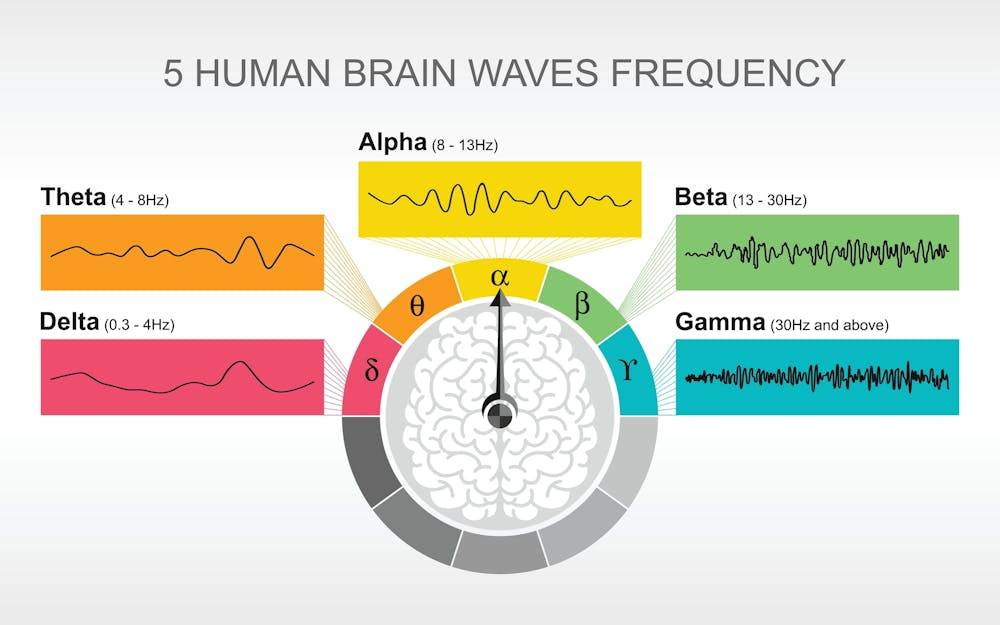
As neuroscientist Susan Hillier explains in more detail, different brain waves reveal distinct mental states:
- “gamma” is linked with states or tasks that require more focused concentration
- “beta” is linked with higher anxiety and more active states, with attention often directed externally
- “alpha” is linked with being very relaxed, and passive attention (such as listening quietly but not engaging)
- “theta” is linked with deep relaxation and inward focus
- and “delta” is linked with deep sleep.
The Spanish study found that the same tasks done inside the enclosed pod vs the open-plan workspace produced completely opposite patterns.
It takes effort to filter out distractions
In the work pod, the study found beta waves – associated with active mental processing – dropped significantly over the experiment, as did alpha waves linked to passive attention and overall activity in the frontal brain regions.
This meant people’s brains needed progressively less effort to sustain the same work.
The open-plan office testing showed the reverse.
Gamma waves, linked to complex mental processing, climbed steadily. Theta waves, which track both working memory and mental fatigue, increased. Two key measures also rose significantly: arousal (how alert and activated the brain is) and engagement (how much mental effort is being applied).
In other words, in the open-plan office participants’ brains had to work harder to maintain performance.
Even when we try to ignore distractions, our brain has to expend mental effort to filter them out.
In contrast, the pod eliminated most background noise and visual disruptions, allowing participant’s brains to work more efficiently.
Researchers also found much wider variability in the open office. Some people’s brain activity increased dramatically, while others showed modest changes. This suggests individual differences in how distracting we find open-plan spaces.
With only 26 participants, this was a relatively small study. But its findings echo a significant body of research from the past decade.
What past research has shown
In our 2021 study, my colleagues and I found a significant causal relationship between open-plan office noise and physiological stress. Studying 43 participants in controlled conditions – using heart rate, skin conductivity and AI facial emotion recognition – we found negative mood in open plan offices increased by 25% and physiological stress by 34%.
Another study showed background conversations and noisy environments can degrade cognitive task performance and increase distraction for workers.
And a 2013 analysis of more than 42,000 office workers in the United States, Finland, Canada and Australia found those in open-plan offices were less satisfied with their work environment than those in private offices. This was largely due to increased, uncontrollable noise and lack of privacy.
Just as we now recognise poorly designed chairs cause physical strain, years of research has shown how workspace design can result in cognitive strain.
What to do about it
The ability to focus and concentrate without interruption and distraction is a fundamental requirement for modern knowledge work.
Yet the value of uninterrupted work continues to be undervalued in workplace design.
Creating zones where workers can match their workplace environment to the task is essential.
Responding to having more staff doing hybrid work post-pandemic, LinkedIn redesigned its flagship San Francisco office. LinkedIn halved the number of workstations in open plan areas, instead experimenting with 75 types of work settings, including work areas for quiet focus.
For organisations looking to look after their workers’ brains, there are practical measures to consider. These include setting up different work zones, acoustic treatments and sound-masking technologies, and thoughtfully placed partitions to reduce visual and auditory distractions.
While adding those extra features in may cost more upfront than an open plan office, they can be worth it. Research has shown the significant hidden toll of poor office design on productivity, health and employee retention.
Providing workers with more choice in how much they’re exposed to noise and other interruptions is not a luxury. To get more done, with less strain on our brains, better design at work should be seen as a necessity.
Authors: Libby (Elizabeth) Sander, MBA Director & Associate Professor of Organisational Behaviour, Bond Business School, Bond University

















