

Plummeting fish numbers triggered controversial fishing bans in WA. But no-take zones could benefit fishers
- Written by Tim Langlois, Research Fellow in marine ecosystems, The University of Western Australia
The Western Australian government recently announced the controversial closure of commercial and recreation fishing to prevent a collapse in the populations of under-threat species, such as popular dhufish and pink snapper.
Fishing for these demersal (bottom dwelling) species has been closed along a 900-kilometre stretch of coastline in south-west WA. There are plans to reopen the area in spring 2027, but for recreational fishing only.
One additional measure stands out: once the fishery opens, large “no-take” demersal recovery zones are proposed where all bottom fishing will be banned.
While no-take zones are a key part of Australia’s conservation strategy, they are more often used to create marine parks, rather than to improve fisheries. Proposed no-take zones have been historically unpopular with fishers. But perhaps we can have our cake and eat it too. Does closing areas of ocean to fishing result in a boost to fish numbers inside the protected areas and in surrounding fishing grounds?
Our recent research suggests the answer is yes. Setting aside no-take areas of the ocean, combined with standard fisheries management in the areas still open to fishing, can increase overall numbers of spawning fish. This means greater catch rates for fishers in surrounding areas.
Building a digital reef
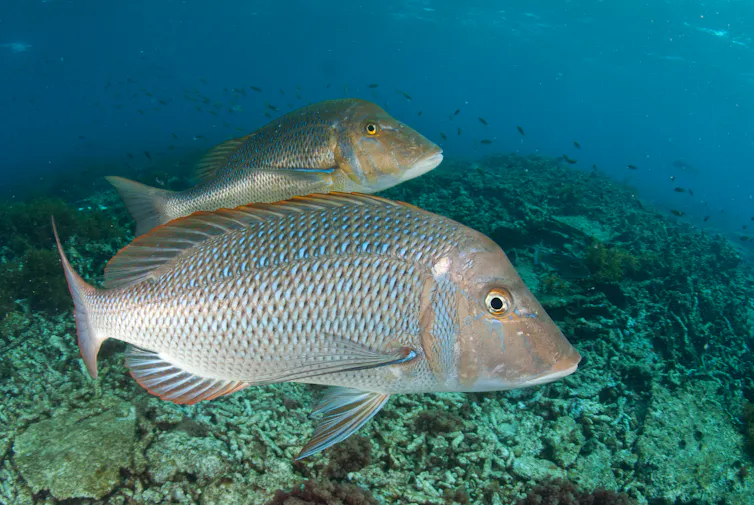
We focused on the population of spangled emperor fish – a golden-coloured fish prized by anglers – in the iconic Ningaloo World Heritage Area. Currently, 34% of Ningaloo is covered by no-take zones, the largest percentage for any region in Australia. These zones were created to protect the diversity of species and create natural areas for tourism, education and science.
Understanding if no-take areas actually benefit fisheries is a challenging task. To compare the effects of protection and closures with standard fisheries management, we built a computer model for the spangled emperor population at Ningaloo.
We divided the reef into more than 1,800 spatial “cells” and included information about habitat distribution, fish movement, reproduction, mortality rates and how much and where fishing was occurring.
The resulting model is a digital “twin” of the spangled emperor population at Ningaloo. It helped us try to answer the question: how best to conserve and manage this vital resource?
Exploring the possibilities
We explored several scenarios: what would happen with only standard fisheries management in place, compared with the addition of no-take zones or closing the area to fishing for five months. We also looked at what might have been achieved by combining all approaches.
The no-take zones delivered clear benefits, particularly by boosting the number of large mature fish and the number of offspring they produced. Closing the area for a five-month period was similarly effective for increasing fish abundance, but less so for large mature fish. Combining the two approaches resulted in a greater increase in large mature fish and replenishment of young fish.
Interestingly, our model predicted the addition of no-take zones resulted in recreational fishing catch rates doubling in open areas near where the fishers accessed the ocean (for example, within 10 kilometres of a boat ramp).
Bigger, older fish matter
Female fish of many species produce far more eggs as they grow larger. One big, older female can produce as many eggs as a dozen or more smaller adults. No‑take zones protect these large individuals, allowing them to survive longer and build up inside protected areas. Their offspring drift into surrounding waters, replenishing stocks and ultimately boosting catches for fishers.
These benefits are greatest for species that remain relatively local. Highly mobile species may require larger or connected no-take zones to achieve the same effect. In this way, no‑take zones help sustain healthy fish populations and fisheries.
Some in the fishing community have historically opposed protected areas, seeing the loss of access as negative. But when we talked to fishers at boat ramps around Australia, many supported protected areas and sensed what our model confirms: setting aside no-take zones can improve environmental outcomes.
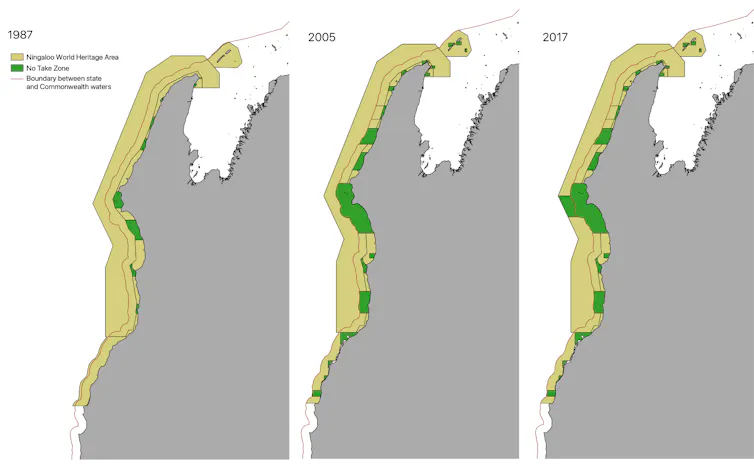
Our research suggests strategic no-take zones – like those in the WA government’s announcement – along with effective management of fishing in other areas could replenish fish populations and increase catches.
We have consistently found that studying no-take zones provides a cost-effective way to understand fish habitat preference, their home-range size and how they spawn. This information will be key to designing no-take zones to protect fish spawning, recover populations and make fishing more sustainable.
Authors: Tim Langlois, Research Fellow in marine ecosystems, The University of Western Australia

















