

Major airlines say they're acting on climate change. Our research reveals how little they've achieved
- Written by: Susanne Becken, Professor of Sustainable Tourism and Director, Griffith Institute for Tourism, Griffith University
If you’re a traveller who cares about reducing your carbon footprint, are some airlines better to fly with than others?
Several of the world’s major airlines have announced plans to become “carbon neutral”, while others are trialling new aviation fuels. But are any of their climate initiatives making much difference?
Those were the questions we set out to answer a year ago, by analysing what the world’s largest 58 airlines – which fly 70% of the total available seat-kilometres – are doing to live up to their promises to cut their climate impact.
The good news? Some airlines are taking positive steps. The bad news? When you compare what’s being done against the continued growth in emissions, even the best airlines are not doing anywhere near enough.
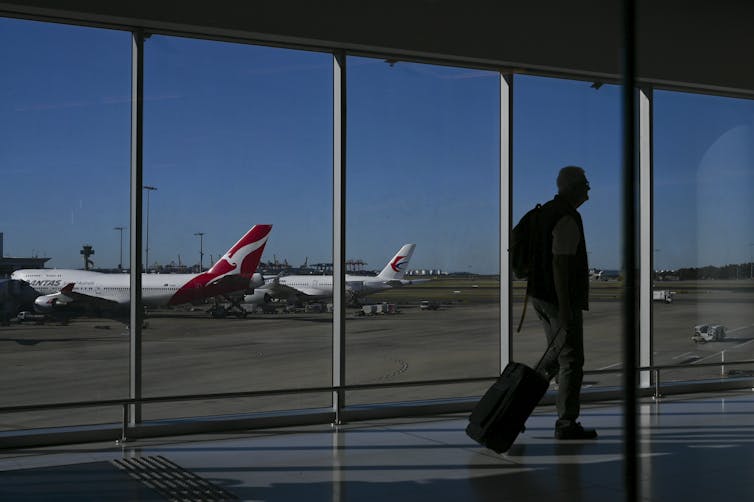 Qantas has pledged to reach net zero carbon emissions by 2050.
Lukas Coch/AAP
Qantas has pledged to reach net zero carbon emissions by 2050.
Lukas Coch/AAP
More efficient flights still drive up emissions
Our research found three-quarters of the world’s biggest airlines showed improvements in carbon efficiency – measured as carbon dioxide per available seat. But that’s not the same as cutting emissions overall.
One good example was the Spanish flag carrier Iberia, which reduced emissions per seat by about 6% in 2017, but increased absolute emissions by 7%.
For 2018, compared with 2017, the collective impact of all the climate measures being undertaken by the 58 biggest airlines amounted to an improvement of 1%. This falls short of the industry’s goal of achieving a 1.5% increase in efficiency. And the improvements were more than wiped out by the industry’s overall 5.2% annual increase in emissions.
This challenge is even clearer when you look slightly further back. Industry figures show global airlines produced 733 million tonnes of CO₂ emissions in 2014. Falling fares and more people around wanting to fly saw airline emissions rise 23% in just five years.
What are the airlines doing?
Airlines reported climate initiatives across 22 areas, with the most common involving fleet renewal, engine efficiency, weight reductions and flight path optimisation. Examples in our paper include:
- Singapore Airlines modified the Trent 900 engines on their A380 aircraft, saving 26,326 tonnes of CO₂ (equivalent to 0.24% of the airline’s annual emissions);
- KLM’s efforts to reduce weight on board led to a CO₂ reduction of 13,500 tonnes (0.05% of KLM’s emissions).
- Etihad reports savings of 17,000 tonnes of CO₂ due to flight plan improvements (0.16% of its emissions).
Nineteen of the 58 large airlines I examined invest in alternative fuels. But the scale of their research and development programs, and use of alternative fuels, remains tiny.
As an example, for Earth Day 2018 Air Canada announced a 160-tonne emissions saving from blending 230,000 litres of “biojet” fuel into 22 domestic flights. How much fuel was that? Not even enough to fill the more than 300,000-litre capacity of just one A380 plane.
Carbon neutral promises
Some airlines, including Qantas, are aiming to be carbon neutral by 2050. While that won’t be easy, Qantas is at least starting with better climate reporting; it’s one of only eight airlines addressing its carbon risk through the systematic Task Force on Climate-related Financial Disclosures process.
About half of the major airlines engage in carbon offsetting, but only 13 provide information on measurable impacts. Theses include Air New Zealand, with its FlyNeutral program to help restore native forest in New Zealand.
That lack of detail means the integrity of many offset schemes is questionable. And even if properly managed, offsets still avoid the fact that we can’t make deep carbon cuts if we keep flying at current rates.
Read more: Flight shame won't fix airline emissions. We need a smarter solution
What airlines and governments need to do
Our research shows major airlines’ climate efforts are achieving nowhere near enough. To decrease aviation emissions, three major changes are urgently needed.
All airlines need to implement all measures across the 22 categories covered in our report to reap any possible gain in efficiency.
Far more research is needed to develop alternative aviation fuels that genuinely cut emissions. Given what we’ve seen so far, these are unlikely to be biofuels. E-fuels – liquid fuels derived from carbon dioxide and hydrogen – may provide such a solution, but there are challenges ahead, including high costs.
Governments can – and some European countries do – impose carbon taxes and then invest into lower carbon alternatives. They can also provide incentives to develop new fuels and alternative infrastructure, such as rail or electric planes for shorter trips.
How you can make a difference
Our research paper was released late last year, at a World Travel and Tourism Council event linked to the Madrid climate summit. Activist Greta Thunberg famously sailed around the world to be there, rather than flying.
Higher-income travellers from around the world have had a disproportionately large impact in driving up aviation emissions.
This means that all of us who are privileged enough to fly, for work or pleasure, have a role to play too, by:
- reducing our flying (completely, or flying less)
- carbon offsetting
- for essential trips, only flying with airlines doing more to cut emissions.
To really make an impact, far more of us need to do all three.
Read more: Climate explained: how much does flying contribute to climate change?
Authors: Susanne Becken, Professor of Sustainable Tourism and Director, Griffith Institute for Tourism, Griffith University


















