

When feral cats are away, potoroos and bandicoots are more likely to play
- Written by: Euan Ritchie, Professor in Wildlife Ecology and Conservation, School of Life & Environmental Sciences, Deakin University
All animals need to eat to survive, grow and reproduce. To do so, they also need to avoid being eaten. This is a big challenge for many of Australia’s native mammals, because when they search for food, they must also escape the attention of introduced predators, namely, feral cats and red foxes.
Tragically, many have been unable to overcome this test of survival, becoming one of the 40 native mammal species driven to extinction since European colonisation.
But what happens if we reduce the numbers of introduced predators? Do our surviving native species think there is less risk of being the next meal for a cat or fox? How do they respond? And how might we tell? With peanut butter balls, of course!
A deadly game of hide and seek
Natural environments contain predators and prey engaged in a deadly game of hide and seek, and – from the prey’s perspective – a landscape of fear. The extent to which the two groups are aware of each other and able to respond (hunting vs hiding and escape) varies across time and space. Prey might perceive some areas as a riskier proposition, such as more open habitats or times when predators are most active. They therefore reduce their activity to minimise the likelihood of being eaten.
But avoiding being eaten comes at an energetic cost. It may mean preferred areas or times to feed are reduced, which in turn limits rates of growth, reproduction and survival of prey species. Prey animals are constantly weighing up this tradeoff of risk vs reward as they go about their lives.
Tasty treats can assess risk appetite
We can’t know for sure how much animals fear being eaten, but we can assess it indirectly, through their willingness to eat. In our recently published study, we measured how much food animals don’t eat as a indicator of their fear of being eaten. The more food they give up, the greater the risk of predation those animals are assumed to perceive. These experiments are made easier by the fact many mammals are mad about gobbling up peanut butter.
French Island has long been fox free, but had thousands of feral cats. In 2010, authorities began a feral cat eradication, which made it a perfect place for our research.
Importantly, we were able to start our experiment prior to an eradication program of feral cats, which began in 2010 on French Island, Victoria. This means we were able to measure changes in long-nosed potoroos and eastern barred bandicoots habitat use and foraging as cat numbers and activity fell.

So, on fox-free French Island, we placed balls of peanut butter, rolled oats and golden syrup into trays with soil and dug them into the ground, ensuring they were below the soil surface. We did this in more open grassland areas (likely riskier habitat, with less cover and protection from feral cats) and more densely vegetated areas (less risky habitat, due to increased cover).
We used camera traps to measure how often potoroos and bandicoots visited these feeding trays to dig up the tasty treats, and how much of the peanut butter balls they left behind in different habitats and at different periods throughout the ongoing feral cat eradication program.

When feral cats are away, native animals play (more)
As the number of feral cats on French Island was reduced, potoroos and bandicoots used both open and closed habitat types more frequently, and they increased their activity, giving up less food over time. This suggests bandicoots and potoroos do recognise feral cats as a threat, and are able to fairly rapidly change their habitat use and foraging accordingly.
Aside from the obvious benefits of fewer feral cats killing and eating potoroos and bandicoots on French Island, our study suggests there may be substantial benefits for native wildlife — namely increased access to habitats and foraging opportunities — even before the ultimate longer-term goal of cat eradication can be achieved.
Our study’s results are encouraging. Outside the safe havens of invasive predator-free islands and fenced sanctuaries, feral cats are notoriously hard to eradicate from large areas, and there is a constant threat of their return.
To change this, new and more effective ways to control and eradicate feral cats are needed. But until then, reducing and keeping feral cat numbers lower, while also carefully managing habitats to benefit wildlife, can still give native animals the helping hand they need to survive.
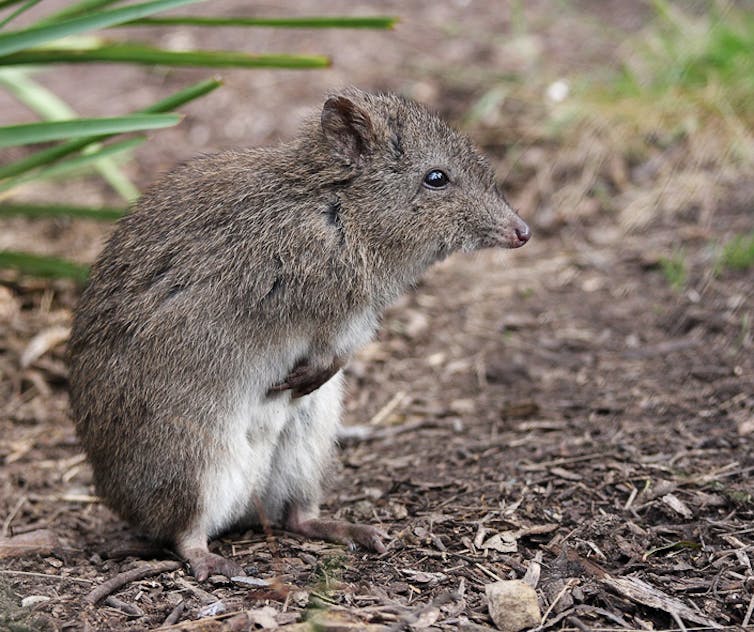
 We need to do all that we can to give Australia’s native mammals, including eastern barred bandicoots, a helping hand.
Zoos Victoria, CC BY-NC-ND
We need to do all that we can to give Australia’s native mammals, including eastern barred bandicoots, a helping hand.
Zoos Victoria, CC BY-NC-ND
We would like to acknowledge that this work was led by former Deakin University Honours student, Te Ao Marama Eketone, and it occurred on the unceded Country of the Bunurong/Boonwurrung peoples.
Authors: Euan Ritchie, Professor in Wildlife Ecology and Conservation, School of Life & Environmental Sciences, Deakin University


















