

Science knows of 21,000 bee species. There are likely thousands more
- Written by: James B. Dorey, Lecturer in Biological Sciences, University of Wollongong
It’s a question that has sparked the curiosity of scholars and bee lovers for decades: how many species of bees are there in the world?
This might, at first, seem like a silly question. But it is a topic of genuine importance – especially if we want to protect our pollinators.
Now, in a new paper published in Nature Communications, we provide the first statistically derived estimate of bee species richness around the world. But this work isn’t just about bees. It provides the tools needed for scientists to estimate the number of all species on Earth.
Why do bees matter?
Bees are the most important animal pollinators, so it’s crucial to know how many species there are in the world.
Globally, and corrected for inflation, pollination of crops is worth roughly A$745 billion per year. Pollination is also crucial for our diet and wellbeing with 75% of food crop diversity and 35% of total food production benefiting from animal pollination.
However, that’s far from the complete story.
Bees are what’s called a “keystone” group. That is, just like the keystone in a stone arch, removing that group would result in cascading ecological impacts – and potentially, as implied by the analogy, collapse.
Recent estimates have suggested that 90% of flowering plants (roughly 307,000 species) are pollinated by animals. Plants produce our oxygen and sequester carbon, moderate temperatures, prevent erosion, protect coastlines, form the foundation of food webs, and so much more.
Bees are also of immense cultural value. Humans have been working with honey bee products for at least 9,000 years and quite possibly longer for stingless bees.
Our current estimates
The European honey bee and bumblebee species are the best known bees in the world. But there are many more.
In his 2007 book, Bees of the World, US entomologist Charles Michener estimated there were more than 18,000 known bee species – and over 20,000 in total.
But we already have surpassed this number with roughly 21,000 named bee species globally.
Those are global estimates. But what about a more specific one?
Australia is a relatively well-understood region with at least four estimates of as high as 2,000.
But, these are all guesses without statistical backing.
How do we estimate undiscovered species?
Bee datasets around the world are growing thanks to both career and citizen scientists.
For our new study, we used more than 8.3 million bee records (where they’ve been found), a country-level checklist of bee species, and a species (taxonomy) list of roughly 21,000 species names.
We then used statistical modelling to estimate the “lower bound” of the possible number of species globally, by continent, and by country.
More simply, we look at how well we have sampled species to estimate the minimum number of new species that are still to be found.
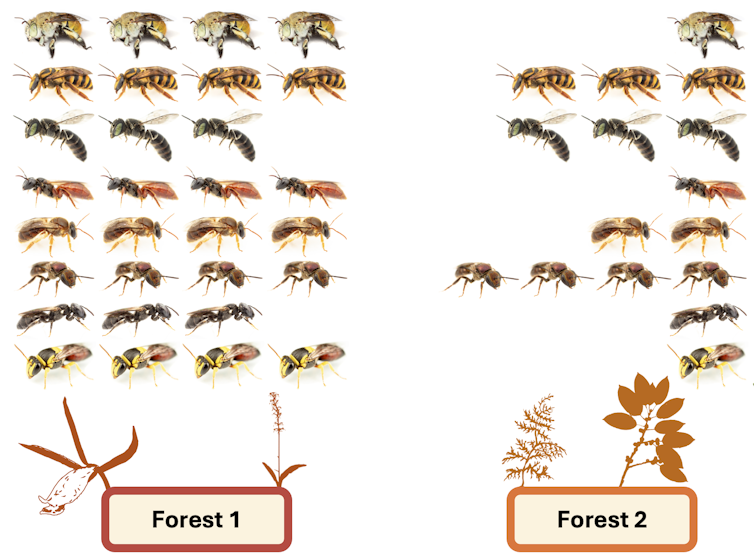
Imagine that you go and sample two forests for bees. In the first, you find eight species, all in similarly high abundance. In the second, you also catch eight species – but while some are in high abundance, you also find some only a handful of times.
You might expect that you have discovered most of the species in the first forest because you are getting the same ones over and over again. In the second forest you’re finding many rarely occurring species, which hints that more diversity may be discovered if sampling continues.
Now expand this process to the level of countries, continents, and the globe.
So, how many bee species are there?
Globally, we estimated there are at least 24,705 to 26,164 bee species in the world (an 18–25% increase on previous estimates).
At current rates of description (roughly 117 species per year), it would take between 32 and 45 years to describe all of the world’s bee species. However, we may take much longer as our estimate is conservative, and we are likely to discover new species more slowly as fewer remain to be found.
Importantly, most new bee species are expected to be found in Asia and Africa.
Perhaps this is not surprising, as bee research in Asia has many challenges and data from Africa are very limited with some countries having zero usable bee data points.
Some species diversity is most easily detected using genetic techniques. This can easily go unnoticed — and means we shouldn’t be surprised if our estimates are surpassed in the future. Even in wealthy nations, such as Australia, we saw that not using genetic techniques might lead to lower estimates of species richness.

Highly valuable data
We have shown that it’s possible to estimate the total number of bee species, and indeed any species, on a country level using existing data.
These data are highly valuable in several respects.
A detailed cost-benefit analysis of investment in discovering and documenting new species in Australia found that every $1 invested in discovering all remaining Australian species will bring up to $35 of economic benefits to the nation.
These data can also be used to prioritise our discovery and taxonomic efforts, as well as prioritising conservation efforts to conserve our most important species.
Through the application of these methods we can, at long last, start to answer the question “how many species are there in the world?”.
Authors: James B. Dorey, Lecturer in Biological Sciences, University of Wollongong


















