What is hypnobirthing, the technique the Duchess of Cambridge used?
- Written by: Mary Steen, Professor of Midwifery, University of South Australia
In a new parenting podcast, Catherine, the Duchess of Cambridge, said she used hypnobirthing techniques to help her get through severe morning sickness – a condition called hyperemesis gravidarum.
She also used the techniques during labour.
She told the Happy Mum, Happy Baby podcast:
I saw the power of it, the meditation and the deep breathing and things like that, that they teach you in hypnobirthing, when I was really sick, and actually I realised that this was something I could take control of during labour.
It was hugely powerful.
So what is hypnobirthing and what does the evidence say about its use?
Calmness and relaxation
Hypnobirthing aims to reduce fear, pain and anxiety during childbirth. It involves learning calm breathing techniques, some deep relaxation, guided mediation, visualisation, positive suggestions and affirmations.
These affirmations might include phrases such as, “I have the ability to give birth to my baby,” or “I trust in my body and my baby to help me.”
Read more: Explainer: what are women's options for giving birth?
Hypnobirthing teaches women to induce a “self-hypnotic” state of mind where a woman focuses her attention inwards, concentrates deeply and this helps her to decrease peripheral awareness. But she can still respond to suggestions and affirmations.
When a woman is afraid she will physically become tense, rigid and produce the stress hormones adrenaline and cortisol. Her perception of pain will increase and this can affect labour.
Hypnobirthing aims to counteract the effects of fear and help women secrete the hormones oxytocin and endorphins which enable her to remain calm and relaxed, so labour can progress.
Some women who have used hypnobirthing techniques say they feel like they are day dreaming, in a trance and drifting into a calm, deeply relaxed state but are not actually sleeping.
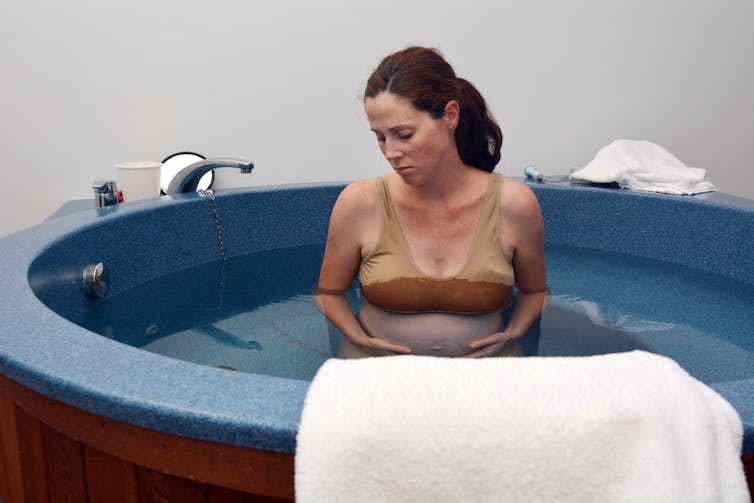 Women who use hypnobirthing techniques aim to decrease their peripheral awareness.
Shutterstock
Women who use hypnobirthing techniques aim to decrease their peripheral awareness.
Shutterstock
Hypnobirthing techniques are founded on British obstetrician Grantly Dick-Read’s observations. In his 1942 book, Childbirth without Fear, he proposed women in a calm state of mind, and who had faith in their ability to give birth, did so with less pain.
These days, women and their partners or support people can learn self-hypnotic techniques for hypnobirthing by attending one-to-one sessions, group classes or online courses.
Usually, women attend sessions from about 25-30 weeks of pregnancy but self-hypnosis and guided mediation techniques are sometimes taught earlier in pregnancy.
There is also emerging evidence it could be used postnatally if women have had a traumatic birth or are experiencing increased levels of anxiety, stress or depression after birth.
Fear and anxiety in childbirth
Historically, women have been supported and comforted by other women during labour and birth, including in traditional Aboriginal birthing practices. Women would support other women by performing special songs, chants and rituals to ease the birthing process and make the woman feel safe and calm.
But while great advances in care have resulted in better outcomes for mothers and babies in childbirth, many women today are extremely anxious and afraid of this process.
So it’s important find ways to reduce anxiety and fear associated with childbirth.
Read more: Parent education and complementary therapies reduce birthing risks
Other strategies women can also use alongside hypnobirthing include having a continuous support person for labour and undergoing combined complementary therapies, such as yoga, acupressure and learning breathing techniques, in preparation for birth.
What does the evidence say about hypnobirthing?
A 2016 Cochrane review examined the effectiveness and safety of hypnosis for pain management in labour and birth. The review examined nine studies of varying quality which included just under 3,000 women.
It found women who used hypnobirthing techniques used less of some kinds of pain relief such as opioid pain medication or inhaling nitrous oxide and oxygen, than women who didn’t. However epidural rates were similar in both groups.
 The evidence suggests hypnobirthing is linked to a decreased use of opioids and gas, but not epidurals.
Shutterstock
The evidence suggests hypnobirthing is linked to a decreased use of opioids and gas, but not epidurals.
Shutterstock
There were no clear differences between women who used hypnobirthing techniques and those who didn’t for most of the other measures. These included their satisfaction with pain relief, their sense of coping with labour and their likelihood of having a spontaneous vaginal birth.
Importantly, the review found hypnobirthing didn’t cause any harm.
Overall, little research has been conducted on hypnobirthing. We need more well-designed studies to accurately assess the effectiveness of these techniques.
It might help some women and not others
Some women who participated in a clinical trial of self-hypnosis were followed up and interviewed and reported feelings of calmness, confidence and empowerment.
But the techniques don’t work for everyone.
Some women reported feeling frustrated or disappointed when their labour and birth experiences didn’t match their expectations, or when their midwives misinterpreted their relaxed state.
Other women find it extremely difficult to switch off and relax. They may find they’re not able to put themselves into a deeply relaxed state and then respond to positive suggestions and affirmations.
Some women may be sceptical of the process and don’t see any potential benefits.
Read more: Don’t believe everything you see on TV: hypnosis is less far fetched and far more important
Authors: Mary Steen, Professor of Midwifery, University of South Australia
Read more https://theconversation.com/what-is-hypnobirthing-the-technique-the-duchess-of-cambridge-used-132015