

Microbes in Antarctica survive the freezing and dark winter by living on air
- Written by Ry Holland, Research Fellow in Microbial Ecology, Monash University
Winter in Antarctica is long and dark. Temperatures remain well below freezing. In many places, the Sun sets in April and does not rise above the horizon again until August. Without sunlight, photosynthetic life such as plants, mosses and algae cannot make energy.
But that’s not to say all life stops.
In a new study published in The ISME Journal, my colleagues and I show that Antarctic microbes make energy from the air at temperatures as low as –20°C. This finding improves our understanding of how life survives at temperature extremes in Antarctica – and how climate change will affect this important process.
How to make energy from air
In 2017, scientists showed that a large number of Antarctic microbes can generate energy from atmospheric gases present at very low concentrations.
This process is called “aerotrophy”. By using enzymes that are very finely tuned to “sniff out” the hydrogen and carbon monoxide in the atmosphere, these microbes have found a way to make energy from the air itself – a huge advantage in Antarctica’s nutrient-poor desert soils.
What remained unknown until now was the temperature limits of this process. Could aerotrophy be a way to power the continent’s soil communities through the winter?

Taking the lab down south
Measuring how quickly these microbes consume such a small amount of fuel can be difficult.
From 2022–24, we collected surface soil samples from different areas across East Antarctica and analysed them in our lab.
We measured how quickly they can use the atmospheric gases. We also extracted all the DNA from the soil microbes and sequenced it. This tells us what microbes are present, what genes they have, and what they are capable of using as energy sources.
We showed aerotrophy happening in the lab at representative summer (4°C) and winter (–20°C) temperatures. This means hydrogen and carbon monoxide are a viable food source not just over the summer months, but year-round. What was even more surprising though, was the upper temperature limit.
Soil temperatures in Antarctica rarely rise above 20°C. Yet we found microbes in these soils that continued to generate energy from hydrogen up to a staggering 75°C. It seems as though microbes in Antarctic soils are well adapted to the continent’s cold temperatures, but not restricted to them. It’s a bit like seeing a penguin thrive in a tropical jungle.
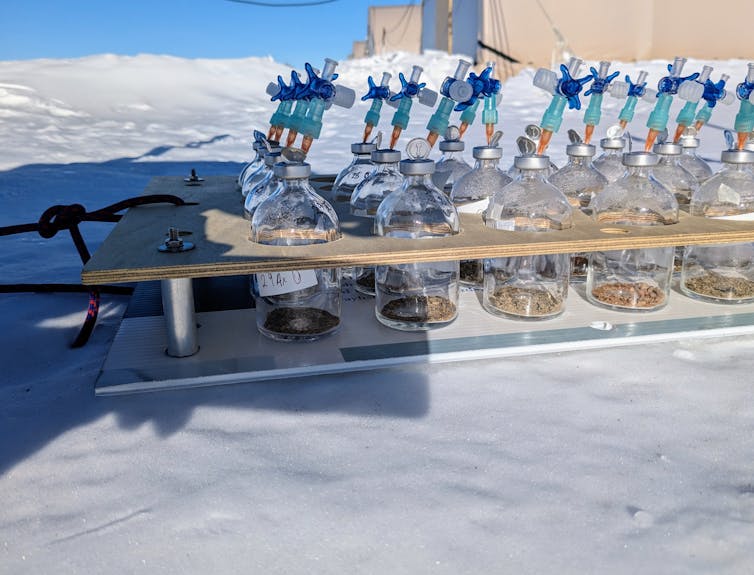
We also wanted to see this process occurring in Antarctica itself, so two years ago we brought the lab down south. We collected fresh soil samples, sealed them in the glass vials, and took gas samples.
For the first time, it was clear that under real-world conditions these soil microbes were still munching their way through hydrogen.

The primary producers of Antarctica
DNA sequencing has showed us that the vast majority of microbes in Antarctic soils encode the genes to gain energy from hydrogen. Many of these bacteria also have genes to take carbon from the atmosphere.
These aerotrophs are “primary producers”, generating new biomass from the air itself.
In most land-based ecosystems, photosynthesis is thought to be the bottom of the food chain. Photosynthesis takes energy from sunlight and carbon from the atmosphere and turns it into yummy organic compounds.
It’s what makes plants grow. Plants are primary producers that are eaten by herbivores, which are then eaten by carnivores.
In Antarctica’s desert soils, photosynthesis is relatively rare. Instead, we hypothesise that aerotrophy fulfils the primary producer role in many places.
This makes sense because, unlike sunlight-dependent photosythesis, we now know that aerotrophy can happen year-round. Another benefit is that it doesn’t require liquid water, whereas photosynthesis does.
Hydrogen in a heating world
Aerotrophy clearly has an important role in Antarctic ecosystems. So next, we wanted to determine how global warming might affect this process.
Under low-emissions scenarios, we predict a 4% increase in how quickly aerotrophs use atmospheric hydrogen. Under very high-emissions scenarios, this increase rises to 35%. The numbers are similar for carbon monoxide.
Although hydrogen isn’t a greenhouse gas itself, it is important because it affects how long some greenhouse gases, including methane, hang around in the atmosphere.
Soils (including the microbes that live in them) are responsible for 82% of all hydrogen consumed on Earth globally. In other words, they are a hydrogen sink. This is a crucial component in the global hydrogen cycle.
There are a lot of factors that determine how microorganisms will respond to climate change. Temperature is just one of them. This study is an important piece of the puzzle as scientists figure out how resilient Antarctica’s unique microbal ecosystems are.
Authors: Ry Holland, Research Fellow in Microbial Ecology, Monash University

















