

Project Hail Mary is packed with hard science. An astrophysicist breaks it down
- Written by Sara Webb, Course Director, Centre for Astrophysics and Supercomputing, Swinburne University of Technology
As an astrophysicist, my world revolves around the wonders of space and the mysteries of the universe. This means I can be a tough critic of science fiction books and films that explore these topics.
But when I walked out of a recent preview screening of the film adaptation of Andy Weir’s 2021 science fiction novel Project Hail Mary, I had tears of joy in my eyes. The filmmakers had done justice not just to the original story, but also to the science at the heart of it.
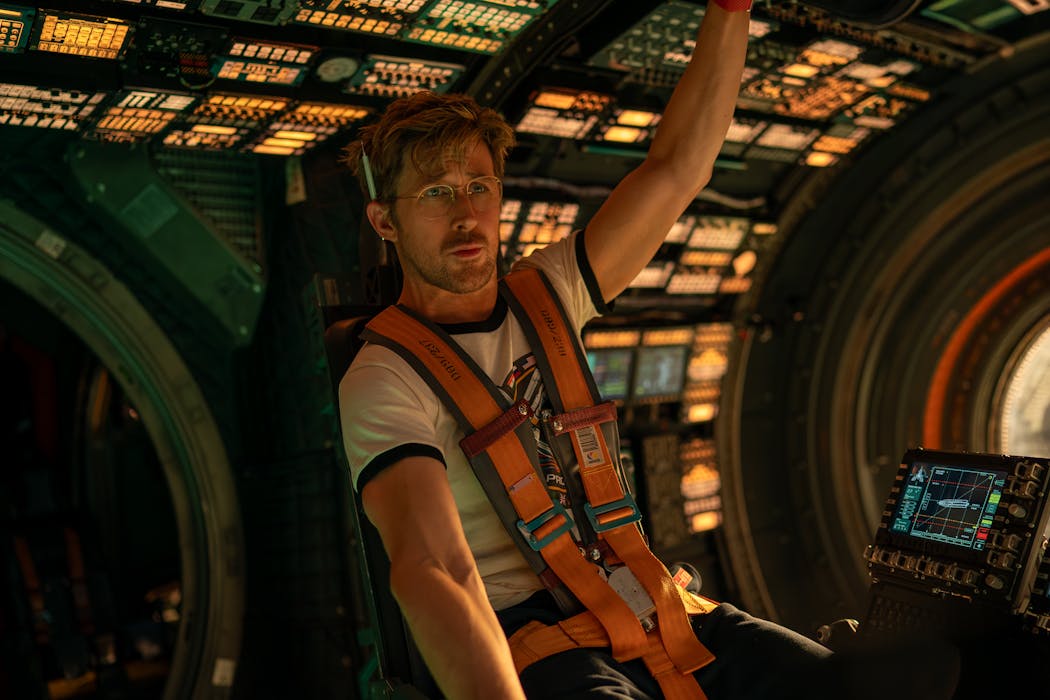
The story revolves around Ryland Grace, played by Ryan Gosling, who awakes from a coma with no memory and no idea why he’s on a space ship 11.9 light years away from Earth. As his memories slowly start to return, the truth becomes clear. The Sun is dying, and he is our only saving grace.
So here are the science facts – as well as the science fiction – of the film, which is in cinemas in Australia and New Zealand from today.
A dying sun
In Project Hail Mary the Sun is dying due to an alien organism that has spread around our part of the Milky Way.
Firstly, could an organism spread from one solar system to another? According to some scientists, yes. It’s a theory called panspermia.
We have no hard evidence to prove it right now. But the theory isn’t completely wild. We know material from solar systems can be transported great distances – we ourselves have witnessed as least three interstellar visitors enter and fly through our Solar System.
If life forms could survive the harshness of space and live on such rocky bodies, it’s possible this is how life could spread. But that life would likely be basic organisms.
As for the organism at the centre of this movie, astrophage, its mechanics and behaviour sit rightly in the wonderful world of science fiction.
The size of space
The idea of humans travelling between stars feels like an almost impossible challenge.
In our galaxy alone there are more than 400 billion stars, but only roughly 100 of them are within 20 light years of Earth.
Project Hail Mary focuses it’s attention on one of those systems, known as Tau Ceti, sitting 11.9 light years away.
If we were to travel to this star with the fastest spacecraft humans have ever flown in, the Apollo 10 module, travelling at more than 39,900 kilometres per hour, it would take us 320,000 years. In a story where the Sun is dying now, there is no time for that. So how does Project Hail Mary overcome this problem?
Enter special relativity.
Special relativity is one of the most paradigm-shifting theories of modern history. Developed by Albert Einstein in 1905, it equated mass and energy as one and the same. It best known by the famous E = mc2 formula.
What Einstein was able to work our mathematically, and we’ve later proved observationally, is that the closer to the speed of light something travels, the slower the time it experiences in its reference frame.
It’s called a Lorentz transformation – and it allows us to determine the time experienced in a reference frame different to our own, say travelling close to the speed of light.
The movie doesn’t give a full physics lesson on this, but rather uses visual cues, including correct mathematics worked out by Grace on a whiteboard to demonstrate this time change.
What Grace determines is that he’s only been in a coma for four years due to the effects of time dilation on a ship travelling that fast. Which is scientifically spot on.
We have to talk about the aliens
While on the mission to save our world, Grace meets another being trying to do the same – Rocky.
We (us astronomers at least) do believe aliens exist somewhere in the universe. This belief isn’t based on crop circles or UFOs; it’s based on statistical chances.
In the Milky Way alone we estimate there are at least 100 billion planets. If life was able to form, evolve and thrive on Earth, there are many reasons why astronomers believe that could be true in other systems.
A lot of our confidence relates to the essential building blocks of life as we know it. All life on Earth is carbon based. But if we break down our existence even more, we find one thing: amino acids. These organic compounds are the foundation of our DNA.
What’s most exciting is that we’ve identified these in space. Samples from asteroids and fallen meteorites have confirmed many of the amino acids needed for life on Earth also exist on other objects in our Solar System.
Alien earths beyond our own
The film allows audiences to see what other planets might look like.
When Andy Weir originally wrote this novel, it was scientific consensus that alien worlds likely existed around Tau Ceti and the home planet of our new friend Rocky, 40 Eridani A.
But in recent years science has progressed and new data suggests both of these systems appear to have had false detections of planets.
So at least for now, Rocky’s home doesn’t exist – but thousands of others do. As of March 2026 astronomers have confirmed 6,100 exoplanets. These are worlds that exist beyond our own solar system, around distant stars, and can be either rocky or gaseous.
One place Grace and Rocky need to explore on their adventure to save the stars is a theoretical planet orbiting Tau Ceti. Here we see stunning hues of green and red, and distinctive swirls of gases mixing in the atmosphere.
It’s reminiscent of the gas giant of our own Solar System, Jupiter.
Project Hail Mary is more than just an epic adventure film with beautiful visuals. It’s a story that reminds us how important our world is – and how vital science is to our continued existence on it.
Authors: Sara Webb, Course Director, Centre for Astrophysics and Supercomputing, Swinburne University of Technology

















