

How 'Earthships' could make rebuilding safer in bushfire zones
- Written by: Martin Freney, Lecturer in Industrial and Sustainable Design, University of South Australia
Recent disastrous bushfires have rebooted debate about how to (re)build in the Australian bush. Questions are being asked about building standards, whether a fire-proof home is possible, the value of fire bunkers when it’s too late to leave, and if we should even live in the bush any more.
I suggest homes and community buildings in bushfire-prone areas can be made much more fire-resistant, perhaps even fire-proof, by adopting earth-covered, off-grid structures – known as Earthships – as the new standard.
Read more: Before we rush to rebuild after fires, we need to think about where and how
Built for survival
Houses sheltered by earth have a higher chance of survival in a bushfire. This is because earth-based constructions are non-flammable (while topsoil can burn and smoulder, clayey, sandy and gravelly soil does not).
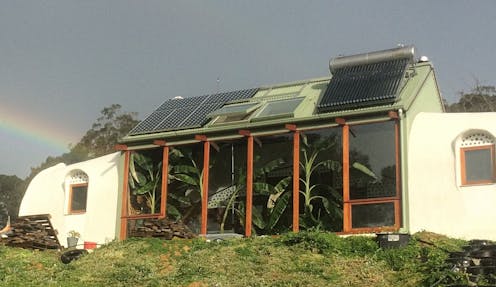
A typical Earthship design has double-glazed windows to the north to let in winter sun, while mounds of earth, pushed up to roof level, protect the south, east and west walls. Taking this a step further, an earth-covered house includes a layer of earth over the roof.
The north-facing double-glazed windows (an essential element of passive solar design) is the only part of the building that needs some other protection.
Bushfire building codes and standards already demand that windows have extra-thick, toughened glass to resist burning debris and intense heat. Double glazing (two layers of glass separated by a small air gap) offers extra protection. In very high-risk areas, bushfire shutters are a requirement.
Although not demanded by building codes, automated sprinklers could be used to spray water on the windows. But automated systems are problematic during a bushfire when power and water supplies are likely to fail.
Read more: No food, no fuel, no phones: bushfires showed we're only ever one step from system collapse
Independent water supplies (big water tanks) and pumps (usually petrol or diesel) are often a condition of approval for new homes in fire-prone areas. However, these are difficult to automate because of choke, throttle, ignition and refuelling issues.
Examples around Australia
Enter the Earthship. Invented by American architect Michael Reynolds, thousands have been built all over the world, often by owner-builders.
Earthships, invented by Michael Reynolds, are now found all over the world.Australian examples can be found in all states, including at Ironbank in South Australia, Kinglake in Victoria, East Augusta and Jurien Bay in Western Australia, and Narara and Marulan in New South Wales.
Earthships have an electric pump powered by solar panels and a battery for day-to-day water supply – and to fight fires. Sprinklers can then spray water on any vulnerable areas regardless of grid failures and without needing to deal with the flammable fuel that petrol and diesel pumps require.
The standard Earthship design has another feature that could save lives. Underground pipes called earth-tubes or cooling tubes bring fresh air into the building at a nice temperature (better than outside) due to the heat-exchanging effect of the earth around the pipes. When wet fabric is placed over the end of the pipes, these can filter out bushfire smoke.
Earth-covered homes are very air-tight, which combined with the earth-tubes helps keep out smoke and reduce asphyxiation risks.
Another defence mechanism is the “greenhouse”, a sunroom and corridor space on the sunny north side used for passive heating and cooling, treating wastewater and growing food. Yet another layer of double glazing isolates the greenhouse from the living spaces behind it. Adding indoor sprinklers (commonplace in commercial buildings) to the greenhouse could create a “wet buffer zone” and stop embers blowing into living areas where flammable furnishings are a hazard.
An iconic Earthship feature is the tyres used to form the exterior earth walls. While empty tyres are highly flammable, in this design they are not. The tyres are filled with compacted earth and protected by a layer of earth many metres thick (inside walls are rendered). There is already evidence of their fire-resistant nature.
Read more: Australian building codes don't expect houses to be fire-proof – and that's by design
Safer for the planet too
My PhD research focused on the energy efficiency and environmental footprint of the Earthship, comparing it to other construction systems and designs.
A look at the author’s Earthship Ironbark.Earth is a low-cost, readily available material. It takes very little energy to dig it up, needs no processing and minimal (if any) transport. It is difficult to think of a more sustainable, inexpensive and non-flammable material.
I found off-grid homes minimise their eco-footprint by kicking three very dirty habits: the power, water and sewage grids. “Earthy” construction methods, such as Earthship, rammed earth, mudbrick and strawbale, also have much lower environmental impacts.
Earth-covered buildings are renowned for their energy efficiency. Earth insulates and has “thermal mass”, an architectural term for dense materials (e.g. concrete, brick, rammed earth, water). Thermal mass evens out temperature changes by absorbing heat when it is too hot inside and releasing heat when it is too cold inside. This means minimal heating and cooling bills.
There are a few “tricks” to getting council approval. Hire an experienced structural engineer and use a private certifier or surveyor for building rules consent as they are better equipped to certify compliance with the National Construction Code. The one aspect of the Earthship I couldn’t get approved was an indoor greywater garden and toilet-flushing system.
Read more: Sustainable cities? Australia's building and planning rules stand in the way of getting there
Parts of the roof are earth-covered with fire-fighting sprinklers on the roof and windows. If I was building again I’d prioritise bushfire resilience by making it fully earth-covered with fire shutters, sprinklers and a safe room.
Further study is needed to scientifically validate my proposal here. However, we already have some evidence that Earthships, with a few minor design changes, might be the most sustainable, liveable, economical, fire-resistant buildings ever conceived of.
Authors: Martin Freney, Lecturer in Industrial and Sustainable Design, University of South Australia
Read more https://theconversation.com/how-earthships-could-make-rebuilding-safer-in-bushfire-zones-131291


















