

A solution to cut extreme heat by up to 6 degrees is in our own backyards
- Written by: Alessandro Ossola, Research Coordinator - Smart Green Cities, Macquarie University
Australia just experienced the second-warmest summer on record, with 2019 being the hottest year. Summer temperatures soared across the country, causing great economic and human loss. The good news is we can do something about this in our own backyards. We have found trees and vegetation can lower local land temperatures by up to 5-6℃ on days of extreme heat.
Our newly published research into a summer heatwave in Adelaide suggests that a simple solution to extreme heat is literally at everyone’s doorstep. It relies on the trees, the grasses and the vegetation in our own backyards.
Read more: Out in the heat: why poorer suburbs are more at risk in warming cities
What did the study show?
During a three-day heatwave that hit Adelaide in 2017, AdaptWest took to the skies to measure land surface temperatures from an aircraft. Our analysis of the data collected on that day suggests urban trees and grasses can lower daytime land temperatures by up to 5-6℃ during extreme heat.
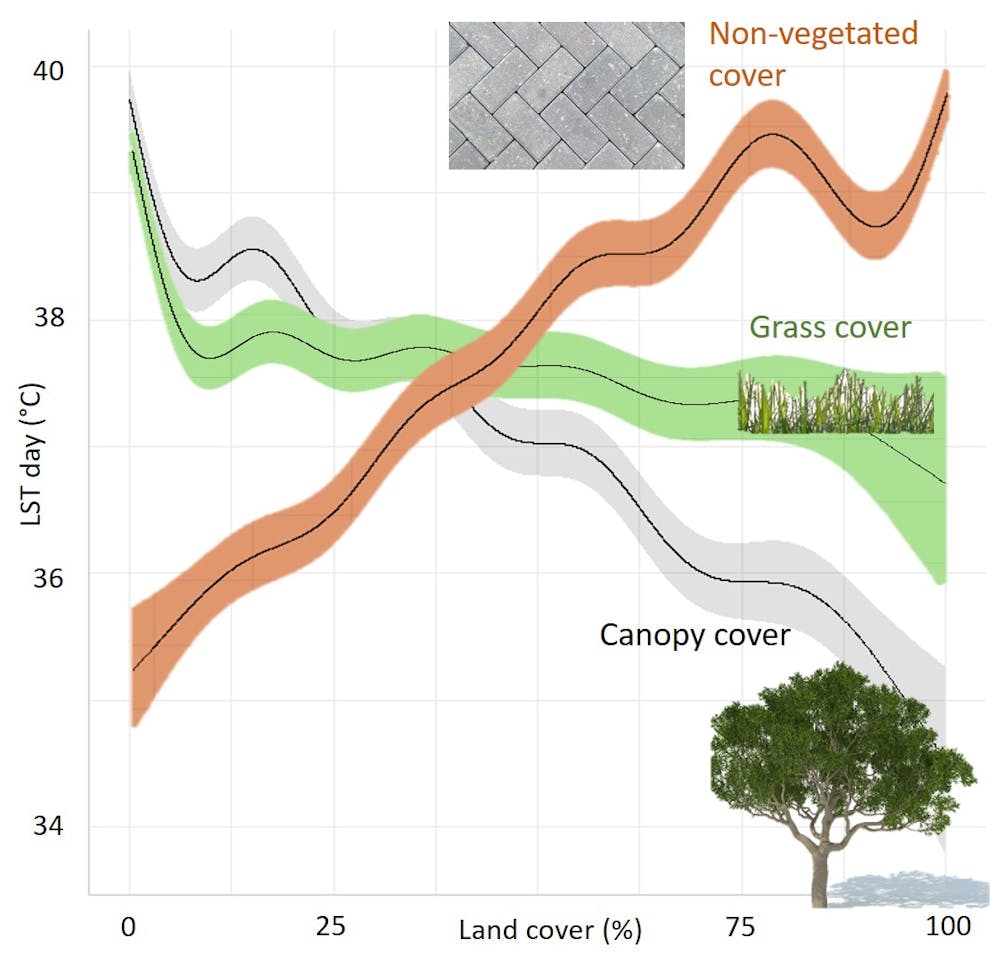 Effect of vegetated and non-vegetated cover on daytime land surface temperatures recorded in 120,000 land units in western Adelaide during a three-day heatwave.
Ossola et al., 2020. https://doi.org/10.25949/5df2ef1637124
Effect of vegetated and non-vegetated cover on daytime land surface temperatures recorded in 120,000 land units in western Adelaide during a three-day heatwave.
Ossola et al., 2020. https://doi.org/10.25949/5df2ef1637124
The largest temperature reductions were in the hottest suburbs and those further away from the coast. These significant reductions were mostly achieved thanks to backyard trees.
So this benefit that urban trees provide has two key aspects:
maximum cooling happens when needed the most – during days of unbearable heat.
maximum cooling happens where needed the most – close to us, the people, in the communities where we live.
Our analysis also shows the humble home garden more than pulls its weight when it comes to reducing extreme urban heat and its harmful effects. Although yards and gardens cover only about 20% of urban land, these private spaces provide more than 40% of the tree cover and 30% of grass cover across western Adelaide. This is comparable to what can be found in many other Australian cities and towns.
 Daytime thermal imaging of land surface temperature in Walkley Heights, Adelaide, taken from an aircraft (inset) on February 9 2017 at the peak of a three-day 40°C heatwave. The area on the right is cooler (blue shades) because of greater vegetation cover. In the hotter area on the left (red shades) a residential development built in 2003 has smaller yards with less tree cover.
AdaptWest and Airborne Research Australia
Daytime thermal imaging of land surface temperature in Walkley Heights, Adelaide, taken from an aircraft (inset) on February 9 2017 at the peak of a three-day 40°C heatwave. The area on the right is cooler (blue shades) because of greater vegetation cover. In the hotter area on the left (red shades) a residential development built in 2003 has smaller yards with less tree cover.
AdaptWest and Airborne Research Australia
In fact, private tree canopy cover is considerably greater than that of typical urban parks or public green areas. This means these private green spaces are a vital yet often overlooked resource for fighting extreme heat.
Read more: Our land abounds in nature strips – surely we can do more than mow a third of urban green space
Planning climate-ready cities
Climate models and projections predict extreme heat days and heatwaves will become more frequent and intense. Penrith reached 48.9℃ on January 4 this year, making Western Sydney the hottest place on Earth that day. Given that heatwaves are already considered Australia’s deadliest climate-related disaster, the forecast temperatures pose an urgent threat to human livelihoods.
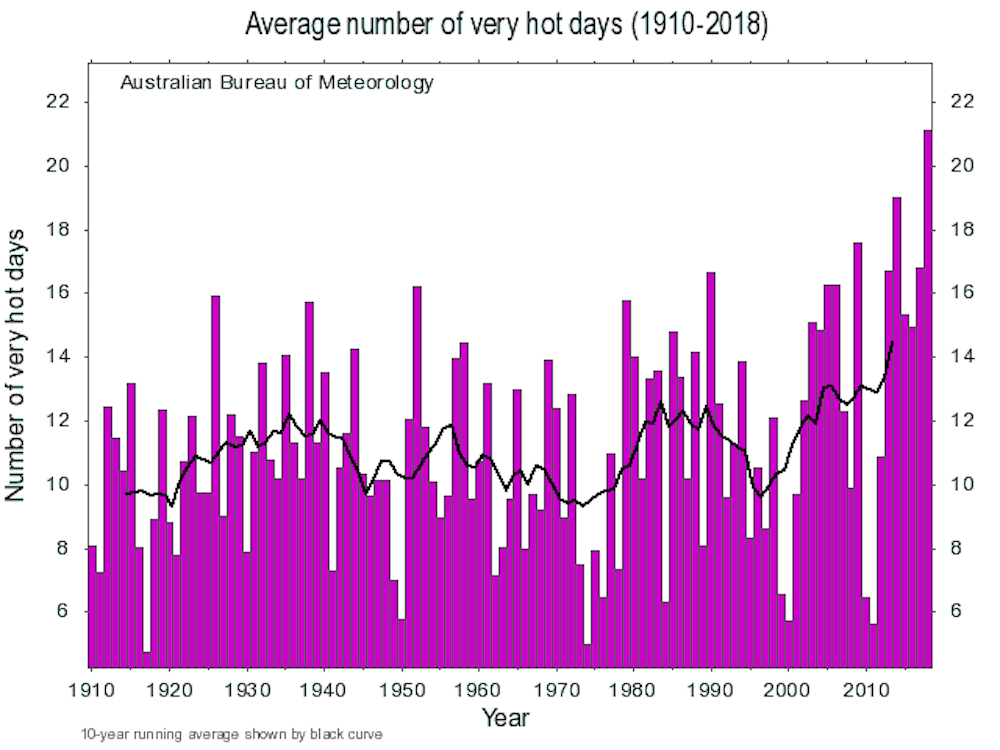 Number of very hot days (maximum above 40°C) per year and trend line (running 10-year average) for Australia.
Bureau of Meteorology, CC BY
Number of very hot days (maximum above 40°C) per year and trend line (running 10-year average) for Australia.
Bureau of Meteorology, CC BY
Urban planning is increasingly having to take extreme temperatures into account. For instance, the City of Sydney recently announced an ambitious policy to increase urban green cover to 40% by 2050 for climate change resilience. Currently, this level of green cover is found in only a handful of suburbs in cities like Melbourne, Sydney and Adelaide.
Read more: How do we save ageing Australians from the heat? Greening our cities is a good start
To achieve such ambitious and life-sustaining goals, our results point to the need to retain, protect and enhance urban greenery in our own yards. As our cities become increasingly dense, people’s trees and yards can play an invaluable role in adapting to climate change.
Most council, state and federal policies to date have neglected yards and their trees when thinking about climate change adaptation. When envisioning how Australian cities should grow, develop and thrive, more attention has to be given to the spaces where our yards and trees can help reduce the catastrophic effects of a warming climate on people and communities, right at our doorstep.
Climate change is causing a social, cultural and political revolution. It calls for bold, decisive and immediate action. This is a lifetime opportunity for smart and proactive planning, policy-making and community action. This work needs to begin now.
Urban forests don’t grow quickly, however. We need to be encouraging low-water-use grass and shrub covers as a fast interim strategy for urban cooling.
This is a stopgap measure until a large army of climate-ready tree soldiers, that we can decide to plant today, take over the job of fighting climate change and extreme heat in our future cities.
Read more: Our cities need more trees, but some commonly planted ones won't survive climate change
You can find more information and updates at Macquarie University’s Smart Green Cities and Adelaide’s AdaptWest.
Authors: Alessandro Ossola, Research Coordinator - Smart Green Cities, Macquarie University


















