

Australian schools are closing because of coronavirus, but should they be?
- Written by: Rachel Wilson, Associate Professor in Education, University of Sydney
The World Health Organisation overnight declared that the coronavirus responsible for COVID-19 is now a pandemic, and called on countries to take “urgent and aggressive action”.
The virus has affected more than 113,702 people and resulted into 4,012 deaths globally. At the time of publication, there have been 126 people diagnosed with COVID-19 in Australia and three deaths linked to the virus. These numbers are likely to increase.
Australia has issued restrictions for travellers from China, South Korea, Iran and Italy. Four schools, two in New South Wales and two in Victoria, closed temporarily after students and a staff member tested positive for the virus.
In recent days, Victorian premier Dan Andrews has warned the public to prepare for statewide school closures. Federal education minister Dan Tehan said the trigger for more widespread school closures had not yet been reached, but it seems “clear now that the idea of containing the virus is getting harder and harder”.
There is currently no vaccine to protect people against COVID-19, so public health authorities will need to use non-pharmaceutical interventions in response to the outbreak. These can include isolating infected people, quarantining those exposed to the virus, and closing schools.
Current policy and guidelines
The federal government recently released the Australian Health Sector Emergency Response Plan for Novel Coronavirus (COVID-19). It says:
State and territory governments are responsible for the operational aspects of public health responses […] They will […] implement social distancing measures as per national recommendations and local risk assessment […] and support outbreak investigation and management in residential aged care facilities, schools, prisons and other institutions.
This makes clear there is no specific national plan for schools to contain the virus. The statement seems to suggest the current plan is to “support outbreak investigation” as opposed to preventing the outbreak.
Supporting the outbreak investigation is a reactive measure, which leaves schools vulnerable to outbreaks without a strategy to prevent them.
There is general advice available for schools but this focuses on international students or those recently returned from a high-risk country, and those who have had contact with someone who is infected.
Without a concrete national plan, individual schools rely on state and territory advice, which varies significantly (see NSW and NT). This may mean there will be an untimely and inconsistent response to containing COVID-19 in schools across Australia.
What can schools do?
Measures schools can use to prevent infections fall into two groups: improving personal hygiene, and enforcing social distancing to reduce the possibility of contact between infected and non-infected people. Australian research simulating and modelling social distancing suggests this is likely to be effective against a novel virus, like the COVID-19 virus, if introduced quickly.
1. Promote good hygiene and minimise activities that involve personal contact.
Schools can provide age-appropriate and repeated instruction about personal hygiene and interpersonal physical contact. This includes: how to frequently wash hands, correct use of masks and gloves, strategies to avoid personal contact (such as no handshaking or sharing pens), and correct etiquette for sneezing and coughing (into elbow, turn away where possible).
Schools can provide instruction on proper hand washing.Schools can place sanitisers in high-traffic locations such as at the entrance to classrooms and gyms, and next to elevators and main hallways. They can also increase cleaning of contact surfaces such as stair rails, desks, computer lab stations and keyboards.
2. Make changes to school timetables to minimise student exposure.
These include staggering recess and lunch breaks to avoid having the whole school on the playground at one time and ensuring fewer students interact at break times.
Strategies should also be put in place for students moving between classrooms to avoid hallway crush. A wise step would be to rotate teachers between classrooms, not students.
Suspending large school events and school excursions can also help.
3. Ensure students who have returned from ANY overseas country self-isolate for at least two weeks.
The global spread of the virus, which is now at the pandemic stage, is at the point that any air and cruise ship travel is a significant risk.
Read more: Worried about your child getting coronavirus? Here's what you need to know
4. Provide online education for quarantined and self-isolated students.
This responsibility will fall on states and territories and many have already developed online systems. The difficulty will be in lifting them to scale. UNESCO has provided a list of online resources to help support students.
5. Ensure vulnerable students are supported
Extra support should be provided to vulnerable students and schools with high proportions of vulnerability. Australian Indigenous communities are at particular risk from COVID-19 infection, as are students in special schools for those with disabilities.
Both these groups of students, who are often disadvantaged socioeconomically, will also need specialist support if they are to receive alternative education online.
What about closing schools?
According to UNESCO 14 countries have closed schools nationwide including Japan and Italy. These are called proactive closures as they include schools where infections have not been identified.
A further 13 other countries, including Australia, have reported some closures of schools. Some of these are reactive, responding only when an infection is identified in a school. So far in Australia all school closures have been reactive.
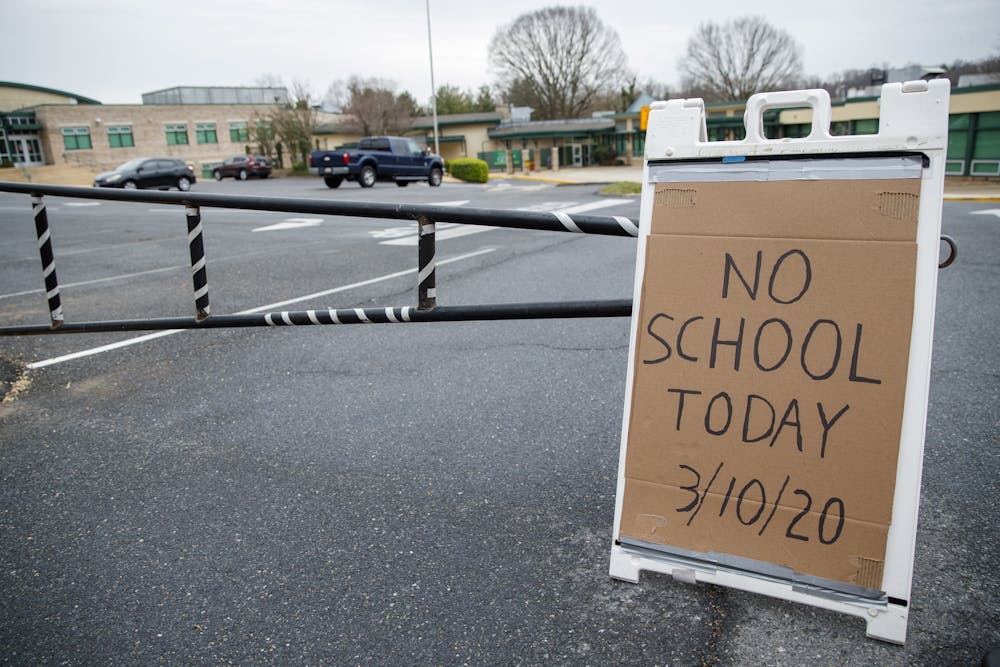 Georgetown Day School in Washington, DC closed for a day in an effort to mitigate the spread of COVID-19.
SHAWN THEW/EPA
Georgetown Day School in Washington, DC closed for a day in an effort to mitigate the spread of COVID-19.
SHAWN THEW/EPA
There are variations in the length of time schools have closed and when decisions were made to close them. Japan issued a national directive for school closures when there were 186 confirmed infections in the country, compared to Italy when there were 2,500.
A review of several studies suggests widespread, proactive school closures have been effective at reducing the rate of new influenza cases, but research on the length of time they should be shut is inconclusive.
Evidence suggests that, during the 1918 influenza pandemic, widespread school closures (it is not clear what proportions were proactive or reactive) and other non-pharmaceutical interventions in particular communities were associated with lower death rates.
Read more: 8 tips on what to tell your kids about coronavirus
The rationale for closing schools during pandemics is that children are thought to be important vectors of transmission. They are more infectious and susceptible to most influenza strains, and high contact rates in schools favour transmission.
In the case of the 2009 swine flu H1N1 pandemic, 60% of cases infected were 18 years old or younger. But the COVID-19 seems to not affect children as much as the elderly. Children show milder symptoms and there are fewer infections among them. That said, they may still be significant vectors in transmission.
We need a national approach to virus containment and educational provision, with schools at the centre of our response to the COVID-19 pandemic.
Authors: Rachel Wilson, Associate Professor in Education, University of Sydney


















