

Injured your ACL? It’s more than just a knee injury
- Written by Daniel Kadlec, Researcher, Athlete Health and Performance, School of Medical and Health Sciences, Edith Cowan University
It’s an athlete’s worst fear. Hearing a loud “pop” and feeling severe pain are usually the first signs you’ve torn your anterior cruciate ligament, also known as the ACL.
The ACL connects your shin and thigh bones, and is one of the key ligaments that help stabilise your knee joint.
Research suggests ACL injuries are becoming increasingly common across all age groups. Children as young as ten are rupturing their ACLs, with many never regaining their pre-injury strength or ability.
So how do ACL injuries happen? And what makes them so serious?
Why the ACL matters
The ACL is an indispensable part of your knee joint. Its main job is to keep your knee stable by stopping it from rotating or extending too much. This is especially important if you regularly twist, pivot or land on your knee joint.
ACL injuries are most often a result of the fatigue-failure process. This is the idea that repeatedly using and putting strain on the ACL, without proper training, makes it significantly weaker over time.
Doing specific strength exercises and regular physical activity can help slow this process. But if you don’t do these activities, even minor movements can gradually weaken your ACL.
Importantly, ACL injuries don’t just affect elite athletes. Injury rates are just as high in amateur and community sport, where access to athletic rehabilitation is typically more limited. This means people playing at amateur levels can face longer, more uncertain paths to recovery compared to professional athletes who have a specialist team of medical and performance staff. As a result, many amateur athletes stop playing sport altogether.
Why are ACL injuries so severe?
Unlike many other tissues in the body, the ACL has a very limited capacity to heal. Once torn or damaged, it can’t regenerate in a way that restores its original structure or function.
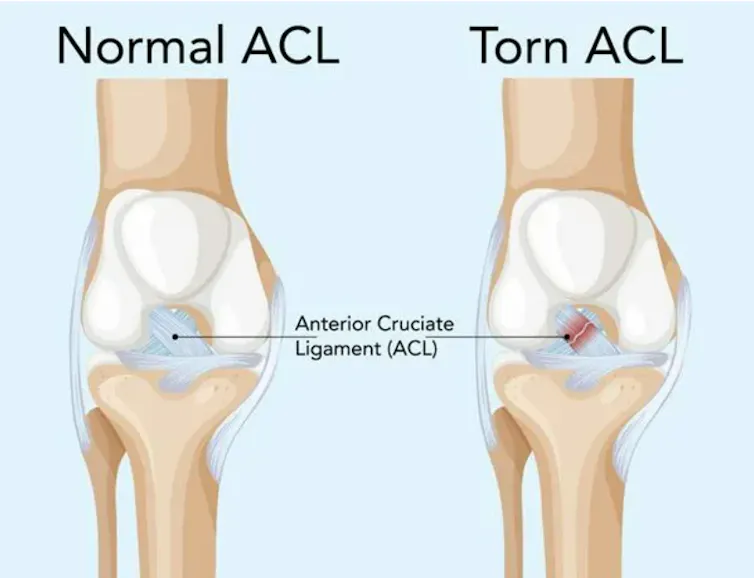
ACL injuries impact the stability of the knee, often causing the joint to “give way”. This leads to physical symptoms such as pain and swelling. But ACL injuries can also damage other parts of the leg including the meniscus, cartilage and other ligaments.
Over time, a person with an ACL injury may develop osteoarthritis, a painful condition where the cartilage in your knee breaks down and causes the bones to rub together. Even with appropriate medical care, one in two people who tear their ACL will have knee osteoarthritis.
The road to recovery
Recovering from an ACL injury can be a long, and at times painful, process that typically lasts between nine and 12 months. Any attempt to speed this up increases the risk of re-injury. And subsequent ACL injuries often have more severe consequences than the initial rupture.
The recovery process starts with diagnosis. This usually involves seeing a medical professional, such as a GP or physiotherapist, in a clinic. They often use MRI imaging to assess the damage to your ligaments and knee joint.
Many people will then have surgery to reconstruct their torn ACL. This requires the surgeon to take a piece of suitable tissue, known as a graft, from another part of the body to put it where the torn ligament was. Using special screws, they then secure the replacement tissue to the bone.
No matter how you treat an ACL injury, rehabilitation is key. An exercise physiologist or physiotherapist can help you rebuild the strength and flexibility of your knee joint through exercises focused on reducing swelling and restoring your range of motion.
Rehabilitation is particularly important if you’re planning to return to sport. As you heal and recover, you’ll go through several phases of exercises. By taking this gradual approach, you’ll be better prepared to perform more high-risk movements, such as pivoting or jumping.
Increasingly, ACL rehabilitation prioritises psychological health. This has given rise to a biopsychosocial approach to recovery, where recovery relies on physical healing as well as a positive mindset. Athletes can use strategies such as goal setting to manage the emotional ups-and-downs of sustaining a serious injury. This approach also recognises how crucial an athlete’s support network, which may include coaches, teammates and family, is to their recovery.
Injuring your ACL can take an immense physical and psychological toll. That’s why getting support from qualified medical professionals, as well as a close social network, is vital.
Authors: Daniel Kadlec, Researcher, Athlete Health and Performance, School of Medical and Health Sciences, Edith Cowan University
Read more https://theconversation.com/injured-your-acl-its-more-than-just-a-knee-injury-278080

















