

Green tram tracks cut heat and beautify cities. Why isn’t Australia doing it?
- Written by Milad Haghani, Associate Professor and Principal Fellow in Urban Risk and Resilience, The University of Melbourne
Cities are hotter than the surrounding countryside. Paved surfaces such as asphalt and concrete trap heat and release it at night. But as climate change worsens, this is becoming a real risk for residents.
Researchers are racing to find ways to protect urban residents from rising temperatures and pollution. As recent research shows, there’s no single fix for urban heat. Different places need different solutions, from tree canopies to cool roofs to reflective pavements.
Taming urban heat doesn’t necessarily require extravagant ideas such as air-conditioned footpaths. Some of the most effective tools are simple adjustments to infrastructure we already have, using nature to cool cities down with vegetation, soil and water.
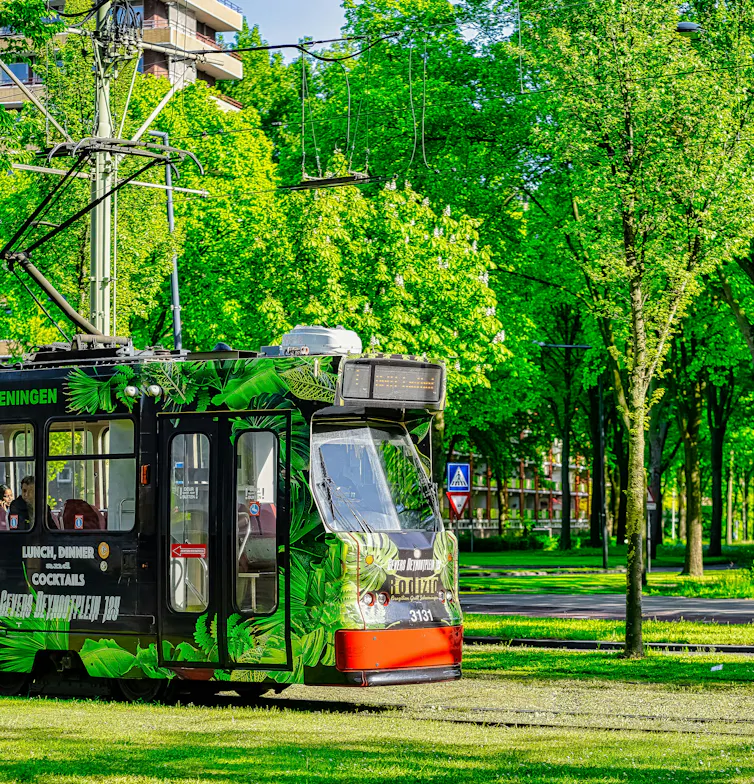
One promising solution is hiding in plain sight: our tram tracks (particularly the many sections that run on their own corridors, separated from traffic). Cities around the world have been greening their tram corridors by replacing concrete with grass or low vegetation.
The idea is not new – grass-covered tram tracks date back to Berlin in 1905 – but has seen a resurgence since the 1980s. And the results are surprisingly effective.

How does this work?
A green tram track replaces the usual concrete around tram rails with a layer of healthy vegetation. Many cities use grasses or species of sedum, a genus of drought-resistant succulents able to survive in extreme conditions such as heat, low water and constant vibration.
The plants sit on a thin substrate designed to hold moisture and drain excess water, essentially turning part of the tram corridor into green infrastructure.
These systems are typically used on sections where trams run in their own corridor, rather than in lanes shared with general traffic.
Once in place, this simple system delivers multiple benefits:
Better stormwater management: Green tracks absorb and slow rainfall instead of letting it run straight into drains. Studies show these systems can increase water storage by 50–70%, easing pressure during intense storms and supporting “sponge city” goals, even in relatively dense areas with limited open space.
Lower surface and air temperatures: Plants don’t trap heat like concrete does. Thermal scans of green tracks show surface temperatures are roughly 10°C lower during summer peaks.
Less noise and vibration: The plants dampen sound and vibrations from passing trams, though this effect is modest.
Plantings along tram tracks can help trap dust and fine particles on busy corridors, and provide a small boost to local air quality.
Even these narrow strips of green tracks help biodiversity by creating continuous habitat for insects and acting as ecological connectors between parks, nature strips and street trees.
Then there are the aesthetic benefits. In many cities, residents have reported that they prefer the softer, greener look of these tracks.
Where are these tracks?
Green tram tracks are now found in dozens of cities across Europe and beyond.
Greening is popular. A study of Warsaw residents found more than 90% viewed their city’s green tracks positively, rating them around five times more favourably than conventional paved track.
A Swedish study found a similar pattern. Residents described the grassed tram track as beautiful, calming and a clear improvement over a hard, traffic-dominated corridor.
Municipal staff, however, were more cautious. They acknowledged the visual and environmental benefits but worried about long-term maintenance costs and whether the model could be scaled across the network.
How much does it cost?
Installing a green track usually costs more than a bare concrete slab. But there are ways to keep costs down.
Grass needs mowing, watering and occasional replanting, which makes councils understandably nervous about ongoing budgets.
Sedum succulents have much lower maintenance needs and can need little or no irrigation once established. This reduces lifecycle costs even if the initial planting is more expensive.
Studies comparing grass and sedum tracks have found the long-term maintenance burden is much lower for sedum, while the main visual and environmental benefits are largely preserved.
Can this work in Australia?
Australia experimented with the idea of green tram tracks well before many other countries. Almost 20 years ago, Adelaide installed a small-scale grassed track as part of the Glenelg tram extension. While small, it is now considered an early example of using a nature-based solution in railways.
Sydney now boasts a much more substantial example. The Parramatta Light Rail has more than a kilometre of green track, using sedum plantings. This makes Australia’s largest and most modern installation.
It’s a good start. But there’s much more that could be done. Australia has about 339km of tram and light rail. Melbourne has more than 250km, making it the largest network in the world. And more tracks are being built.
Green tram tracks can’t be installed everywhere. They can’t be planted where tracks are built into the road and where cars, trucks and buses would run over them. They need a protected, stable track bed with no heavy traffic.
Much of Melbourne’s tram network runs along long medians and dedicated corridors, such as St Kilda Road, where tracks are already separated from traffic and could easily support green tracks.
In recent years, Sydney has expanded its light rail network through the CBD and out to the east and west. Canberra and the Gold Coast run modern systems designed with separated trackbeds, exactly the conditions where green tracks thrive.
Green tram tracks are not a silver bullet for urban heat. But they offer something rare in transport infrastructure: a visible, popular, nature-based upgrade able to cool streets, manage water, relax neighbourhoods and improve how a city looks and feels.
As Australia invests billions in new tram and light rail lines, the benefits of green tracks are too significant to ignore.
Authors: Milad Haghani, Associate Professor and Principal Fellow in Urban Risk and Resilience, The University of Melbourne


















