

Can I get coronavirus from mail or package deliveries? Should I disinfect my phone?
- Written by: Euan Tovey, Associate Professor & Principal Research Fellow in Medicine, University of Sydney
According to Google Trends, the top two most searched terms about mobile phones this week in Australia were “how to disinfect phone” and “how to clean your phone.”
And the third most-searched “can I get coronavirus from…?”-style question in the past week in Australia was “can you get coronavirus from mail?” (If you were wondering, “can you get coronavirus from food?” was number one, followed by “can you get coronavirus twice?”)
In short, many Australians are wondering what role phones and mail and/or package deliveries may play in the risk of coronavirus transmission.
To better understand the risk, and what you can do to reduce it, it helps to think about how your phone or mail might come into contact with coronavirus - and what the evidence says about how long it lives on various surfaces.

What do we know about how long the coronavirus can survive on a phone or mail?
Not a whole lot yet.
There has been some general media reporting on the role that surfaces play in the transmission of this coronavirus, termed SARS-CoV-2. That’s the disease that causes COVID-19.
But the main peer-reviewed journal paper on this topic was published about a week ago by the New England Journal of Medicine.
That paper found:
SARS-CoV-2 was more stable on plastic and stainless steel than on copper and cardboard, and viable virus was detected up to 72 hours after application to these surfaces.
It also noted:
On copper, no viable SARS-CoV-2 was measured after 4 hours […] On cardboard, no viable SARS-CoV-2 was measured after 24 hours.
These might be underestimates. The virus may survive even longer on these surfaces, depending on conditions. That’s because these studies looked at how long the virus would survive when in a “buffer” (a solution in which viruses live in the lab). In real life, they would be in mucous and would be more stable.
The fact that the viruses seemed to last longest on plastic is something of a worry and means that, on phones, the virus could potentially last for days.
It is important to remember this is a new virus and we don’t yet have all the data. New findings are emerging every day.
It’s also possible that, in reality, the virus may last longer on phones than indicated in the recent lab experiments.
CDC data published yesterday detected the faint genetic signature of viruses (viral RNA) which had survived 17 days on surfaces in cruise ships. That doesn’t mean infectious virus particles were found after 17 days – only a part of the virus was detected in this study – but it does suggest there may be some cause for concern regarding how long this coronavirus can last on surfaces. More research is required on this question.
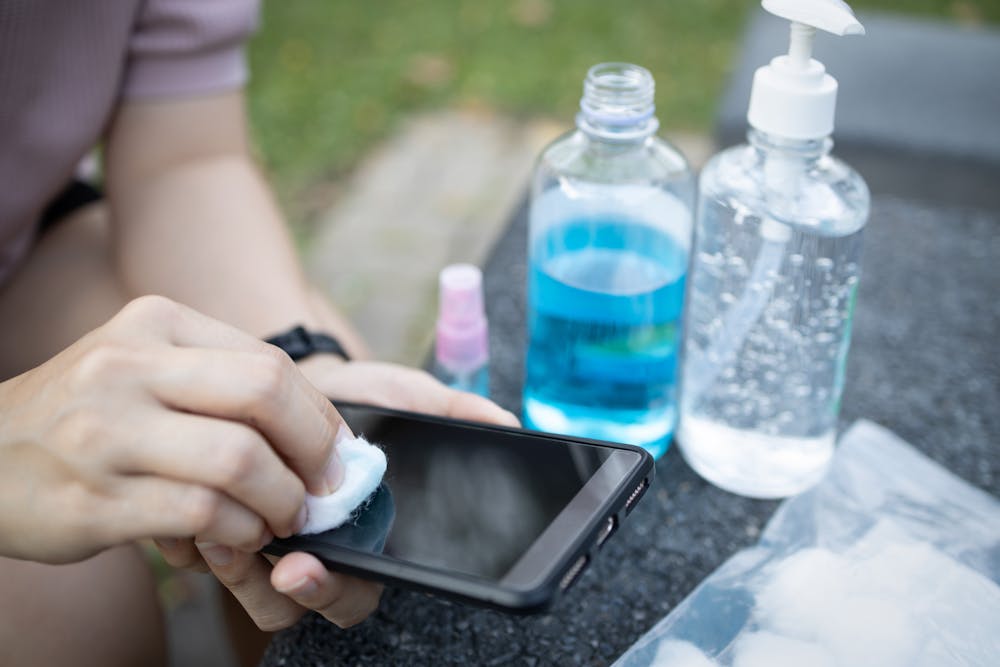 Ideally, you should be cleaning your phones, tablets and keyboards with alcohol wipes - if you can get them.
Shutterstock
Ideally, you should be cleaning your phones, tablets and keyboards with alcohol wipes - if you can get them.
Shutterstock
How might virus particles end up on a phone?
Talking on the phone generates an invisible spray of airborne droplets. A person with COVID-19 can have a lot of virus in the mucous at the back of their throat, so they’re likely spraying the virus on their phone every time they make a call.
If an infected person hands their phone to someone else, the virus could transfer to the new person’s fingertips, and then into their body if they touch their mouth, eyes or nose. (And remember, not every infected person displays the classic symptoms of fever and cough, and may be infectious before symptoms show).
It’s also possible there is an oral-faecal route for transmission of coronavirus. This coronavirus is often detected in faeces.
That means, for example, that tiny particles of poo generated by flushing a toilet could settle on a toothbrush, on a phone brought into the bathroom or on surfaces/food in an adjoining room. They could then end up in your mouth. At the moment this has not been shown, but it is certainly possible. SARS was sometimes spread by this route.
That’s why frequent handwashing with soap is so crucial.
What about mail?
It is technically possible a package or mail coming to your house is contaminated with virus picked up somewhere along the way by people handling or coughing on it. I think, though, the infection risk is very low because, as the New England Journal of Medicine study found, the survival time on cardboard is thought to be around one day.
And unlike plastic surfaces, cardboard is porous. That means a droplet would probably penetrate into the material and may not be so easily picked up when you touch the package.
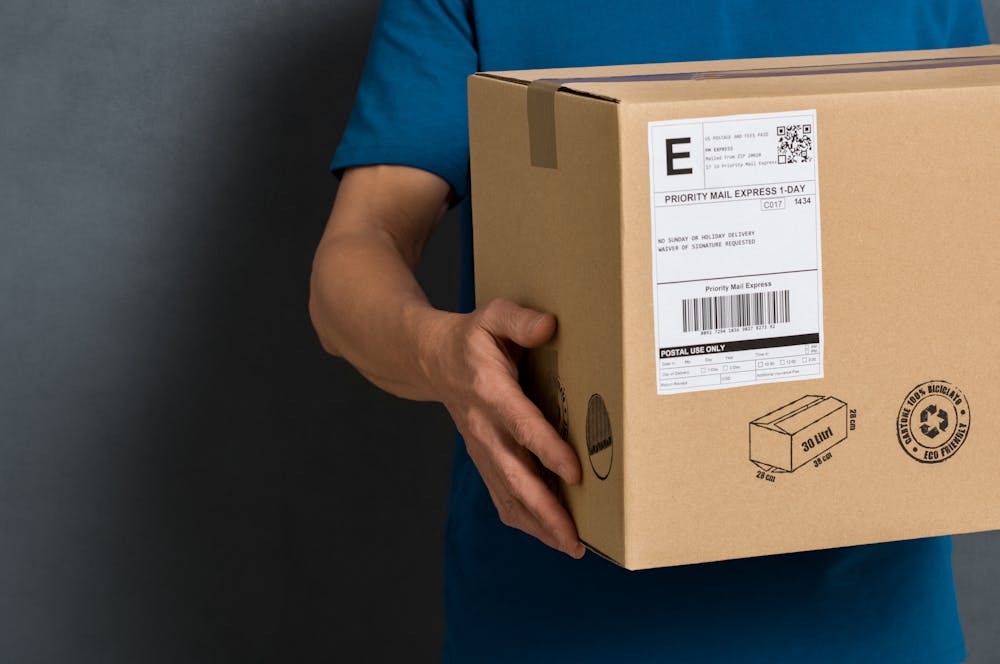 The survival time on cardboard is thought to be one day.
Shutterstock
The survival time on cardboard is thought to be one day.
Shutterstock
What can I do to reduce my risk?
For starters, do the obvious things: wash hands frequently, reduce your contact with others (and if you do see other people, stay at least 1.5 metres apart, particularly if you are talking). Definitely don’t go out at all if you’re unwell.
Keep your phone to yourself. I’d be very reluctant to share my own phone with anyone right now, especially if they seem unwell.
It’s not clear what role children play in the transmission of this coronavirus but, just in case, children should be washing hands before they touch their parents’ phones. That said, it seems more likely at present that adults give it to children than the other way round.
Ideally, you should be cleaning your phones, tablets and keyboards with alcohol wipes (which need to be around 70% alcohol). They are quite effective at deactivating viruses (if somewhat hard to get now). Most baby wipes only have a low percentage of alcohol so are less effective but just the wiping would help remove virus particles.
In the worst case scenario, you can try using a damp cloth with a small amount of soap and water to clean your phone - but don’t let water get inside your phone and wreck it.
When it comes to mail and package deliveries, try to keep apart from the delivery person. Many delivery people are already forgoing the customary signature on the tablet, meaning you don’t have to touch a device or e-stylus that many others have already handled. You could consider wiping down a package before opening it, and washing your hands well after disposing of the packaging.
At the end of the day, the risk is never zero, and the world is a nightmare if you go too far down this route of worrying about every single surface.
Read more: What steps hospitals can take if coronavirus leads to a shortage of beds
Authors: Euan Tovey, Associate Professor & Principal Research Fellow in Medicine, University of Sydney


















