

Tea tree oil may affect fertility, the EU says. A pharmacologist explains why that’s so misleading
- Written by Ian Musgrave, Senior Lecturer in Pharmacology, Adelaide University
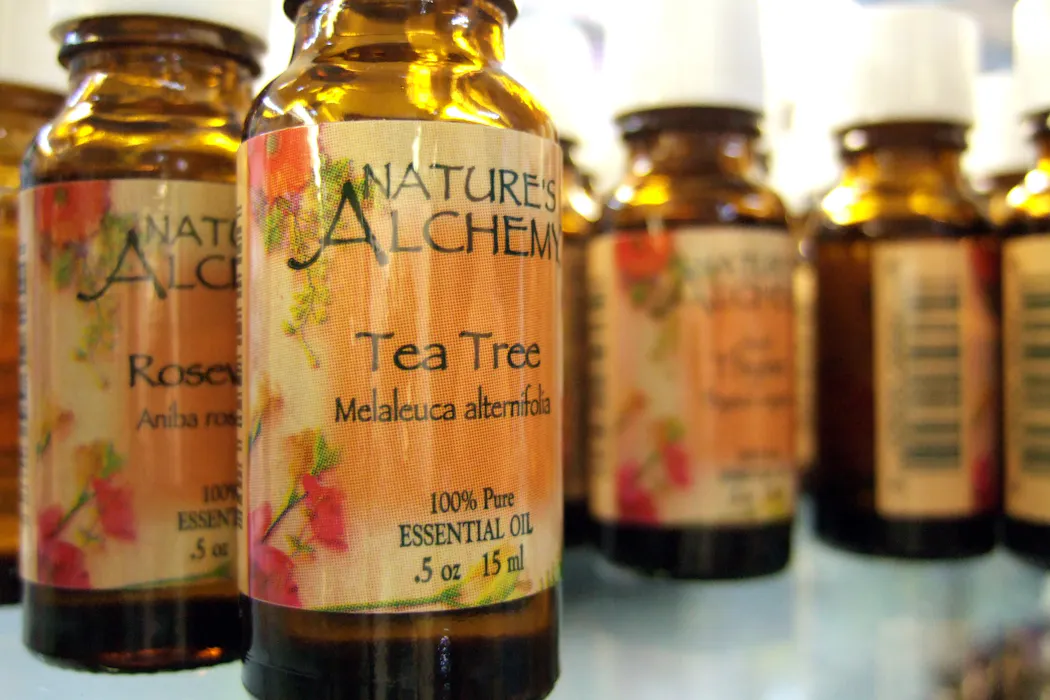
The heady scent of tea tree is one of the iconic smells of the Australian bush. And the essential oils derived from tea trees have been used as medicines, first by Indigenous people, then by colonists.
Today, many of us have a bottle of tea tree oil at home, or use shampoo or creams containing it. Tea tree oil is also a major export earner for Australia.
Now media reports suggest the European Union (EU) is concerned tea tree oil may affect people’s fertility and may ban imports.
Let’s see whether we really need to worry about any impact of tea tree oil on our reproductive system.
The many uses of tea tree oil
Leaves of Melaleuca alternifolia trees and other species of Melaleuca produce an essential oil that’s used medicinally and in a variety of toiletries and cosmetics. This oil is a complex mixture of nearly 100 aromatic compounds.
Tea tree oil has been used as an antiseptic since it became commercially available in the 1930s. It has antibacterial, antifungal, anti-parasite and antioxidant properties.
Laboratory experiments suggest it may also help reduce inflammation and enhance healing.
It’s used to treat acne, seborrhoeic dermatitis, and as a mouthwash to treat gingivitis (gum disease). However, the clinical evidence for these uses is not strong.
Tea tree oil is also used in cosmetics and toiletries, such as shower gel and face wash, in various concentrations.
Is tea tree oil safe?
The most common adverse effects of tea tree oil are when it’s used on the skin. In some people, the skin can become sensitive and allergic contact dermatitis can develop. This is particularly when used neat (using the pure oil) rather than after using cosmetics and toiletries, which contain lower concentrations.
Acute toxicity, when there are rapid side-effects coming on within minutes, to tea tree oil via skin application is rare.
Drinking tea tree oil, even diluted or in small concentrations, is not recommended as this can be deadly. There have been reports of cases of depression of the central nervous system (where brain activity slows down) and possible injury to the lungs.
How about the reproductive system?
The EU has been concerned about the potential impact of tea tree oil on the reproductive system for several years.
In November 2023, the European Chemicals Agency’s Committee for Risk Assessment proposed tea tree oil be classified as a presumed human reproductive toxicant, under category IB.
This classification would mean a ban on tea tree oil in pesticides, and cosmetics and toiletries used in the EU.
The decision rested on the results of reproductive toxicity experiments. This involved administering tea tree oil to rats orally at various concentration for ten days, before mating. Female rats also received tea tree oil while pregnant and up to the weaning of the offspring.
In the females, measures of fertility, including the number of embryos implanted and mean litter size, were no different to those that had not been given tea tree oil.
At the highest doses, the sperm counts of male rats were lower. But this wasn’t the case for rats given tea tree at 25 milligrams of tea tree oil per kilogram of body-weight per day. That’s around 0.028 millilitres of tea tree oil per kilogram a day.
This doesn’t sound much, but for a 60kg human, that would be equivalent to drinking about one-and-a-half millilitres of pure tea tree oil a day. Nobody is going to be drinking that amount day in, day out. Virtually every application says not to ingest any tea tree oil because of its known human oral toxicity.
This is the level that has no effect on reproduction. The level for reproductive toxicity is twice that.
In cosmetics and toiletries, no-one would be exposed to that much tea tree oil. Less than 4% of tea tree oil components are absorbed via the skin. So even if you did smear that much tea tree oil on yourself, the concentration your body would be exposed to is less than a tenth of the amount that has no effect.
Rats also metabolise tea tree oil components differently to humans. They produce a toxic byproduct that affects sperm. By comparison, humans only produce trace levels of this byproduct.
So what happened recently?
In November 2025, another European committee, the Scientific Committee on Consumer Safety gave its update.
It considered the issues of dose and metabolism outlined above. It also considered human pharmacovigilance data (where therapies are monitored over time to track any potential safety issues). The pharmacovigilance data showed no sign of reproductive toxicity associated with human use of existing products.
It considered tea tree oil’s use in cosmetics and toiletries to be safe up to the maximum concentration of:
- 2.0% in shampoo
- 1.0% in shower gel
- 1.0% in face wash
- 0.1% in face cream.
The United Kingdom has also weighed in. In August 2025, its Health and Safety Executive didn’t classify tea tree oil as a reproductive toxicant.
What this means for the EU’s classification of tea tree oil in the future is unclear. Shifting it to another category – toxicity category 2, a suspected human reproductive toxicant – would be an option.
In a nutshell
Europe’s initial evaluation of tea tree oil as a presumed human reproductive toxicant in 2023 understandably sounds alarming. But the 2025 update has toned down warnings.
The subsequent re-evaluation of evidence – of tea tree oil’s concentrations and applications, species-specific toxicity, and real-world data tracking safety in humans – means we can be much more confident of its safety.
Tea tree oil, when used as directed, is much safer than the headlines suggest.
Authors: Ian Musgrave, Senior Lecturer in Pharmacology, Adelaide University

















