

Robots can run a marathon and play ping pong. But will they ever achieve true sporting greatness?
- Written by Jonathan Roberts, Professor in Robotics, Queensland University of Technology
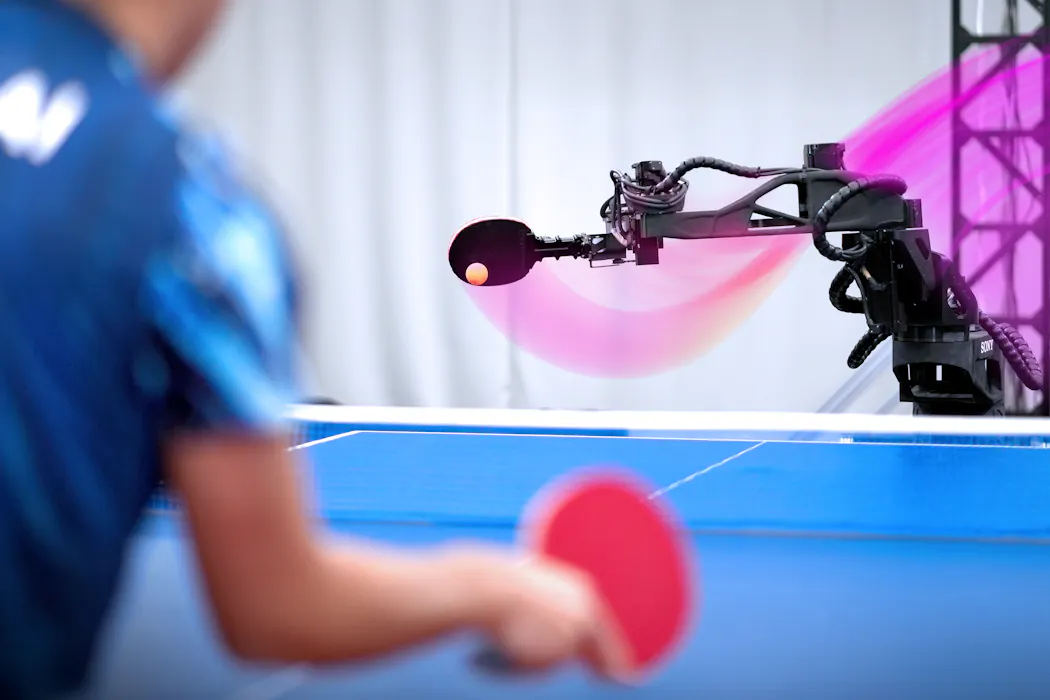
A humanoid robot recently made headlines around the world for running a half-marathon and beating the human world record. Around the same time, an AI-powered robot defeated an elite human player in table tennis. What the robot lacked in experience, it made up for by reacting faster and more consistently than any person could.
These moments feel like milestones. Finally, it seems machines are stepping into one of the most human arenas – sports.
But while it is tempting to frame this as robots versus humans, sport robotics isn’t really about competition. It’s about how machines can learn to move, react and interact in dynamic, unpredictable environments – and what that means for human performance.
How do you train a robot to play sport?
Training a robot to play sport is fundamentally different from training a human athlete.
People learn through practice, coaching and experience, constantly adjusting to changing conditions. In sport science, this is often described as a tight coupling between perception and action. That is, seeing, deciding, and moving in one continuous loop.
Robots, by contrast, are trained using a combination of simulation, data and control algorithms. Engineers build detailed virtual environments where robots can “practice” millions of times. They learn how to track objects, predict motion and coordinate their bodies. Sometimes, motion analysis techniques are used to track athletes doing the specific movements the robot needs to emulate.
For fast-paced sports such as table tennis, the challenge is extreme. A robot must detect the ball, predict its trajectory and execute a precise movement within fractions of a second. This requires close integration between computer vision, machine learning and real-time control.
One of the biggest advances in recent years has been the ability to train robots in simulation and then transfer those skills into the real world – a process known as “sim-to-real”. Combined with rapid improvements in sensors and computing, this has dramatically accelerated progress.
We’ve seen similar developments in robot basketball and robot soccer, where systems have evolved from simply locating the ball to coordinating as teams, making tactical decisions and adapting to opponents.
Beyond entertainment
While robot athletes make for compelling demonstrations, their greatest impact will likely be behind the scenes where they can be used to train human athletes.
One of the central challenges in sport is designing effective practice. Athletes need repetition to build skill. But they also need variability to reflect real competition. Too much repetition becomes predictable; too much variability becomes chaotic.
Robotics offers a potential way to balance both.
A robotic training partner can deliver highly repeatable actions at elite intensity, while also introducing carefully controlled variation. For example, a robotic tennis server could replicate the motion of a world-class player while systematically varying ball speed, flight and placement.
From a sport science perspective, this creates what is known as a “representative learning environment”. The key benefit is it replicates the key perceptual and decision-making demands of elite competition, which is difficult for coaches to recreate in the training environment.
In our work, we’ve been exploring how robotics could support sports such as tennis, cricket and the football codes. The goal is to combine realism, repeatability, variability, and data to enhance skill development and link technique to outcomes.
Robots may also help manage training load. They can reduce the physical demands on coaches and training partners while still exposing athletes to high-quality game-like scenarios.
Beyond performance, there are opportunities for fan engagement. Interactive robots at live events or demonstrations of elite skills could offer new ways for audiences to experience sport.
Will robots ever be ‘great’?
Over the next decade, robots will likely become more agile, more robust and better able to operate in complex environments. Tasks that robots currently find difficult, such as running on uneven terrain and catching or throwing balls, will become increasingly achievable.
But even as robots improve, there are important limits.
Sporting greatness is not just about executing movements perfectly. It involves creativity, decision-making under pressure, and the ability to adapt in ways shaped by experience, emotion and context.
From a sport science perspective, elite performance emerges from the interaction between the athlete, the task and the environment. Robots can be engineered to perform specific tasks extremely well, but they do not experience this interaction in the same embodied, meaningful way.
This means robots may surpass humans in tightly defined challenges – such as bowling a cricket ball with perfect consistency – but they are unlikely to achieve greatness in the holistic human sense.
A new role for robots in sport
Rather than replacing athletes, robots are more likely to become part of the sporting ecosystem.
In the same way that video analysis and wearable sensors have transformed training, robotics offers a new tool for coaches and sport scientists. It enables practice environments that can be precisely controlled, repeated, and adapted to individual needs.
The real opportunity is not to build robot champions, but to better understand human performance, and help athletes reach higher levels.
Authors: Jonathan Roberts, Professor in Robotics, Queensland University of Technology

















